Reply To:
Name - Reply Comment
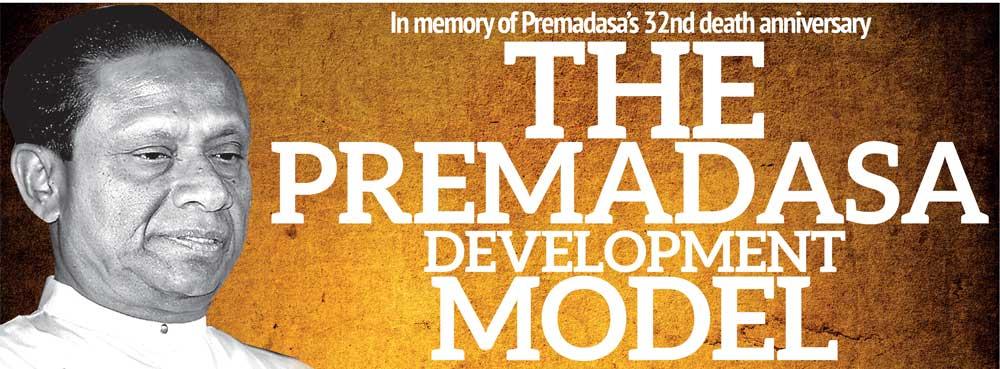
 Thirty-two years have passed since the death of former President Ranasinghe Premadasa. The terrorist attack targeting him on May 1, 1993, undoubtedly remains in the memory of many people. To anyone studying recent political trends in our society, it is true that he can be valued as a distinguished politician who made a significant development contribution that cannot be overlooked. Beyond this, President Premadasa’s political activities demonstrated numerous interventions that can be discussed across multiple levels. In this article, I discuss his public service that spans across multiple domains. One conclusion that emerges from all this is that he proposed a new development model for our society. Speaking in more academic terms, in post-colonial Sri Lankan politics, President Premadasa’s activities helped build a new development model that adapted Western frameworks to our country while being rooted in indigenous values. His commemoration becomes more meaningful when reading the “Premadasa intervention” from such a foundation.
My first observation is about an important idea that Premadasa presented regarding the democratic model in our country. With the end of colonial rule, the concept of “democracy” or governance by the will of the people introduced to our country was used by some leaders as a methodology to obtain public consent once every five years to do ‘whatever they pleased.’
The meaning of representative democracy thus became reduced to a practice of seeking public opinion only once every five years. That Premadasa had a different understanding of this matter becomes evident when looking at his keynote address at the Colombo Rotary Club in 1973. Specifically, he proposed that the voter’s role in representative democracy should not end with casting a vote once every five years, but rather democracy should be implemented with continuous participation in the policies, decisions, and implementation programmes that the government undertakes for development processes. This idea that Premadasa presented as an opposition MP in the 1970s aligns remarkably well with the concept of Deliberative Democracy that became philosophically discussed in the 1990s. In my view, the Gramodaya Mandala (Village Awakening Councils) initiative that Premadasa introduced in 1989 can be understood as an attempt to implement this idea.
On one hand, by establishing Pradeshiya Sabha as a new rural/urban governance structure, Premadasa created rural and urban citizen participation. Through his Gramodaya concept, he transformed the smallest unit of this process—the village—into a ‘dialogical forum.’ The Gramodaya Mandala was established as a rural model of participatory democracy by bringing together community leaders in a village, including religious leaders, school principals from the education sector, heads of rural community-based organizations, and other group leaders.
Welfare and Social Security
Another very important aspect demonstrated in Premadasa’s development model was the positioning of social welfare and social security as two distinct concepts. Many politicians view these as one and the same. As a result, on one hand, the misconception that social welfare is ‘something for the poor’ develops because it is seen as part of social security. Social welfare in a country, such as education and health sectors, should be built through government intervention as services that can be utilized by every citizen of the country. Social welfare is not a service directed at just one segment. Social protection is a different matter altogether. It means empowering disadvantaged social groups to integrate them into the mainstream society. Programmes like Janasaviya implemented such social security initiatives.
A prominent area in Premadasa’s development model was the housing construction project. By 1977, the housing culture in our country was in a deplorable state. On one hand, one segment of society did not have land to build a house. On the other hand, someone who owned a small plot of land did not have the necessary capital to build a house.
Some people who could somehow secure these two requirements (land and capital) did not have the need to build a house. As a result, in the early 1980s, what was seen throughout the country were villages filled with very primitive types of housing such as tents, huts, sheet metal houses, and straw-thatched houses.
Premadasa’s intervention regarding housing in his development model completely revolutionised the ‘shanty mentality’ that existed in the country. Moreover, he introduced a new concept of ownership through housing. People without rights tend to behave irresponsibly. One reason for the increase in wasteful lifestyles and lower-grade addictions like alcoholism was the lack of fundamental thinking about “rights” among people in that social stratum.
The housing concept in Premadasa’s development model was to socialize ‘new ownership through housing.’ This concept of rights to housing strongly influenced certain segments of the oppressed society who lived “fluid lives” to be drawn into social and family bonds.
Similarly, through this housing programme, the message was communicated to the upper social strata that housing construction was becoming a new fashion.
The success of this process was demonstrated by the construction of 100,000 houses during the period 1978-1983 and one million houses during the period 1984-1989 as a prioritized program of the 1977 government.
After 1990, garment exports became the main source of income in the country’s export sector. It is widely known that this was a process initiated based on a fundamental concept and program of Premadasa.
Many who look at this program only see the amount of dollars coming into the country through it. However, another important part of it was the systematic transformation of unskilled labour scattered throughout the country into skilled labour, providing thousands of job opportunities in villages outside the capital city. The production of wealth as well as the distribution of wealth are equally important. Especially in a social democratic economic model, the process of wealth distribution takes a very important place. In that sense, it is correct to state that the Premadasa development model paid great attention to creating opportunities that were distributed to society.
A Third Path in Development
Thus, it becomes evident that Ranasinghe Premadasa’s fundamental political intervention proposed a new leap in the field of economic development for this country. Both the extreme left and extreme right brought the country a defeated and dependent policy model. The foundation of the Premadasa development model was that an escape from this could only be achieved through a new moderate path of development.
The world-renowned economist and Nobel laureate Amartya Sen once stated that economic development is about producing freedom for a country’s activities. The foundation of the Premadasa development model was the production of opportunities in a broad economic space that connected distant rural communities.
Accordingly, my view is that the foundation of the Premadasa development model consisted of:
(1) Building participatory democracy through a new dimension of representative democracy; (2) Properly separating social welfare and social security, creating an investment scope through social security; (3) Establishing a social contract on rights with the housing concept; (4) Creating a foundation for the distribution of wealth opportunities within society by utilizing dispersed rural unskilled labour; and (5) Through these, establishing a third path of development.
At this moment, thirty-two years after Premadasa’s death, it is clear that the country can only be protected by moving toward such a new development path. I would like to state that taking the initiative to advance in this direction would be the most special tribute to him.