Reply To:
Name - Reply Comment
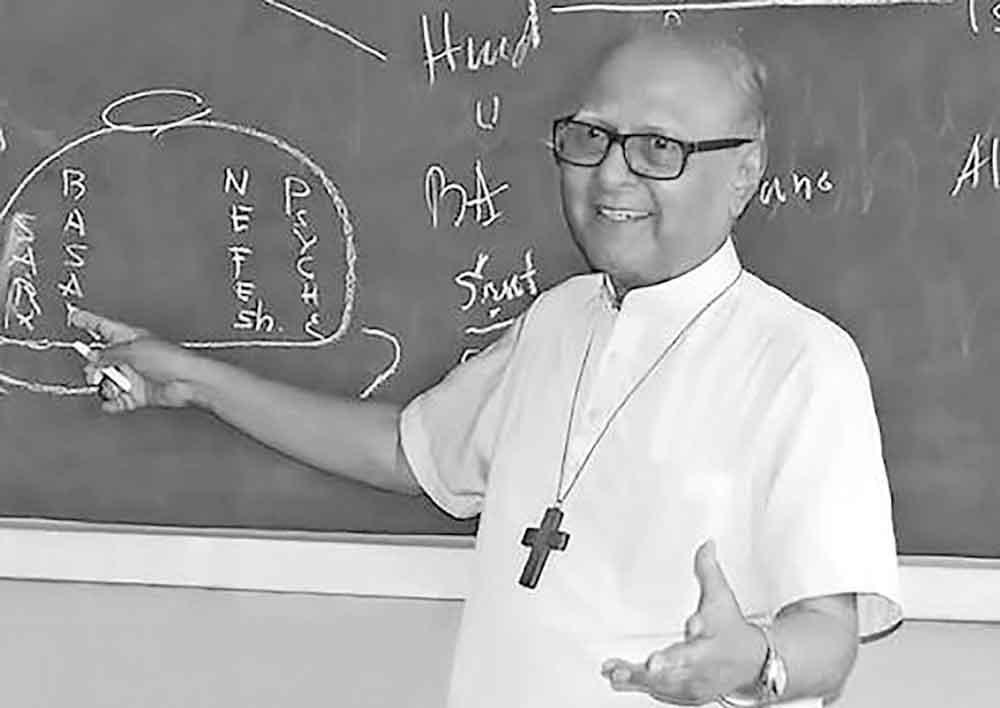
 The late Tissa Balasuriya OMI once described the late bishops Leo Nanayakkara OSB, and Luxman Wickremasinghe, as ‘trendsetters.’ I wish more emphatically to extend that same designation to the late Fr. Aloysius Pieris SJ at the three-month commemoration of his demise.
Many eulogies, felicitations and honours have been bestowed on this Asia’s frontline ‘trendsetting theologian’ as one who inspired several generations of thinkers and activists, encouraging both the ‘discipline at the desk’ and the ‘discipline in the field’. Alongside many others we unequivocally regard him as a distinguished contextual theologian and, perhaps more evocatively, a theological pollinator with his distinctly ‘Pierisian grace and grammar’ as an original thinker.
In this three-month commemorative write up, I wish to reiterate his audacious work that often stood at odds with the winds of certain ecclesiastical rigidity, clericalism, and the theological stagnation within the church life. Throughout his scholarly career, Fr. Aloy remained a profoundly ‘homegrown pollinator-guruji’: deeply rooted in the Asian ethos yet acutely aware of the global theological trends and their internal geopolitics. His erudition as a Jesuit Indologist was remarkable and unique. If there is someone who might stand alongside him in scholarly breadth, then it is Patrick Olivelle, another Sri Lankan scholar now based in Texas. Both, in their own ways, belong to a lineage of Indological scholarship that includes figures such as Max Müller (1823-1900) and Arthur Llewellyn Basham (1914 -1986).
Aloy’s legacy, distinctly his own, rests among such illustrious company. He could read Hebrew, Greek, and Latin texts alongside Buddhist and Hindu literature in Pali and Sanskrit with a rare fluency. Careful guidance of his readers and listeners to understanding these ancient traditions within the concrete realities of the present was commendable. His scholarship was not antiquarian; but was interpretative, contextual, dialogical and was accessible.
A Vacuum
Few scholars today possess the capacity to enter deeply into the diverse religious texts and move across them with such intellectual ease in conjunction with a hermeneutical discernment. Fr. Aloy’s writing combined meticulous exactitude, with imaginative theological insight sometimes expressed in what one might call a uniquely ‘Pierisian idiom’. Whether explicating a Hebrew-semitic concept, a Greek philosophical nuance, a Sanskrit śloka, a Pali sutta, he illuminated them through a contextual reading grounded in cautious historico-textual scrutiny and their extrapolation with zest for originality.
Such scholarship is increasingly rare in an age overwhelmed by information but often lacking intellectual depth. Today, the knowledge systems are inundated with data, yet the academic rigour and research calibre required to transform information into wisdom and evidence-based research is frequently missing. Fr. Aloy’s work reminds us that genuine scholarship demands both discipline in critical search and contemplative attentiveness.
Bhikkhu Links
Among those who influenced him were also bhikkhus like the late Kotagama Vachissara and Dr. Walpola Rahula, themselves ‘trendstters’ within the Sangha Sasana. Aloy faced the arduous task of recognising such intellectual currents, nurturing and expanding them despite the constraints of ecclesiastical conservatism, apathetic traditionalism, and the theological obstinacy within religious institutions including his own. Fr. Pieris was a ‘lead trendsetter’ who preferred the periphery rather than the centre of ecclesiastical limelight. He helped Christians in Sri Lanka to understand that the ‘periphery is not marginal’ but ‘central to the vitality of Christian life’ in Asia. He repeatedly reminded them that they were Asian Christians, not merely Christians living in Asia, each group culturally distinct in the realities of their own context.
For his intellectual and academic contributions, he was awarded the honorary Doctor of Letters (D.Litt.) at the general convocation of the University of Kelaniya (Nov. 2015). The citation, read by the Chancellor, the late Most Ven. Welamitiyawe Dharmakirthi Sri Kusaladhamma Thera, recognised not only the depth of his erudition but also the social relevance of his scholarship.
Aloy Himself a Trendsetter
He acknowledged that the Protestant churches in Sri Lanka were often more progressive and forward-looking than his own Roman Church. Yet rather than respond defensively, he sought to learn from these movements. He nurtured theological reflection grounded in culture, social responsibility, and what might be described as a form of socio-political entrepreneurship, always oriented toward building people and fostering a shared future for Sri Lanka.
If one were to identify an indigenous theologian courageous enough to stretch the rigid boundaries of his own ecclesiastical tradition and who effectively granted permission for others to ‘do theology’ on behalf of the people, it would surely be this Jesuit, Aloy Pieris. In this sense, he embodied the insight of Gustavo Gutiérrez, who urged theologians to ‘drink from our own wells.’
Thus, Fr. Aloy stands as a genuine ‘trendsetter’ of our times. His intellectual range, subtle humour, appreciation of art, and sensitivity to aesthetic beauty combined in a rare personality, small in stature but colossal in witness and being. These qualities enriched his scholarship, sharpened his theological insights, and invited his listeners and readers to engage critically with his ideas.
A Non-Partisan Mahatma
Fr. Aloysius Pieris also emerged as an important national symbol of non-partisan integrity. First, he embodied this stance within the conservative structures of his own church with a sense of loyal dissent. Secondly, he distanced himself from the transactional ‘pay-as-you-go’ politics that has characterised many political regimes in Sri Lanka, particularly since 1977. However, disappointingly during his last rites at Tulana which he founded, there was evidently a subtle move to affiliate him into a ‘trend of politics’ bent on a ‘populist wave’ which he would not have warranted considering the nonpartisan disposition he maintained profoundly. His unwavering ethical independence deserves recognition alongside his academic achievements. A ‘trendsetter’ like Fr. Aloy, marked by intellectual honesty, its freedom, and integrity, become the cornerstone of a genuinely non-partisan public life. They embody what might be called a ‘principled middle ground’ of a public intellectual in the name of justice and compassion
accompanied through wisdom.
In remembering Aloysius Pieris, we ruminate more than a brilliant scholar; we reminisce a prophetic conscience within the church and the nation. His life was unobtrusive but a firm reminder that theology cannot remain imprisoned within the ecclesiastical comfort zones or the guarded walls of academic institutions. It must walk with the poor, listen to the wisdom of cultures to dialogue with the ‘religious other’. By attuning deeply to the voice of Jesus of Nazareth and Gautama Buddha, whom he revered as his Rabboni and Satta of agapeic-wisdom, evoked a new path of
Buddhist-Christian dialogue.
He demonstrated that authentic faith matures not in isolation but through courageous encounter and with intellectual honesty in the quest for authenticity shunning bigotry. In this sense, Fr. Aloy was indeed ‘a theological pollinator’, crossing boundaries, creating ideas and populating them, and nurturing a moral imagination capable of renewing both the church and society. His demise leaves an abyss at a time already marked by an alarming intellectual timidity, petty institutional caution and single narrative-based agendas. Yet the seeds he sowed in minds, movements, and interreligious friendships will continue to germinate and flourish. They stand as a formidable challenge to future generations: that the true task of theology is not to protect inherited subjective certainties, but to cultivate a living faith courageous enough to vernacularise itself to transform the native ethos with justice (yutti), wisdom (paññā), and compassion (karuna) both inside and outside one’s fold.