Reply To:
Name - Reply Comment
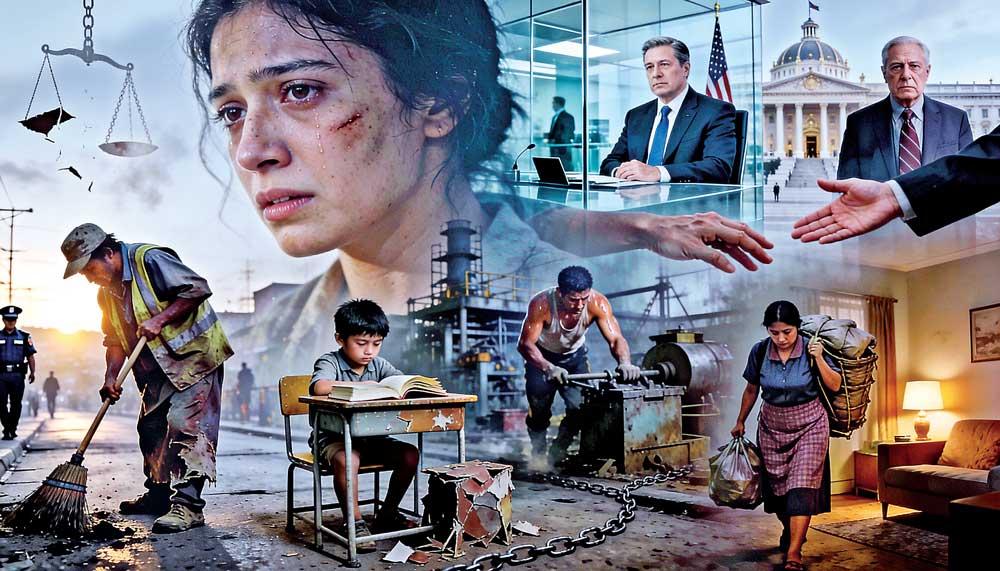
AI Generated photo
By Oneli Nonis
“The measure of a society is how it treats its most vulnerable.” — Mahatma Gandhi
Human rights are not abstract principles locked inside international conventions — they live and breathe in the everyday spaces we occupy. They exist in the tone we use when we speak to another human being, in the respect we show the sanitation worker sweeping the pavement at dawn, and in the quiet dignity we extend to a child struggling through school. On this Human Rights Day, the promise of the Universal Declaration of Human Rights (UDHR) feels more urgent than ever:
“All human beings are born free and equal in dignity and rights.” These words remind us that titles are temporary, positions are fleeting, power shifts, and privilege can vanish — but dignity is inherent. No one is more, no one is less.
Jean-Jacques Rousseau famously wrote that “Man is born free, and everywhere he is in chains.” While he spoke of political constraints, today his words echo in social hierarchies, class divides, gender inequalities, and systems that decide whose voice matters and whose does not. A school prefect may speak with authority, but a janitor deserves the same respect. A manager may guide an office, but a security guard has equal human value. A President may lead a country, but cannot claim greater dignity than the farmer who feeds it. The essence of human rights is equality — the recognition that every person, regardless of job, gender, birthplace, identity, or economic status, carries the same intrinsic worth.
The world, however, continues to struggle with this truth. Case studies illustrate the consequences of forgetting our shared humanity. In India, a sanitation worker named Manoj, employed through a private contractor, died inside a sewer due to lack of protective gear. His death sparked outrage but also revealed an uncomfortable truth: society notices the worker’s absence only when tragedy strikes. In Sri Lanka, during the pandemic, garbage collectors and municipal workers faced stigma and discrimination despite being frontline workers, some being denied entry into shops or even neighbourhoods. Yet they kept the country running. These stories remind us that human rights are violated not only through violence but also through everyday disrespect and invisibility.
At its core, Human Rights Day invites us to re-examine how we treat the people around us — not those with power, but those whose labour sustains our lives silently. Equality is not proven in declarations; it is proven in daily interactions.
Workplaces are often the first environment where human rights are tested. They are where power dynamics surface, where hierarchies form, and where titles often overshadow humanity. And yet, the UDHR is clear: “Everyone has the right to work… and to just and favourable conditions.” But rights at work go beyond salary and contracts — they encompass dignity, respect, safety, equality, and voice.
In many countries, workers face discrimination based on gender, ethnicity, caste, disability, language, and class. Women face pay gaps, harassment, and constant pressure to prove themselves. Migrant workers — from domestic workers in the Middle East to construction workers in Asia — endure long hours and limited freedoms. And people in lower-income or labour-intensive jobs frequently face disrespect from customers, employers, and even colleagues.
Real case studies highlight these inequalities. In Bangladesh’s garment industry, workers — mostly young women — report verbal abuse, unsafe conditions, and wages barely above survival level. In Sri Lanka, female factory workers in the Free Trade Zones have documented harassment, poor living conditions, and retaliation when reporting abuse. Migrant housemaids returning from Gulf countries have shared heartbreaking testimonies of withheld salaries, confiscated passports, and emotional abuse. Even white-collar workplaces are not immune: employees report microaggressions, bullying, and toxic hierarchies disguised as “office culture.”
Yet the issue is not only systemic — it is human. Consider the story of Jeevani, a Sri Lankan office cleaner in Colombo who worked for 15 years in the same building. One day, she shared in an interview that only two people in the building ever addressed her by her name. To everyone else, she was simply “cleaning girl.” Despite doing essential work, she felt invisible. Her story is shared by millions of workers worldwide — security guards, tea pluckers, waitstaff, drivers, hospital attendants, sewer workers, domestic helpers.
It is here that human rights truly begin: in whether we look them in the eye, thank them sincerely, ask their name, and treat them as equals. Hierarchies may structure workplaces, but they can never determine dignity. A janitor and a CEO are not separate on the scale of humanity.
The workplace must evolve into a space where every employee — regardless of role — feels valued. A fair workplace is not one where everyone has the same job; it is one where everyone has the same humanity.
If workplaces are where human rights are tested, then homes and schools are where they are first learned. Children observe how adults treat household workers, how parents speak to each other, how teachers treat students differently, and how society categorises people by class. These early experiences shape their understanding of equality — or inequality.
The UDHR emphasises that “education shall promote understanding, tolerance, and friendship among all nations and groups.” Schools are not only places of academics; they are the earliest laboratories of human rights. When a child mocks another for their uniform, skin colour, religion, or socioeconomic background, the earliest seed of discrimination is planted. When a teacher praises wealthier students more or ignores a child struggling with language, inequality grows. And when school hierarchies — prefects, monitors, cliques — become spaces of bullying, leadership slowly transforms into oppression.
Case studies show how severe the consequences can be. In South Korea, a 16-year-old boy died by suicide after years of bullying, prompting national conversations about school safety. In Sri Lanka, students from plantation communities have reported discrimination in urban schools, including assumptions about academic ability. Teachers in some rural districts note that students without brand-name shoes or schoolbags face teasing that pushes them toward dropout. These are not isolated incidents — they reflect the deep relationship between dignity and early social environments.
But homes, too, shape human rights. They are the first places where respect or disrespect is normalised. When adults shout at domestic workers or call them by demeaning names, children learn that some humans can be spoken to harshly. When a parent dismisses a girl’s dreams or gives her more chores than her brother, gender inequality is reinforced. When households treat differently-abled family members as burdens rather than full human beings, the violation begins within the home itself. The family may be the foundation of society, but it can also be the first site of injustice.
A powerful Sri Lankan case is that of , a 13-year-old who worked as a domestic helper and faced years of abuse. Her case exposed how hidden violations can be when they occur in private spaces. It reminded the country that the home is not automatically a safe place — safety must be ensured, not assumed.
Human rights cannot be taught only in textbooks. They must be lived, observed, and mirrored in daily behaviour — at the dinner table, in classrooms, and in the way adults treat everyone around them.
Beyond homes and workplaces, human rights extend to public life — the street, the bus, the market, the hospital, the courts, and parliament. Every interaction in public space is an opportunity to demonstrate respect or neglect, humanity or hierarchy.
When a bus conductor shames a schoolgirl for her clothes, a human right is violated. When a woman is harassed on a train and no one intervenes, her dignity is ignored. When a disabled person struggles to access a public building, their right to participation is denied. When a refugee or minority community member is insulted for their identity, equality is abandoned.
Case studies reveal these truths globally. The murder of George Floyd in the United States exposed systemic racism and led to worldwide protests calling for equality and justice. In India, caste-based discrimination continues in workplaces, temples, and public spaces. In Sri Lanka, Muslims faced targeted hate speech during several political cycles, reminding us that human rights are vulnerable to political manipulation. The persecution of the Rohingya in Myanmar illustrates how quickly rights can collapse when hatred is allowed to grow.
But society can also be a site of extraordinary courage. The Aragalaya movement in Sri Lanka was a moment where people of all backgrounds — Tamil, Sinhala, Muslim, Burgher, rich, poor, young, old — came together in defence of dignity and accountability. Women played a key role in peaceful protests, legal support, and community organisation. Human rights are most visible not when violated, but when defended by ordinary people.
Rousseau’s belief that humans are naturally good but corrupted by social structures feels relevant here. Society can teach discrimination, but it can also teach solidarity. The tone of a country — its respect, its empathy, its humility — is built from millions of small interactions: offering a seat, holding a door, refusing to ignore injustice, correcting friends when they speak disrespectfully, voting with conscience.
Every society has the potential to become humane — not through laws alone, but through collective behaviour.
Human Rights Day is not merely a date — it is a promise. A promise that dignity does not depend on salary, title, or status. A promise that respect must be universal, not selective. A promise that a cleaning lady and a CEO must be treated with equal humanity, because human worth is not something we earn — it is something we are born with.
From workplaces to classrooms, from homes to the streets, every interaction we have carries weight. The words we choose, the tone we use, the way we acknowledge someone’s presence — these are all everyday expressions of human rights. We often think of violations as large-scale issues, but they begin in small, familiar spaces: a rude comment, a dismissive gesture, a humiliating tone. Protecting human rights starts with protecting dignity in ordinary life.
The UDHR envisioned a world where “the recognition of the inherent dignity” of every human being forms the foundation of freedom, justice, and peace. This vision is not unattainable. It begins when we greet the cleaner by name, when we teach children kindness, when we speak respectfully to service workers, when we stand up for someone being mistreated, when we acknowledge our shared humanity.
On this Human Rights Day, let us choose to be better. Let us build a world where dignity is not conditional. Where no job is considered “lesser.” Where no person is unseen. Where respect is not earned by power, but given freely to all. Because in the end, the true measure of a society is not how it treats its leaders — but how it treats its most vulnerable.
A world that honours every human is a world worth fighting for. And it starts with us. Each of us. Every day.