Reply To:
Name - Reply Comment
By Prof. Samitha Hettige
When the US Dollar wasn’t flying very high, those who supported the government spoke of reaching a ‘rich country to live a beautiful life’.
Since the US Dollar took wings, some Economists, Politicians and even Astrologers started flying tweeting about a weakening government-not many seem to be seeing the strong State which existed for 2,500 years absorbing short term socioeconomic shocks.
Since 1931 Sri Lankans have been changing governments at elections. Before colonization, elections weren’t known and government and States were considered one by some.
Historic records indicate that State had the power to take many shocks over the centuries. One might even argue that Arahath Mahinda’s model State prevailed though the administrative capital shifted due to security threats.
Sri Jayawardenepura which was referred to as the city of rich people in ‘Selalihini Sandeshaya’ was made capital by King Parakramabahu VI. Though it isn’t clear if he also spoke of a ‘rich country and a beautiful life’, he united the country with support from all people (including Tamils and Muslims),
Buddhist monks and especially the Chinese Emperor. Thus he can be considered as the last to strengthen the state before colonization. With colonization the State was weakened systematically and ended being a small part of the mighty British Raj by 1815.
The weak State which prevailed since then wasn’t allowed to be strong even after Sri Lanka was given the ‘Dominion’ status on February 4th 1948 as per some constitutional experts.
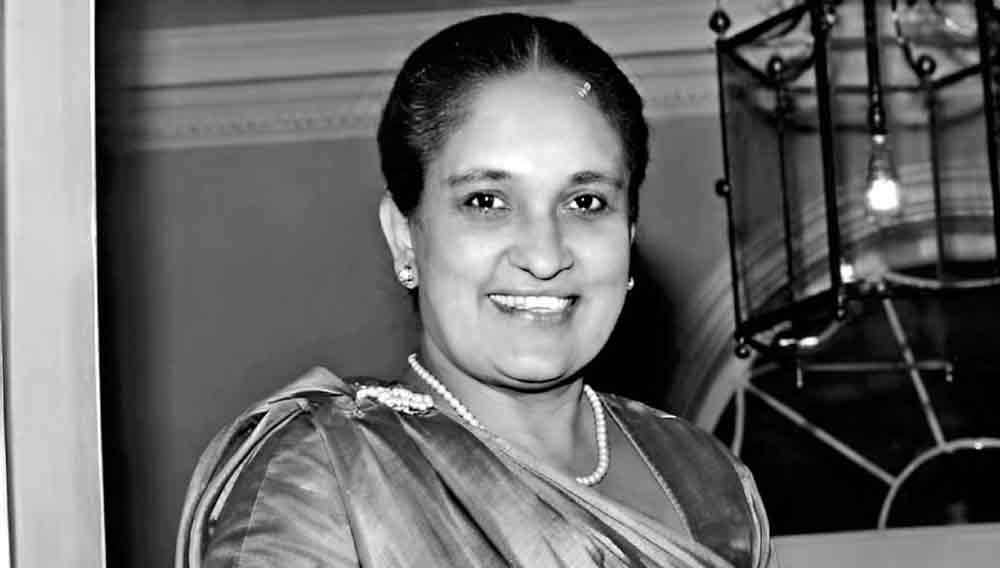
Mission of Sirima Bandaranaike
Mahawala-thenna ‘Rate Mahaththya’ and Barnes Ratwatte ‘Rate Mahaththaya’ (Grandfather and father of Sirima) were two men (in 1800s and early 1900s) who attempted to educate young Buddhist monks in English medium.
That was considered a visionary move to strengthen ‘to be independent State’ since monks were an integral part of Arahath Mahinda model State (Ref. Ven. Balangoda Ananda Maithree).
Both men may have never imagined that their 3rd generation ‘Sirima’ would one day be the plan implementer.
As the first female Prime Minister of the world and ‘Dominion’ Ceylon, Sirima had a bitter experience of depending on British judges for justice after the 1962 coup. Thus after the 1970 election victory she gathered the Members of Parliament who enjoyed a 2/3 majority to discuss Sri Lanka’s first ever ‘Republican’ (‘Autochthonous’) Constitution.
The gathering was at the ‘Navarangahala’.
It was the assembly hall of the Royal Junior School (RJS) in Colombo 07.
RJS was an independent State owned primary school and the ‘Navarangahala’ was the brainchild of late H.D. Sugathapala who was the Head Master till 1970.
After the discussion, Parliament gathered and Speaker Stanley Tilakaratne accepted the proposal to adopt the new Constitution on 22nd May 1972 renaming Ceylon as Sri Lanka.
With the new Constitution, Sirima took many bold steps to strengthen Sri Lanka State.
The Judiciary became independent from the Privy Council. Land Reforms Commission strengthened State land mass. The forex fraud investigation commission was established to punish those who violated forex laws.
Another notable move was the issuing of ‘National Identity Cards’ with support from the German Democratic Republic (East Germany). However, she was defeated at the 1977 election and its good if future generations could analyze her ‘Democratic Aragalaya’ to change the fate of the State.
Population should be mindful when electing governments.
Their choice should never weaken the State. 22nd of May could thus be considered as the day the ‘State’ became independent. Views expressed are personal.