Reply To:
Name - Reply Comment
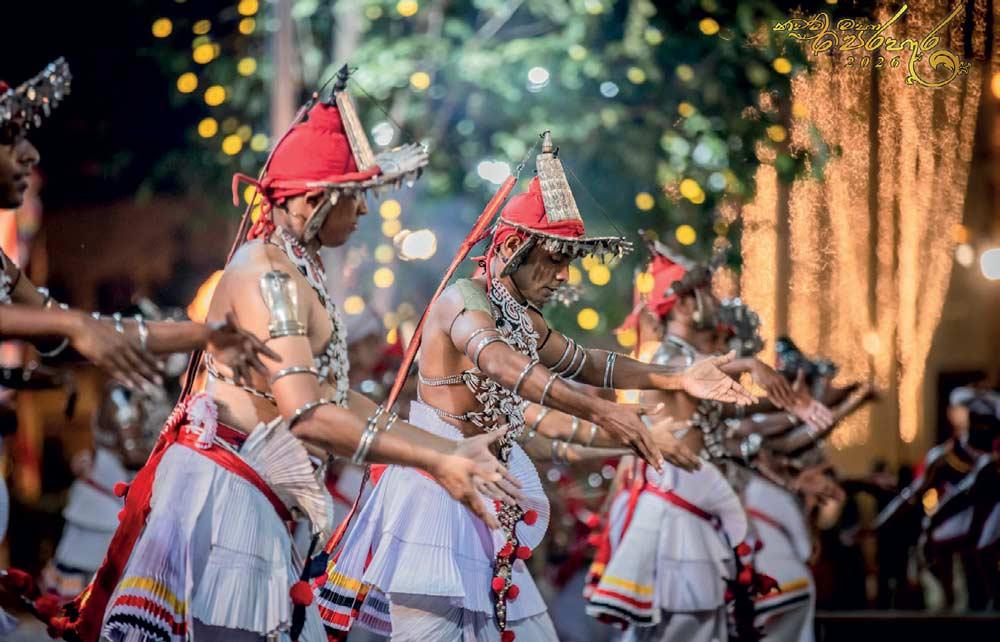
Dancers are a key part of the colourful procession

Gangaramaya Navam Perahera is a vibrant, colourful two day Buddhist procession in Colombo. It features majestic elephants, traditional dancers and drummers, attracting a large crowd near the Gangaramaya temple every year. This year, it is scheduled for January 31 and February 01 (Navam Full Moon Poya day and the day before.) Over one thousand performers including Kandyan dancers and cultural displays from across the country are featured in the procession along with decorated elephants.
This prestigious performance conducted annually on the Navam Full Moon Poya day starting on the pre-poya day by Gangaramaya temple in Colombo is a prestigious Buddhist religious event ranking alongside the Sri Dalada Maligawa Esala perahera of Kandy and the Duruthu perahera of Kelaniya Raja Maha Viharaya.
This perahera is of special significance as it is the only Buddhist pageant of this scale parading the streets of Colombo.
PERFORMERS OF THE PAGEANT
More than one thousand performers make the pageant magnificent, splendid and imposing. Whip crackers or ‘Kasakarayas” inaugurate the procession by cracking their whips in the air. Whip crackers serve a number of purposes. First, it is a means of clearing the way for the main perahera. Spectators confine themselves to the pavement and leave the road entirely for the procession to pass without any disruption. Secondly, it is a signal that the main procession is approaching. It is also an offering made by sound indicating the majesty of the procession. Devotees young and old including school children walk behind, most of them carrying flags and banners and the others with trays of flowers in their hands.
More than one hundred beautifully adorned elephants including tuskers provide majesty and elegance to the procession. The tusker of the temple carries the relic casket on its back. As in the case of Sri Dalada Maligawa Esala perahera and the Kelaniya Raja Maha Viharaya Duruthu perahera, the caparisoned elephants are adorned in a costume consisting of three parts viz. the body part, the forehead garland called “Neththi Malaya” and the ear ornament called “Kan joduwa”.
Large quantities of foam Rubber, unblemished cloth, velvet and coral etc. are required to make these costumes for elephants. These expensive costumes add to the majesty and elegance to the elephants that provide a majestic appearance to the perahera.
The dramatic performers in Gangaramaya Navam perahera can be categorised into four groups. Firstly, there are ordinary dancing teams representing Kandyan dancers, low country dancers and Sabaragamuwa dancers.
The world oldest and most ubiquitous musical instrument, viz. the drum is used in all these dancing performances. Various kinds of drums such as “Getaberaya” “Mangul beraya”, “Yakberaya” i.e. the drum which is small in the middle and “Rabana” are beaten to produce rich and melodious sounds in harmony with the dancing performances and “vannams” or songs of the performers. In addition, a pair of cymbals or “Thalapota” also called “Thithalama” is played in all these dancing performances to keep in tune, melody and span of time. This is a pair of round metal plates used as a musical instrument. A loud ringing sound is made when the two cymbals are hit together.
Elegant dancers
Dancers in their costumes look very elegant when they move in the procession. They sing vannams while dancing. Vannams are metrical verses sung by dancers to provide lyrical music in their performances.
There are eighteen vannamas such as “Thuranga” (horse) Vannama, “Vairodi” (Cat’s eye gem) Vannama, “Savula” (cock’s Vannama and the most important “Gajaga” (Elephant Vannama). When the performers dance to the tune of Gajaga Vannama they move like elephants.
Ves Natuma is a special kind of Kandyan dancing. These dancers have to undergo training for a long period before being qualified to perform this kind of dances. After being well trained, the performer will be entitled for the “ves costume” with a beautiful head dress. “Pantheru“dancers form another group. Each dance has a circular instrument called “Pantheru” which produces a clinging sound. This makes the performers melodious.
The most important group is the group of “Hewisi” or drum players. They produce a drum roar with the large drum “Daula”, the double drum ”Tammattama” and the trumpet or the bugle hone “Horanewa”. The combination of these musical instruments produces a melodious music.
“Boru kakulkarayas”or the silt walkers produce special colour to Gangaramaya Navam Perahera. The performers walk high above the ground on two long pieces of wood with places to rest their feet on. They sneer at the spectators from above, offering them entertainment.
Meanwhile conch shell blowers produce gentle and elongated sounds and increase the serenity of the atmosphere.
KOLAMBA PERAHERA
Earlier the perahera conducted by Hunupitiya Gangaramaya Viharaya was known as “Kolamba Perahera”. This procession was so called because it was and still is the only major Buddhist pageant parading the streets of Colombo apart from Bellanwila perahera and Kotte Raja Maha Viharaya perahera which are held in the outskirts and not within the city limits. Kolamba Perahera was conducted in August after Sri Dalada Maligawa perahera in Kandy.
In place of the former Kolamba Esala perahera, an annual pageant conducted during the month of Navam (February) started in 1979 with the support and assistance provided by the then Prime Minster the late R. Premadasa.
Thus Gangaramaya Navam perahera emerged during a time when no major Buddhist pageant was conducted within the metropolitan area of Colombo. As it is conducted at the beginning of the year, many tourists visiting Sri Lanka have the opportunity to watch this colorful cultural pageant.
A significant fact about this pageant is that it is planned and organised in an excellent manner. Seating accommodation for about a million spectators is provided.
GANGARAMAYA TEMPLE
Gangaramaya was originally a small hermitage in a piece of marshy land. It was transformed into a nationally and internationally famous viharaya by Venerable Dewundara Sri Jinaratana Nayake thera, a pupil of Venerable Hikkaduwe Sri Sumangala Nayake Thera. Venerable Jinaratana Nayake Thera who possessed an exuberant personality was liked by Buddhists and non Buddhists alike. Within a short time, the Thera transformed the little Awasaya into a fully equipped temple with the cooperation of the people in the area. Today, Gangaramaya is a superb place of Buddhist worship with the three fold main features Sharirika Dhatu (Physical remains of the Buddha) Maha Bodhi (Sacred Bo tree) and Buddha Rupa (Buddha statues).
Main features of the temple include viharaya (temple), Chetiya (pagoda) the Bodhi tree, the vihara mandiraya, Sima malakaya and the relic chamber. In addition a museum, residential hall, the library, the three storied pirivena, educational hall and an alms hall are also in the premises. The old Simamalakaya was repaired by the generosity of Mr. Musajee. He had offered Dana and pirikara to thousands of monks. He also provided accommodation and other facilities to many Buddhists who came for education.