Reply To:
Name - Reply Comment
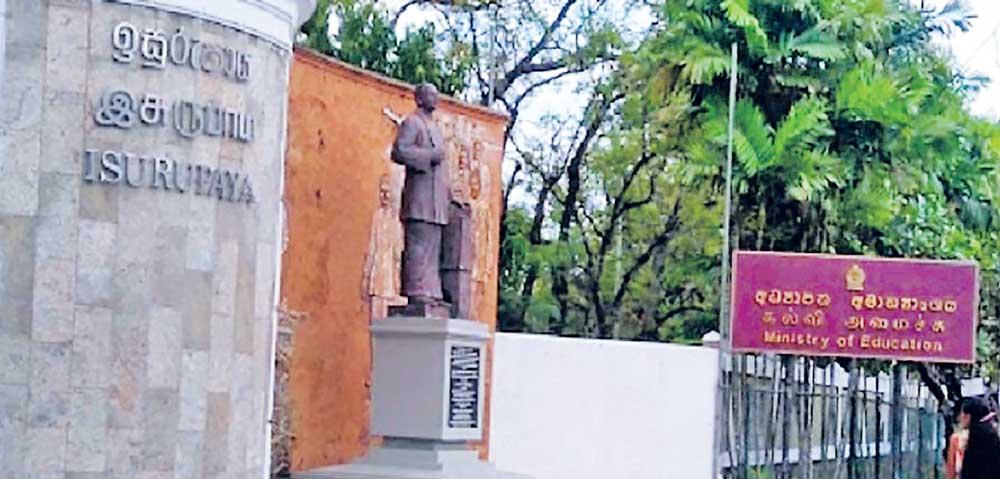
Retired teacher N.Rafideen visited the Education Ministry in Battaramulla with her proposals to uplift education, but had to put up with many negative responses by the authorities
Rafideen not only taught, but also identified unique challenges faced by schoolchildren, often overshadowed by poverty, neglect and systemic inefficiencyHer project proposal presented to the Ministry of Education is equally impactfulHer recommendations include a 1 year programme for primary rural school students to identify early developmental challengesEach time she pitched her ideas to rural school administrators, she encountered resistance |
 Accompanying N. Rafideen, a retired government teacher with over 23 years of dedicated service to rural schools, on her journey to the Education Ministry was an eye-opening and deeply frustrating experience.
Rafideen, a woman who spent her life nurturing young minds, was met with a level of indifference and bureaucratic red tape that left her largely disappointed in the system that promised to be just and efficient.
Over decades of service in some of Sri Lanka’s most remote and underserved schools, Rafideen not only taught, but also identified unique challenges faced by these children—challenges often overshadowed by poverty, neglect and systemic inefficiency.
Based on her experience, she developed a remarkable research project detailing her findings on teaching rural school children, who, without intervention, Rafideen said, “Slip away through the cracks of our educational system.”
Over the years, she voluntarily organised several awareness programmes for rural children across multiple schools, addressing critical issues such as mental health awareness, soft skill development, and, most notably, sexual education for adolescents aged 12–16.
She has also coordinated multiple talent shows for students, particularly drop outs in an effort to connect them with potential investors who could support and fund their aspirations.
These events were often supported by Rafideen’s own personal savings and the limited resources available in the school.
Her project proposal to the Ministry of Education is equally impactful. Her recommendations include a 1 year programme for primary rural school students to identify early developmental challenges, talent shows to empower school dropouts and soft skills development like home gardening campaigns, to align with the government’s “Clean Sri Lanka” programme.
Uphill battle
However, despite ample proof of her dedication, including endorsements from provincial, district and zonal education authorities, Rafideen had to face an uphill battle in her efforts.
Each time she pitched her ideas to rural school administrators, she encountered resistance, delays, dismissive attitudes, gender bias and sometimes even veiled demands for bribes.
Determined to avoid constant negotiations, Rafideen sought support from the highest level, approaching the Ministry of Education, believing a ministry level endorsement would ease her efforts to approach rural schools.
However, what followed was a journey through a maze of bureaucracy, leaving her disheartened.
Her experience at Ministry of Education
On 28 October 2024, Rafideen sent an email addressed to the President, the Prime Minister, the Minister of Education, and all the relevant ministries and secretaries.
The email included her detailed project findings, professional service endorsements and several official approval letters compiled under the subject title ‘Suggestions to Improve Education in Sri Lanka’.
In her message, she underscored the necessity of her proposed project and requested a 20-minute appointment with the Minister of Education to appeal for a letter of endorsement.
Weeks passed without any form of response.
Since securing a fixed appointment before travelling all the way from Kandy to Colombo seemed ideal, Rafideen attempted to email the ministry again.
On 5 December 2024, she followed up with another email, reiterating her request, but once again no response was received.
On December 16, 2024, Rafideen, with an acquaintance, travelled to Colombo to the head office of the Education Department in Battaramulla with the hope of securing a letter of endorsement from the Minister of Education or the Deputy Minister.
Mondays are designated as open days for the general public at the offices to allow direct meetings or consultations with ministry officials.
A large crowd of people, many of whom had travelled long distances using public transport, were seen gathered at the premises, hoping to voice their concerns and have their issues addressed.
At the education department, Rafideen was initially directed to the Minister’s offices, where her first experience with officials proved disheartening. A secretary to the minister dismissed her request without acknowledging her concerns.
After some convincing, Rafideen was instructed to submit a detailed proposal that followed formal criteria. This proposal should include an outline of the project along with hard copies of supporting documents, all prepared to “convince officials” to allocate her an appointment with the Minister.
After much persistence, Rafideen was given the opportunity to meet the Deputy Minister of Education who happened to be present in his office at that time.
The Deputy Minister was impressed with her brief presentation. He then instructed her to submit a detailed proposal to him directly and gave assurance that after a three-week review, a team would evaluate her findings and allow Rafideen to present them to a panel of experts formally.
A week later, the proposal, prepared in accordance with a general criterion for the Deputy Minister, was delivered to the Secretary who accepted it with a promise that it would be reviewed, and a response would be guaranteed in a month’s time.
Yet again, weeks passed without a reply.
On January 20, Rafideen once again traveled from Kandy to the Colombo Head Office with her project proposal, looking for an update. Unfortunately, her experience mirrored that of her previous visit; she was dismissed without a clear response.
It was approximately 3:30 p.m. by the time Rafideen was allowed to meet the Deputy Minister again and it was only after he had completed all his engagements for the day.
Rafideen was dumbstruck by the Deputy Minister’s response, who stated that the project did not fall under his purview. He explained that he had forwarded it to the Non-Formal Education Unit of the department as they were planning new educational reforms.
He further stated that there was nothing he could do to sign off on it, leaving Rafideen feeling confused by the lack of clarity and support from the Minister’s office.
The Deputy Minister then instructed her to meet with the non-formal unit in a week’s time.
Determined to make some progress in her visit, Rafideen decided to check in with the Non-Formal Education Unit.
Locating this unit was like walking through a maze for Rafideen. None of the staff within the department were aware of such a division existing in the ministry!
After much effort navigating the long hallways and staircases of the massive office building, she finally spotted a director board that listed the unit and its room number.
Locating this room, she found a director along with several staff members present. To Rafideen’s dismay, the director of the unit, when consulted, claimed not to have received any project proposal.
An opportunity to present her project
Over the course of an hour, Rafideen had to explain her project and convince the director of its importance.
During this time, she observed the disarray in the surrounding offices. A pregnant staff member (made to sit on a wooden chair) was scrolling her phone the entire time. Another female attendant was engrossed in watching political campaign videos about winning the LG Polls, while several others were chit-chatting about the electricity prices, according to Rafideen.
After an hour of consultations, the Director (of the Non-formal Education unit), who was impressed with Rafideen’s work, personally escorted her to the School Affairs Unit and directed her to speak with the officials there to secure a letter of endorsement. This official seemed to be one of the few individuals who was taking seriously the role entrusted upon a staffer at this institute.
Rafideen then had to wait for another half hour at the School Affairs Unit. While waiting, she encountered a graduate teacher who was there to seek a transfer for her son from the present school to a national school, which is closer to their residence.
The woman, after her brief visit inside the office, returned visibly disappointed, sharing her fruitless experience.
This woman then told Rafideen how the officials provided no assistance at all and went on to question the purpose of having authorities with the power to intervene when they refused to help.
The woman lamented how school principals in her district were demanding bribes of up to one million to perform administrative tasks.
“I will never vote for anyone in this country again,” the woman vowed, leaving the premises in extreme frustration.
Rafiden was then directed to the School Affairs Unit, where she faced a similar dismissal. By the time her turn came, she was advised to approach the Provincial Education Office for a letter of endorsement; and yet again it was a case of passing the ball where responsibility was considered.
Feeling defeated, she decided to call it a day.
While on one of the many elevators in the building, she struck up a conversation with a group of department staff. They vented their frustrations, complaining about low pensions and salaries that barely helped them cover their medical expenses.
It was a glimpse into the systemic inefficiencies and struggles that seemed to flow through every level of the department.
By the time she left the Colombo office, it was already 5 PM. What she observed outside the building again left her appalled—a fleet of official vehicles with drivers waiting to take the ministry staff home.
Meanwhile, people like Rafideen had to endure the grueling four-hour journey back to Kandy on overcrowded public transport, exhausted and disappointed.
The Daily Mirror repeatedly attempted to reach the Education Department to inquire into the incident. Emails were sent to the Prime Minister’s Office, the Prime Minister’s Secretary, and the Secretary to the Ministry of Education. Additionally, phone calls were made to the department contact numbers 0112 784 461, extensions 990, 881, and 143. However, all efforts were unsuccessful.
The Prime Minister’s Office acknowledged receipt of the inquiry, stating that further action would be taken in due course.
Public service inefficiency: What is the breaking point?
Rafideen’s experience reflects the experience of thousands of citizens seeking assistance from public sector institutions.
But what is truly triggering here is that extremely rare individuals like Rafideen, who embody selflessness, dedication, and a genuine desire to uplift others, face systemic disregard, apathy, and outright dismissal from the very institutions that are supposed to enable and support their efforts.
When asked why she persisted, Rafideen replied, “It is difficult to sleep at night knowing we saw all these calamities, and as teachers, we can only do so little about it,”
This is a reason why the contrast between the promises made by leaders—about facilitating social transformation from an individual level to bring change—and the actual reality of the ground situation is infuriating.
Rafideen wasn’t asking for a massive policy change or a grand allocation of resources. Her project did not even have a budget. All she needed was a simple letter of endorsement, backed by a detailed proposal and supporting documents she had already prepared.
Yet, this basic request turned into an enormous struggle and disappointment from a department that employs more than 300,000 people, none of whom could help fulfill her requirement.
It’s also particularly maddening when public servants whose salaries are funded by taxpayers are seen idling away their time, avoiding responsibilities and offering no real assistance to citizens.
Also, the idea that the children of this country are generationally left in debt to fund this kind of behaviour is equally disheartening!