 Kamanthi Wickramasinghe

Reply To:
Name - Reply Comment
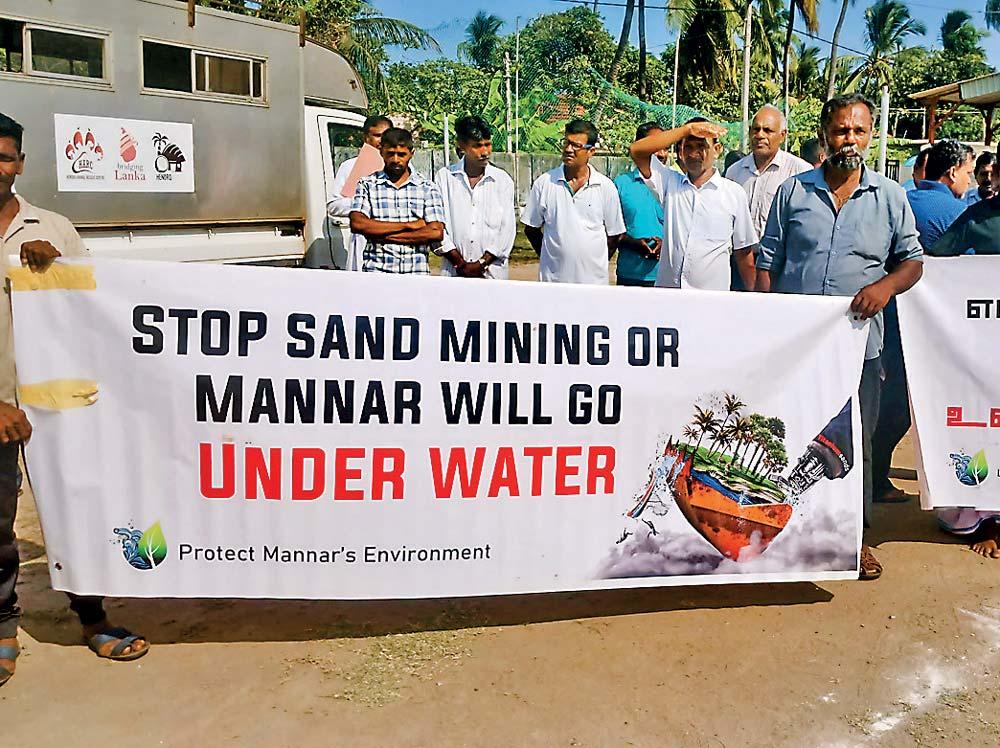
Residents of Mannar Island protest against unsustainable development projects threatening their livelihoods and community
 Liyanage states that the wind turbines obstruct most natural water channels leading to the sea, causing persistent flooding during rain in this area. Consequently, thousands of people are displaced from their homes, often for 3 to 4 months
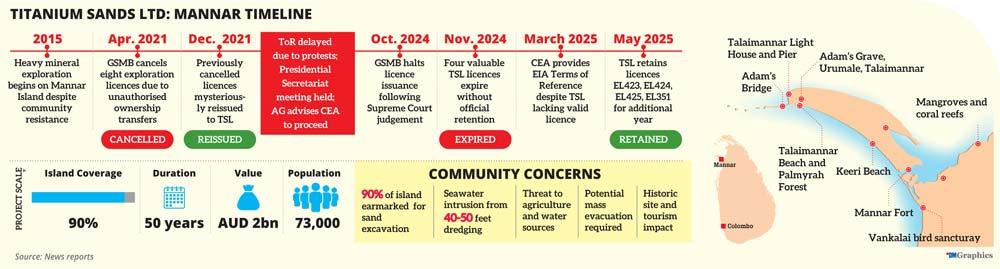
There is also a proposed sand excavation project for a private Australian company, where 90% of the total land in Mannar will be handed over to this said company, and the majority of Mannar’s 73000 residents live here
On June 11, communities living on Mannar Island staged a protest chanting slogans to protect Mannar Island and the country’s resources for future generations. The community called on the political leadership to ensure the sovereignty of its people. This protest is part of a larger campaign to protect the pristine Mannar Island from looming disasters due to various unplanned mega-scale projects that have been planned on this limited stretch of land.
Concerns from the community
Issuing a statement addressed to President Anura Kumara Dissanayake, the Mannar District Citizens’ Committee emphasised that as a responsible community, they are willing to contribute to priority development initiatives. “However the current trajectory of these developments challenge our very existence and infringes upon our fundamental human rights. We, the residents of Mannar unequivocally believe that these unplanned projects, which often circumvent existing laws and disregard proper community consultations, constitute a serious breach of our human rights. They challenge our right to life and our ability to sustain our livelihoods. Furthermore, these hidden projects not only jeopardise our community but also pose a threat to the sovereignty of our beloved country,” the statement read.
Main matters of concern highlighted in the statement include;
The statement underscored that people of Mannar seek their fundamental right to live peacefully and to reside on their land as citizens of this country. They urged the President to immediately halt and suspend disastrous projects in Mannar.
Titanium Sands Ltd – Progression of activities
A grim future for communities in Mannar
|
Jeremy Liyanage |
But several years later, communities living in the immediate surrounds of this project complain about the adverse impacts of conducting dredging activities on a highly sensitive sand island. As a result, protests against heavy mineral exploration companies such as TSL and the ongoing wind turbines fiasco highlight the detrimental impact caused to the pristine Mannar Island and its inhabitants. Despite assurances from the incumbent government, which claimed that they would stop the ongoing heavy mineral sands exploration project, people from the community are still not convinced about these promises.
Speaking to the Daily Mirror, Jeremy Liyanage, Executive Director of Bridging Lanka said that 90% of the island has been earmarked for mining and it’s a 50-year project. “They say this is a low impact, environmentally friendly project and that it’s away from human habitation. This is how they are selling it to the Australian stock exchange. But in reality, about 90% of the island has been designated for this project. Sri Lanka is very foolish because it sells its precious resources for peanuts. There’s ilmenite sand mining happening in Pulmoddai, Trincomalee for 50 odd years and it has been highly destructive. We have done our research there and we spoke to environmental lawyers who said that it’s possible to do ilmenite sand mining in a sustainable way in places like Pulmoddai but that it cannot be done on Mannar Island because it’s a sand island,” he explained.
Liyanage explained that in order to conduct exploration activities, all vegetation has to be cleared and a dredging well has to be dug to extract minerals such as ilmenite, which are at a depth of 40-50 feet. “But when dredging happens, seawater would intrude. They can get their minerals but once sea water intrudes, much of the island is gone. Already much of the island is below sea level. It’s like a basin. People can’t survive here and most people depend on dug wells or tube wells. If they are going to clear vegetation, create lakes and dredge, then there’ll be no water for agriculture, farming, and it would disrupt marine lif,e and the biodiversity in the area would really suffer. No one would be able to live here and people will have to be evacuated. Who will pay for lands, houses and schools because a majority of Mannar district’s population (73,000 people) live on the island which is the most populated. This is a very historic place and we have been developing it as a tourist destination. Imagine what’s going to happen when we see such scarring of the landscape?” he asked.
People living on Mannar Island are already suffering from wind turbines. Mannar Island at its widest is about 6km, and according to the specifics, a large area of land is being occupied by wind power farms. Therefore the capacity to hold more wind turbines (52) in addition to the existing 32 wind turbines remains in doubt. According to Liyanage, the access road connecting all these wind turbines unfortunately blocks most of the natural water channels to the sea. “Now whenever it rains, the whole area floods. Thousands of people are out of their homes, sometimes for three or four months. In December, January and a bit of February, in 2.5 months, we had five flooding incidents. It just destroys everything – houses, cultivations, home gardens. No one now wants to plant home gardens because what’s the use? So we are facing annual flooding just because of those ill-conceived, poorly planned wind turbines. In addition, the bird carnage is huge. Mannar Island is a birding paradise attracting species from Siberia, the Middle East, and Australia. We are destroying their habitats. The vibrations from the huge blades are keeping the fish away from the coast. This is the primary industry of Mannar island,” he added.
Therefore the people of Mannar have said NO to both these projects. “Ilmenite sand mining cannot be done in a sustainable way on Mannar island. With regards to wind turbines it’s a quizzical thing because four locations were put forward for wind turbines and the last option was Mannar Island,” Liyanage added. He explained that there are other parts of Mannar District which are uninhabited and have larger wind velocities. Why was Mannar Island chosen when it was the fourth option? What’s going to happen to people of Mannar? We are not against wind energy but it’s poorly conceived and is in the wrong location. Right now, the Sri Lankan government should do something about flooding. There should be a flooding study and a strategy in place to safeguard the homes, properties and livelihoods of these poor people,” he underscored.
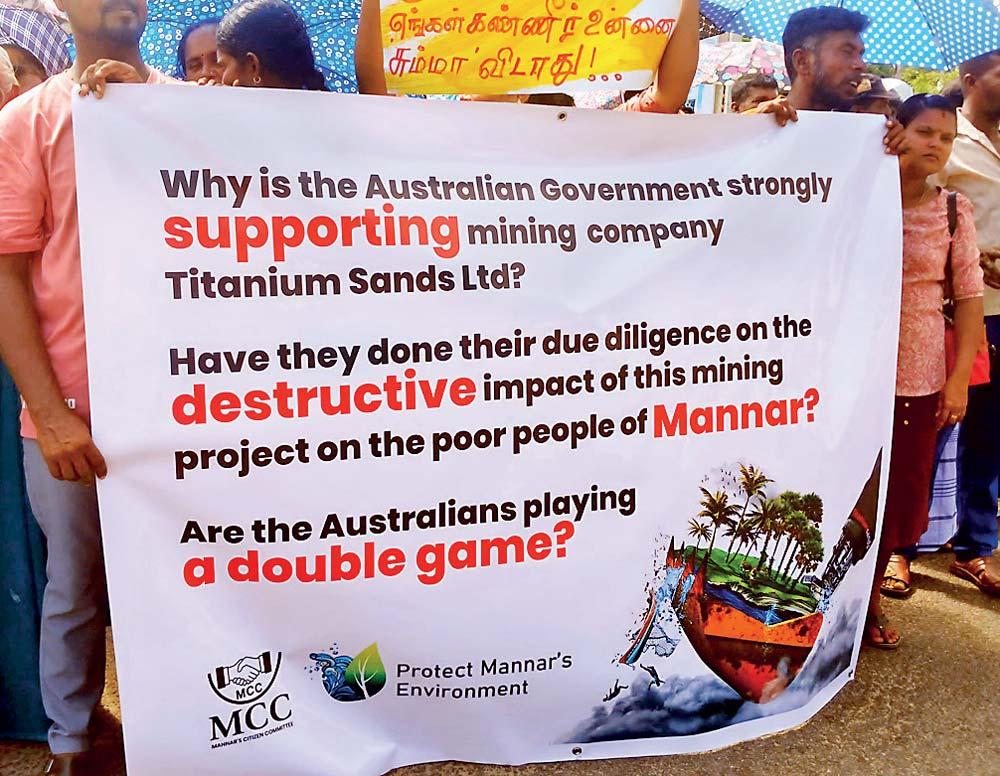
Following the economic downturn, many people in parts of Mannar thrive on rice and a bit of sambol. Biscuits and plain tea is fast becoming an ordinary meal in this part of Sri Lanka. This is why people were encouraged to grow home gardens because the prices of vegetables have shot up by 400%. But with flooding, people can no longer maintain their home gardens. This would have an impact on the growth and nutrition of children and youth. Flooding worsens levels of unemployment in the area as most people are day laborers. The Daily Mirror learned that more people are inclined to sell off their lands for a pittance to land barrens who in turn sell off their lands to overseas companies such as TSL. It is in this backdrop that people continue to protest, calling on the Australian government, that provides substantial aid for economic and livelihood support especially for women and children, to do its due diligence to better comprehend the destructive elements it would bring to Mannar Island and its residents, if Titanium Sands Limited, an Australian mining company, is supported to proceed towards obtaining a mining license.