Reply To:
Name - Reply Comment
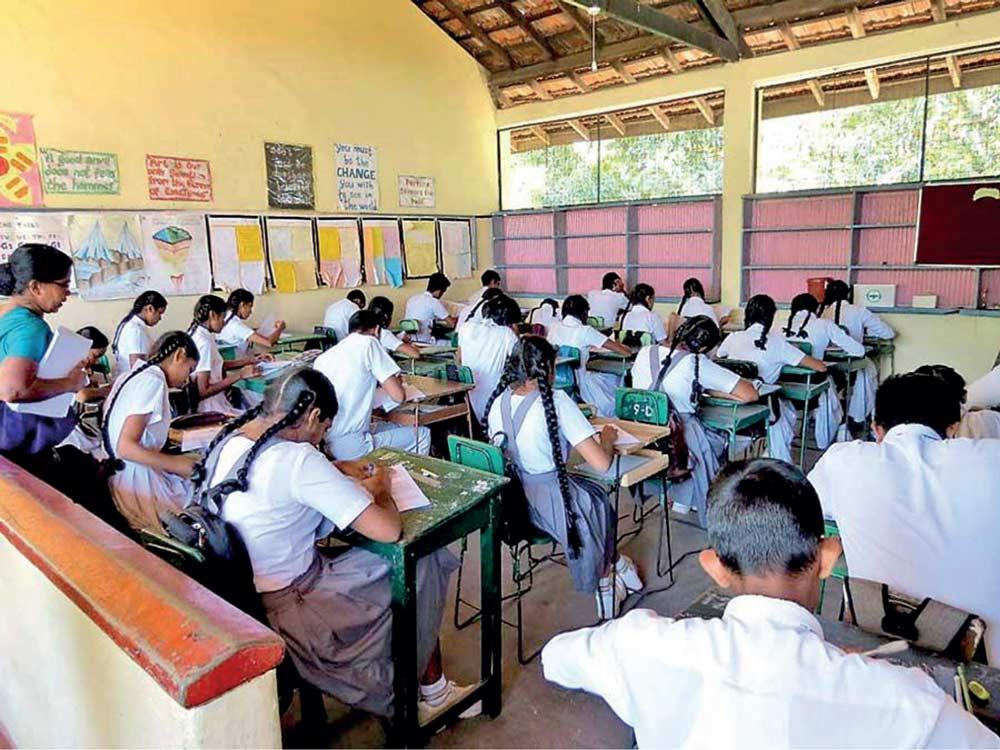
Classrooms like this represent the frontlines of Sri Lanka’s English education revival
 Kannangara’s first great innovation was Central Schools in the thirties, and those functioned in English medium
A previous article claimed that Mahinda Rajapaksa tried to dismantle English Education; however, that is not true, as he supported English Learning. It was Ranil Wickremesinghe who attempted to dismantle it, despite resistance from his Minister of Education, Karunasena Kodituwakku
In 2001, Chandrika Kumaratunga allowed a choice of English medium in government schools as advised by Tara De Mel
 I was away when Ranga Jayasuriya wrote his article with a headline about Sunil Handunetti being possibly a guiding light in promoting English language education. The thrust of his article was not, however, so complimentary about Sunil, whom I believe could be a comparatively efficient Minister, for he was the keenest to engage when we were in parliament together, and did a good job when he chaired the COPE.
But that was not the focus of the piece that I thought would need to be addressed, though since I did not have my computer I could not write a response. I did however point out certain errors to Ranga who, open as always, asked me to write a more comprehensive piece about English Education and the way forward.
First, though I should correct two errors in his piece. He declared that “When C.W.W. Kannangara introduced the Free Education Act, while the country was still a British colony, he also made it mandatory for students to have their primary education in their mother tongue; however, J.R. Jayawardene made an opportunistic intervention, expanding the compulsory swabasha education to the secondary level”.
This assertion is full of errors. Kannangara’s first great innovation (the Free Education Act was 1945) was Central Schools in the thirties, and those functioned in the English medium. His aim was to provide opportunities to rural children – or rather all those outside the charmed circle of the big cities – and for this purpose, the beneficiaries he targeted had to also have access to English as the privileged did.
But then J.R. Jayewardene got into the State Council, in the early forties, and proposed that the medium of instruction in all schools be compulsorily Sinhala, though he then accepted the proposal of his elders and betters that this should also include Tamil. And since they were unwilling to challenge his populist approach, the compromise was that this should apply only to primary education.
But that was just the thin end of the wedge and, in the early fifties, Eddie Nugawela as Minister of Education extended this to secondary level. An exception was made for science, which was then available only in a few schools. The only contribution of the Bandaranaikes to medium policy was when, in the sixties, science too had compulsorily to be done in Sinhala or Tamil, a change effective from the 1965 Ordinary Level examination.
Fortunately, as advised by Tara de Mel, in 2001 Chandrika Kumaratunga allowed a choice of English medium in government schools. Once again Ranga is in error in claiming that “Mahinda Rajapaksa, who succeeded Chandrika, did everything he could to dismantle English medium education in government schools”. It was Ranil Wickremesinghe who tried to do this, though he was resisted by his Minister of Education, Karunasena Kodituwakku, and when Mahinda came to power, he said firmly that English medium should continue, and squashed one of the leading lights at the NIE who had tried to sabotage our effort.
But it is how we should move forward that Ranga wanted me to address. The answer is obviously for this government not only to be advised by those who have succeeded in changing things in the past, but also to have in place able people to implement productive measures swiftly. And this should be done on a large scale, for, as I told Tara when she said she planned to introduce English medium in one school in Colombo and one in Kandy, that would be disastrous. The policy had to be national, to ensure that as many youngsters as possible would benefit.
Unfortunately those with a track record of success in this field – and I make no bones about my own contribution, in addition to Tara and the devoted Parvathi Nagasunderam of Sri Jayewardenepura and Nirmali Hettiarachchi, whom I put in charge of teacher training and materials production respectively – are now too old to function effectively, not least because of the complications covid created for our health. But there are plenty of youngsters who have done a great job in not only enhancing opportunities to study English, but also carrying through innovations in teacher training for English, with methods far in advance of the disastrous methods still prevalent in teacher training colleges.
Ranga unfortunately does not mention any of the courses now being offered in what might be termed cutting-edge institutions with regard to English teaching, and training for English trainers. Chief amongst these are some Colleges of Technology, in particular the one in Kurunegala, where Nandana Balasooriya, recently appointed as its Director after brilliant stints at Trincomalee and Wariyapola, has kept on with the Diploma in English and Education, which sadly the TVEC did not encourage after I was dismissed. And now Galle has a similar leader in Upali Saddhananda, who did a brilliant job with several intakes at different levels when he was a teacher at the Technical College in Matara.
Now the TVEC has an innovative Chairman in the form of Dharmasiri Wickremesinghe who, as Vice-Chancellor at UNIVOTEC, before he too was got rid of, took the DTET Diploma holders for degrees, and with his excellent staff produced several good teachers. I can only hope he will encourage more of this now that he sits at the head of the Vocational Education system in the country.
When I wanted universities, while I was in charge of English medium at the Ministry, to offer English Language Teaching as a subject, the suggestion was summarily rejected on the grounds that universities were not for vocational training. Only USJP under Parvathi Nagasunderam took up the challenge, which is why its external English degree soon became the most popular in the country. And in time, other universities have followed, though sadly we still do not have modules in teaching mathematics, another subject in which we are in dire need of more teachers nationwide.
But some universities have gone further, notably Uva Wellassa, which, having started under a brilliantly innovative Vice-Chancellor, Chandra Embuldeniya, has developed an English Language Teaching Department under G H Abeyweera, who was Dean of the Faculty of Management. The only such Department I believe which is not overshadowed by an English Department, it offers a degree in English Language and Applied Linguistics that provides much-needed soft skills for teaching.
Meanwhile, the TVEC has approved a Certificate for Pre-school and Primary English Teachers developed by Ravi Pratap Singh, who was my principal consultant for soft skills when I was developing better English curricula for the vocational training system. I asked him for a syllabus for Pre-school teachers, an area much neglected, and he continued this work, to ensure joyful activity, including music, to make English fun. I can only hope that provincial councils take this up, since providing such a foundation is one of the key elements in broadbasing English acquisition.
If the government approached just a few of those now at the cutting edge of English teaching – and I should note that Parvathi’s successors at Sri Jayewardenepura are also doing much – it can transform English teaching and swiftly develop the competencies Sunil Handunetti wants, which gave rise to Ranga’s article.