Reply To:
Name - Reply Comment
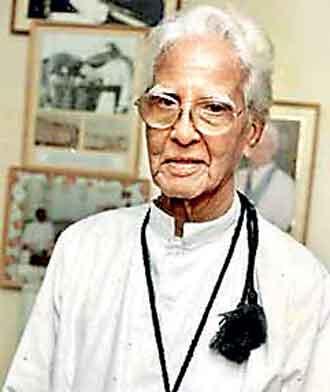
 In 1983 he was selected for Philippine’s Ramon Magsaysay Award, considered as the “Nobel Prize of Asia” and meant to honour those responsible for transformative leadership and selfless service in Asia. He was the only Sri Lankan to win such an achievement

 |
 |
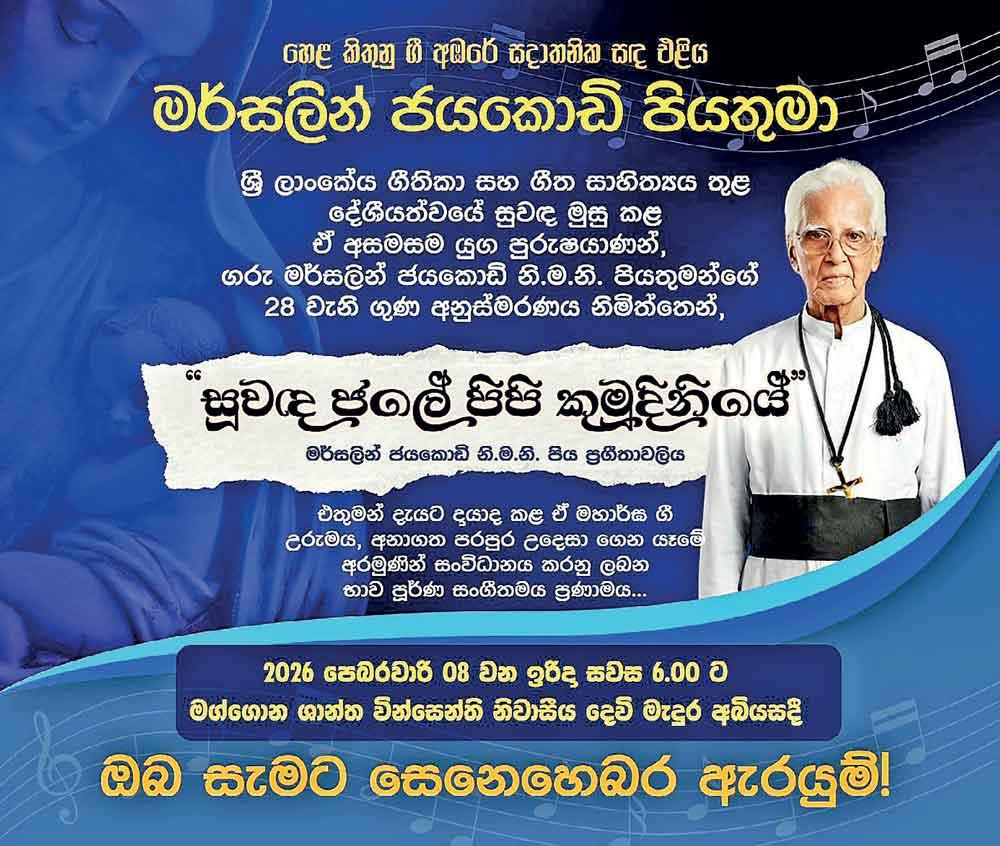
Commemorating the 28th death anniversary of great poet, versatile musician, writer and journalist Rev. Marcelline Jayakody OMI, an evening of musical tribute titled “Suwanda Jale Pipi Kumudiniye -- Marcelline Jayakody Prageethawaliya” will be held at 6 pm on Sunday, February 8 at St Vincent’s Home, Maggona.
Organised by the Catholic priests of Oblate of Mary Immaculate (OMI) congregation at the St Vincent Home in Maggona, at this evening of music, songs and hymns penned and music composed by the late priest will be sung by youth and the clergy, and discussions will be held about their literary and musical depths.
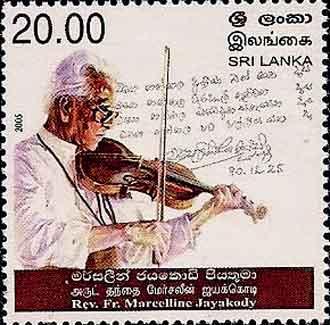
The tribute and the commemoration of Fr. Marcelline Jayakody is timely as this revolutionary religious dignitary had a deep love for Sri Lanka, its culture, literature and music; he was even selected to train the choir which sang ‘Namo Namo Matha’ at the first Independence ceremony in 1948. It is viewed that this performance impressed the authorities to accept it as the national anthem in Sri Lanka.
At a time when Sri Lanka celebrates its Independence, it is fitting that remembering Fr. Jayakody whose music helped to Sri Lankanise the church liturgy and its music from westernised Christian church music. Caught between the Western-oriented Christianity and Sri Lanka’s predominantly Sinhalese Buddhist culture, Fr. Jayakody used his creativity and imagination to bring locals closer to their faith, and find solace and peace in a language that they understand and enjoy.
Despite obstacles and oppositions, Fr. Jayakody took a bold challenge to enculturate liturgy especially music, an attempt so many failed to understand at that stage. A man much ahead of his time, what Fr. Jayakody initiated was one of the core ideas of the Second Vatican Council which took place between 1962 and 1965.
Born on June 3, 1902 in a family of an Ayurvedic doctor from Sandalankawa and a mother who was born a Buddhist, he studied at the Roman Catholic Boys School, Madampe, and later at St. Joseph’s College, Colombo. After entering the Seminary, he was ordained a Catholic priest on December 2, 1927.
Fr. Jayakody penned his first hymn to Mother Mary (Jesus’s mother) ‘Sapiri Sama’ (Full of Grace) in 1933 and he also started his newspaper column in the same year.
1950s was a decade of great cultural revolution in Sri Lanka. While the late Prof. Ediriweera Sarachchandra created his original stylised play “Maname” in 1956 in theatre, Dr. Lester James Peries made his debut ‘Rekhawa’ or ‘Line of Destiny’ which changed the destiny of Sri Lankan cinema. Fr. Marcelline Jayakody played a pivotal role in this success, writing all six playback songs -- ‘Olunelum neriya rangaala’, ‘Sudusanda eliye’, ‘Anuradhapura Polonnaruwa’, ‘Sigiri Landakage’, and ‘Mini Muthu PayataYataWenawa’ set to the music of Sunil Shantha and all ‘Rekhawa’ songs became instant hit songs in Sri Lankan music and remain evergreen since then.
Fr. Jayakody also penned the song ‘My Dreams are Roses’ sung by Sunil Shantha in the film, ‘Romeo Saha Juliet Kathawak’ (1969), directed by G. D. L. Perera. Fr. Jayakody was one of the few clergymen who went to study music at Ravindranath Tagore’s internationally acclaimed school of music ‘Shantiniketan in India.
Over the years, this great lyrics writer in robes has written lyrics and music for more than 1,000 songs and hymns, an inimitable accomplishment for anyone in the world of music and art.
As a poet, Fr. Jayakody was the first Christian priest to win the State Literary Award for his book of poems, ‘Muthu,’ in 1979, and his keen interest in poetry made him to become an ardent member of “Hela Havula.” He held the post of the President of Sinhala Poet’s Association for many years until his death. As a journalist, he was the editor of the Catholic newspaper ‘Gnanartha Pradeepaya,’ and was instrumental in changing its style and content to suit more to the Sinhala readership.
Fr. Jayakody was honoured with the “Kalasuri” title by the state for more than six decades of service to arts and culture.
Winner of the ‘Nobel Prize of Asia’
Though silent, the magnanimous service rendered by him to Sri Lanka’s literature, art, music, cinema, and on the whole to all Sri Lankans devoid of ethnic religious barriers, was noticed by the outside world. In 1983 he was selected for Philippine’s Ramon Magsaysay Award, considered as the “Nobel Prize of Asia” and meant to honour those responsible for transformative leadership and selfless service in Asia. He was the only Sri Lankan to win such an achievement.
Selecting Fr. Jayakody for this prestigious Award for Journalism, Literature and Creative Communication Arts, the Board of Trustees of the Ramon Magsaysay Award had cited “for enriching his country’s ‘world of song and music’ with spiritual and human rejoicing.”
Selecting Fr. Jayakody for the award, the Ramon Magsaysay Board stated: “Although severe religious and ethnic divisions remain in Sri Lankan society, the songs he has given his people to sing have helped bridge these tragic differences. From lullabies to Christmas carols, they have been put on records and tapes and have added joy to daily life. Like his essays and poems, they have also become vehicles for enabling his people to understand the deeper significance of what they see in nature.
“This silver-haired, singing priest, who stands tall and cheerfully exudeing his faith, has helped through music and song to bring to every Sri Lankan an awareness of his heritage. His travel books are alerting his people to the beauty of their country, its sounds, history, the rhythm of the cropping season and their profusely flowering trees. Not neglecting his westernised church upbringing, his radio plays on the lives of Western composers bring a broader dimension to the culture.”
In a concluding note it stated: “Fr. JAYAKODY is a living demonstration that accepting a vocation in the priesthood need never be a retreat from life. His versatile creativity continues to enthuse with spiritual content and philosophical insight the everyday experiences of young and old. As his songs so gladly proclaim, man can take a few steps further along the path where God beckons — to realisation of his better self.”