Reply To:
Name - Reply Comment
 During the period 2011 – 2025, Manel became a prolific writer. She wrote 12 or more books--five books for teenagers (Yovun Nawakatha) the second of which (Aselage Lokaya) won the Godage award for the best book in that category
By Sumangalika Dharmadasa
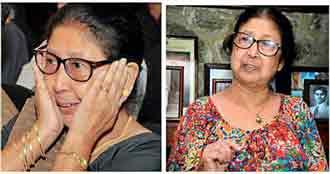 On 18th January, 2026 I bade Goodbye to one of my dearest friends -- Manel Eriyagama. Our friendship of over sixty years, begun as youthful undergraduates, ripened and progressed steadily through different stages and ages -- and finally moved gracefully into old age.
Until I settled in Colombo during the Covid days, we would meet often, although we had retired by then, as we both lived in Eriyagama, Peradeniya. Even after I moved to Colombo, our communication lines remained intact via telephone. She would call whenever she was troubled in mind, and we would discuss and dissect the vexing problem until we arrived at an acceptable explanation.
About a week prior to entering hospital for the last time, Manel called me urgently. This was unusual because she had already called to wish us for the New year. The matter which bothered her this time was odd for Manel. She said that she was upset because she wasn’t religious enough and had seldom found the time to listen to Bana (sermons). She felt she could have found answers to certain problematic issues that way. I gave her a list of Bhikkus whose Bana would appeal to her, along with the relevant TV channels and schedules. I’m sure that she did listen and derived comfort thereof.
Manel and I entered the University of Peradeniya in October, 1965 as did Aubrey, Kumari, Sadara, Ranjini, Malkanthi and others. Manel entered from Kandy and was allocated to Ramanadan Hall along with her many friends from Mahamaya College. I moved into Hilda Obeysekara Hall with my friends from Ladies College, Colombo. I met Manel for the first time in the Dean’s office of the faculty of Arts. We had both come there to sort out a problem with Time Tables. Manel wished to offer Economics (Sinhala medium) and English while I wanted to do History in the Sinhala medium and English. There was no provision for these combinations in the main Time Table, so were obliged to ‘sacrifice’ one subject. Manel dropped English and I dropped History.
During the first few months of our first academic year, we ‘freshers” were pushed headlong into a full blown campus strike. We were thrilled by the novelty of it all, but frightened too by the hectic activities that ensued. The majority of students in Manel’s Hall of Residence, including Manel and her clique, were supporters of the strike and boycotted lectures joyfully. However, most of the ‘freshers’ at Hilda Obeysekara Hall, fell in line with the decision of our seniors to oppose the strike, and were obliged to attend lectures that we would have gladly boycotted! Being on two different sides, Manel’s perception of that strike was somewhat different from my own. However, it did not mar our friendship. If at all, it helped us see both sides of the coin. After we graduated, all three of us – Aubrey Kuruppu, Manel and I drifted into the Sub Dept of English (later, ELTU) then headed by Prof. Doric de Souza. Manel was already there (having done a General Degree), and Aubrey and I joined soon after, when Prof. de Souza proposed that we should. It was not a proposition that we could very well turn down. We were recruited as ‘casual staff’ and paid only Rs. 15 per hour, but we didn’t mind!
Working with top academics
In addition to the illustrious Prof. Doric de Souza himself, we had other luminaries too, like Dr. Kamal de Abrew, Dr. Thiru Kandiah, and Dr. Sarath Wikramasooriya. Naturally, we were in awe of the star-studded galaxy. We were overawed by our senior colleagues too, like Hemamali Gunasinghe (ex Maname Kumari, no less) Sarojini Knight, Lalitha Gunawardene, Walter Perera (Snr) Amy de silva etc. At first, the three of us would often sit in our old classrooms, away from the noisy bustle of our departmental office. That is, until we got to know our seniors well.
I remember one incident which involved Manel and ‘Plato’ Gunaratne, a senior member we used to ‘avoid’ because we couldn’t fathom him. On this particular day, Manel came running into the Dept. looking flustered and red in the face. She had just had a most embarrassing encounter with Plato. She was coming down the stairs from the second floor when she missed a step and fell headlong into the outstretched arms of Plato! (who was waiting at the bottom to go up.) “I’m so sorry Mr. Gunaratne” she had spluttered. Plato cut her short and said “Oh it’s ok. A happy accident Miss Bopitiya… a very happy accident indeed!”
Our respect and fear of our boss Prof. de Souza was so great that we were careful never to come late to work. If somebody happened to be late, that unfortunate person found Prof. de Souza taking the lesson, ignoring the presence of the distraught latecomer. Once, Manel and I witnessed the discomfiture of a senior in this situation. It was this same senior who got blasted for asking for leave to attend a cousin’s Homecoming. Prof. de Souza is supposed to have said: “What leave? When my wife was delivering our first baby, I was right here in the classroom delivering a lecture.” The training we received was rigorous and stood us in good stead throughout our teaching career. The Sub Department of English (which we joined) later became the English Language Teaching Unit and was located in the Arts Faculty. But in the mid sixties, it expanded enormously to accommodate the influx of a tidal wave of swabasha medium students from all over the country, needing help in English to cope with their academic work. This necessitated the setting up of sub units in all the big faculties (at first) and finally, in all the faculties at Peradeniya. All the senior members of the department were transferred to other faculties in order to create the new units. Manel and I (who were now senior enough) were sent to the Faculty of Agriculture where the faculty staff cooperated fully and collaborated with us to establish a fine ELTU in that faculty.
We introduced innovative student - centered programmes that ensured high student participation. Attendance rose because students felt that we were catering to their needs. Manel and I worked as joint coordinators, not knowing (or caring) what our designation was! In hindsight, I believe we were transferred out together, because our bosses knew that we functioned well as a team.
Prolific writer and translator
There was a time in our early days when we planned to collaborate on a project to translate Sinhala Folk Tales into English. We started collecting folk tales in earnest, but gave up when Hemamali (if my memory is correct) told us that it had already been done by Henry Parker and even showed us the book. Our passion for writing and translation faced a temporary setback, but did not die. It continued in a dormant fashion, to resurface many years later, especially in the case of Manel who gained national recognition in the literary world. We now know that Manel’s new career as an award-winning writer and Translator began with her retirement.
During the period 2011 – 2025, Manel became a prolific writer. She wrote 12 or more books--five books for teenagers (Yovun Nawakatha) the second of which (Aselage Lokaya) won the Godage award for the best book in that category and her very first book – Suranimalage Kathava ( published in 2011 )had also been nominated for the same prize earlier. Her fifth book was a novel, after which she turned to translation, winning many prestigious awards. Her first book of translation was ‘Human Machines’ (Minis Yanthra by Piyaseeli Wijemanne) which received the National Sahithya award, and the next was ‘Jewels’, winner of the H.A.I. Gunatilleke award for the best translation at the Gratian awards ceremony, and ‘Treasures’ which bagged the National Sahithya award for the best translation. She gained many lesser trophies, too.
Manel never failed to send me copies of most of her books, and she was eager to hear my comments. She posted me a copy of her very last publication, too – Sonduru Vayyaniya as soon as it was published , perhaps about a month before she became seriously ill. I read the book but, sadly, could not give her feedback because she passed away before I could.
I must mention in passing that no university person that I know has won so many awards for creative work in both languages (Sinhala and English). We colleagues of the ELTU are truly proud of her achievements.
Manel was a great ‘organiser.’ She was the live wire behind our ‘autumnal get togethers’ which all of us enjoyed so much. If not for her organisational skills (roping in helpers, too) and altruistic wish to bring old friends and colleagues together, we may not have had the chance to meet again in retirement and have such fun -- singing, dancing and playing games (not withstanding old age!). The same can be said for our Batch Get Togethers too. She was invariably a member of that organising committee as well.
Thank You, Manel, for doing much more than your duty.
Nandiya, her husband and soul mate, was the most potent presence in her life. I think a fair share of the accolades that Manel garnered should go to Nandiya as well. He was incredibly supportive and was always there for her, as Manel herself has always acknowledged. Being cousins, they knew each other from childhood, and naturally their bond was strong. Her two children were equally caring -- Surammika seeing to all her needs, especially her health issues, and her son, Yasas, who always uplifted her spirits.
We shall all miss her dearly. Goodbye Manel. May you walk the noble eightfold path and attain the bliss of Nibbana.