 Kamanthi Wickramasinghe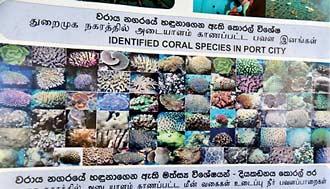
Reply To:
Name - Reply Comment
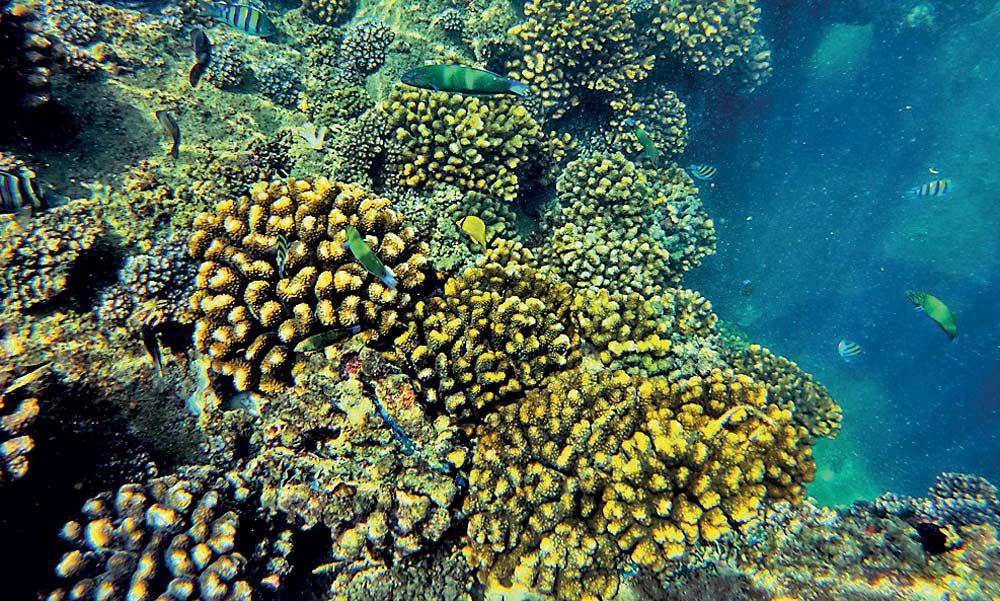
The rapidly developing coral reef at the Colombo Port City is now home to an abundance of marine species (Underwater images courtesy - CWDRC)
Colombo Port City’s latest attraction is a naturally occurring coral colony that’s growing rapidly around its breakwater. Coral reefs are vital ecosystems that support nearly a quarter of marine life while also protecting coastlines. But coral reefs are also vulnerable to adverse climate change events such as ocean acidification which results in coral bleaching. However, in a bid to preserve the already identified corals and marine species at this habitat, the staff and volunteers at the Coral Wall Diving and Research Centre, under the leadership of its Founder/Executive Director Admiral (Retd.) Piyal De Silva have already initiated their efforts in championing coral reef conservation in this area.
Initial steps
The coral colony was initially identified by De Silva when he arrived at the venue back in 2019 for a dive outside the breakwater. Upon discovering this marvel, De Silva made it his responsibility to preserve this naturally occurring coral colony. “Back in 2019 they were in the process of reclaiming the land and completing the breakwater,” said De Silva in an interview with the Daily Mirror.
On the day he discovered the corals, De Silva had come to dive at the Astoria Shipwreck. But due to a mistake in locating transit bearings, which are usually obtained from land objects, he couldn’t locate the shipwreck. “At sea, even a small change makes a big difference. So I decided to swim along the breakwater and at the time the breakwater was new. While swimming I realised corals emerging on almost every boulder. Immediately I realised that it would one day become a fully fledged coral colony. Then I thought I should do a research on how corals would grow here, what kind of corals would be adaptable to climate change and other details,” he continued.
As a former Admiral and Commander of Sri Lanka Navy, De Silva has been a passionate marine environment conservationist from his early days. Thereafter he met with the senior management of Colombo Port City to explain why they should be preserving this valuable resource. He had advised the management to avoid pumping sand into this area and the response had been positive. Subsequently, while conducting a practice every day, De Silva had noticed certain developments in the corals. “Gradually the corals grew fast and most areas were covered with corals. But I also noticed that some corals would break lose and fall off due to human and natural factors,” he added.
Due to frequent fishing activities at the time, De Silva observed how fishing rods would get entangled in corals causing them to break off. Some corals that grew on the edges of boulders would break lose since the boulders couldn’t sustain the weight. An abundance of plastics and coral bleaching were additional threats. De Silva also identified corals that had experienced a huge weight, such as when someone had stepped on them. When canoes moved towards the breakwater people would push back using their oars and in most instances the oars are placed on corals. Ghost nets were another threat to the sustainability of corals.
Birth of Coral Wall Diving and Research Centre
Having identified all these threats that posed a challenge to the sustainability of the coral reef, De Silva realised that there needs to be a continuous patrolling of the location. In addition there had to be a strategy to ensure more corals were being planted to maintain the marine habitat.
He recalled how the Port City management supported him in providing the racks on which he could plant corals. “We had different types of racks because I wanted to try different methods. So I planted different corals and they were collected from different depths, just to understand which corals would survive here. Along with corals, algae also grows parallel. We had to grow and clean them periodically and it was a tougher task than planting corals. Once the corals grow well there’s no chance for algae to grow on nurseries. The fish come to feed on the algae,” De Silva explained.
Eventually many species of fish made this stretch of sea near the Colombo Port City as their home territory.
But even though De Silva was driven by a passion to ‘give a life to the corals that were breaking away’ in his own words, there were limited facilities to support their effort. “Those days we used to come by vehicle, bring equipment from home, get into our diving gear, then come back to the shore and use whatever pipeline available to have a shower and then go home,” he recalled.
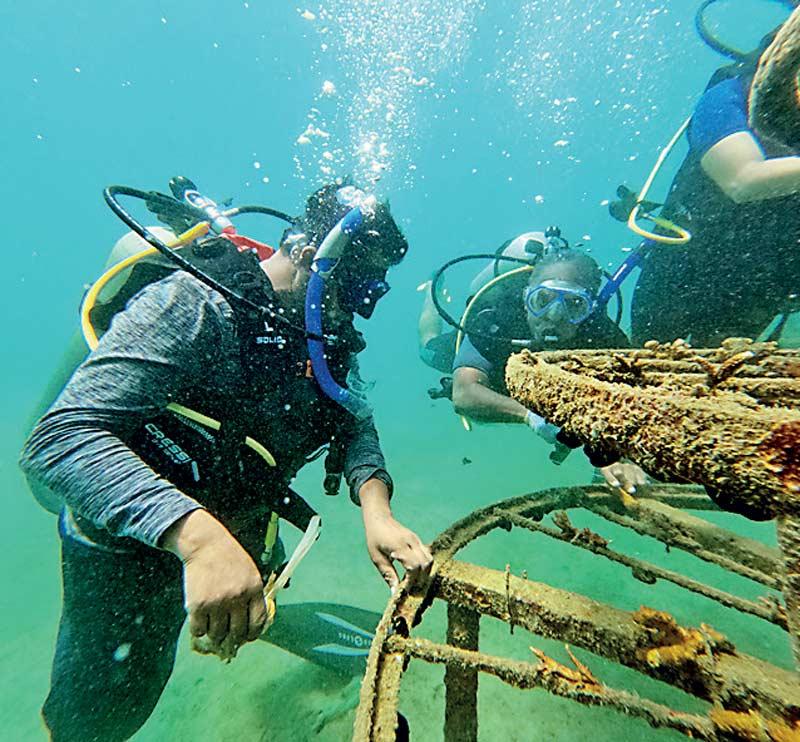
Instructor demonstrating coral planting
This was when he submitted a project proposal to the Port City management, requesting for a suitable place him to establish a diving Centre so that the corals could be properly managed. “In the proposal I recommended getting assistance from scientists, either from Sri Lanka or China. Within few days 12 scientists came and they showed a keen interest in carrying out the studies. They too never expected this water body to be in this shape. All 12 scientists dived and one of the leading scientists, who is a female, suggested that the types of corals and fish in this area should be identified. As a result, they identified 133 species of fish and 75 coral types,” he added.
|
Types of coral species identified at Port City Pix by Kithsiri De Mel |
In the same proposal De Silva had also stressed on the importance of a having a station for people to engage in diving, clean the area and engage in these activities. That was when he got the opportunity to setup the diving centre which has become one of the best diving facilities in the country as of today. The interiors of the diving centre have been designed according to the Reduce, Reuse, Recycle and Up-cycle concept. With railway sleepers on the floor, recyclable materials as partitions, up-cycled furniture and lights from ships that were sent to Bangladesh for scrap metal, De Silva has strictly adhered to a sustainability concept. In its exterior, De Silva envisions to grow a model rainforest-like experience with outdoor showers covered in natural creepers and an outdoor classroom where visitors and children can learn the importance of coral reef conservation.
“When we established this Centre we wanted to fulfill four objectives,” he continued. “One is protecting and conserving the marine environment. Another one is to encourage scuba divers to come and dive with us. The third objective is to support scientists who come here to engage in research and scientific studies and the fourth is to educate children who visit Port City on their educational tours. We have some of the latest equipment for diving and we can accommodate at least 12 divers at a time. We have underwater drones for anyone interested in viewing corals from the shore,” De Silva explained.
De Silva expressed gratitude to his friend Jagath Peththawadu, who had provided him with the finances without any hesitation to establish the diving Centre. “Now we have a fully-fledged diving Centre recognised by PADI Australia. We have all the facilities to conduct basic courses and workshops for organisations. Recently we invited MEPA, Coastguard Department, Wildlife Conservation Department to attend a workshop conducted by us. There is also an Organisation designated for the protection of the ocean and to ensure its well-being and good health. It comes under the UN and they have a project called UN Decade of Ocean Sciences. I was invited to take care of this region and to conduct programmes for youth. We like to encourage more volunteers to learn diving and engage in these activities,” he further said.
Persisting environmental challenges
Certain challenges such as global warming goes beyond the control of humans. De Silva further explained the impact of global warming on coral reef ecosystems. “Once the temperature rises in this area, the near surface temperature also rises. That causes a serious impact to coral reefs. We had one of the best growth of corals some time back, but it disappeared due to the accumulation of warm water. Fortunately we took couple of pieces of these corals and replanted them and now they are growing. I have followed a Japanese model in replanting some corals using vases. Now these places have become coral habitats and a beautiful underwater attraction,” he added.
De Silva also observes a lot of plastics coming into the area, many of which are land-based plastics. “It is not a healthy situation and if we allow this to happen for a long period, this area will become a plastic polluted area and it may become a giant plastic patch. If a giant plastic patch emerges and bacteria develops under this patch it would attract fish. The fish would also feed on micro plastics and the damage is irreversible. If global warming takes place and the temperature continues to rise, it would cause a big damage to corals,” De Silva underscored.
Protecting the rainforests of the ocean
Coral reefs are called the rainforests of the ocean and are important to maintain the biodiversity. When asked why it is important to protect and preserve coral reefs, De Silva said that without corals the marine life is not healthy and in turn life on land would also be in danger. “Much of the carbon dioxide we emit gets dissolved in the atmosphere and from that air around 30% is dissolved in the ocean. Corals require carbon dioxide and then produce calcium carbonate. If carbon dioxide is not absorbed by sea grass, corals or mangroves then ocean acidification would take place. But corals do a great service where it prevents ocean acidification. If ocean acidification takes place we will not have a healthy ocean here. In addition, 25% of marine life usually live with corals. Healthy coral reefs would attract fish as well as tourists. A lot of fish are being bred and they benefit the fishermen outside. Expansion of ecosystems is another priority under the UN Decade of Ocean Sciences and we are looking at expanding the coral and fishery ecosystems. The fishery ecosystem is developing day by day,” he added.
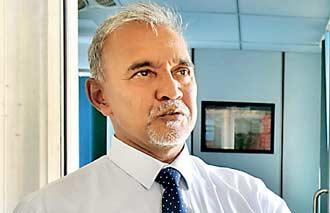
 Now we have a fully-fledged diving Centre recognised by PADI Australia. We have all the facilities to conduct basic courses and workshops for organisations. Recently we invited MEPA, Coastguard Department, Wildlife Conservation Department to attend a workshop conducted by us”
- Admiral (Retd.) Piyal De Silva, Founder/Executive Director, Coral Wall Diving and Research Centre
But whenever De Silva and members of his staff go for a dive, they are in the habit of carrying a catch bag to gather all plastics and remove any ghost nets in the seabed. This is done on a regular basis and they have also organised a plastic collection programme with the assistance from volunteers. If you are not a diver then you are being given a life jacket and a qualified diver to assist you. Therefore, whether you can swim or not is irrelevant and all that matters is the passion and motivation to keep the coral reef ecosystem healthy. Visitors are encouraged to explore this beautiful attraction during weekends. But De Silva said that most foreigners love to come there on weekdays as well. The diving Centre is open from 7.00am to 4.00pm, but De Silva recommends morning hours between 7.00am and 9.00am as the best time for a dive due to there being good visibility, no currents and less chances of getting a sun burn!
| For more information on volunteer opportunities visit https://coral-wall.com/ |