 SUSITHA FERNANDO
Reply To:
Name - Reply Comment
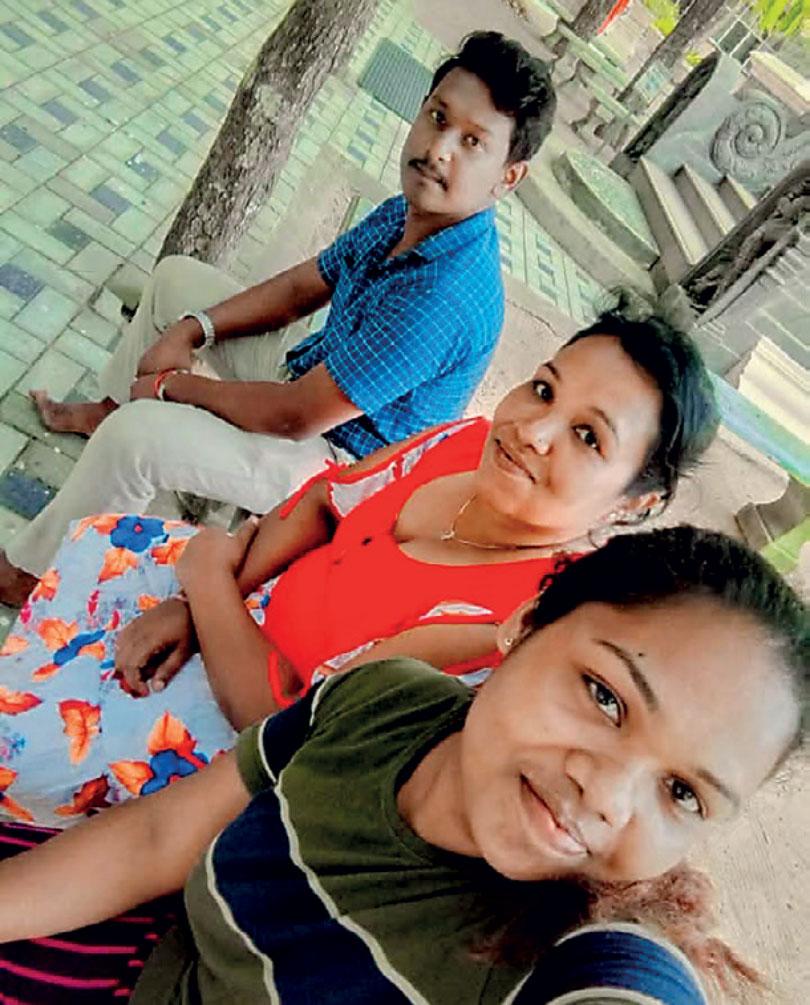
Sneha with her mother Chandani Hettiarachchi and husband Krishan
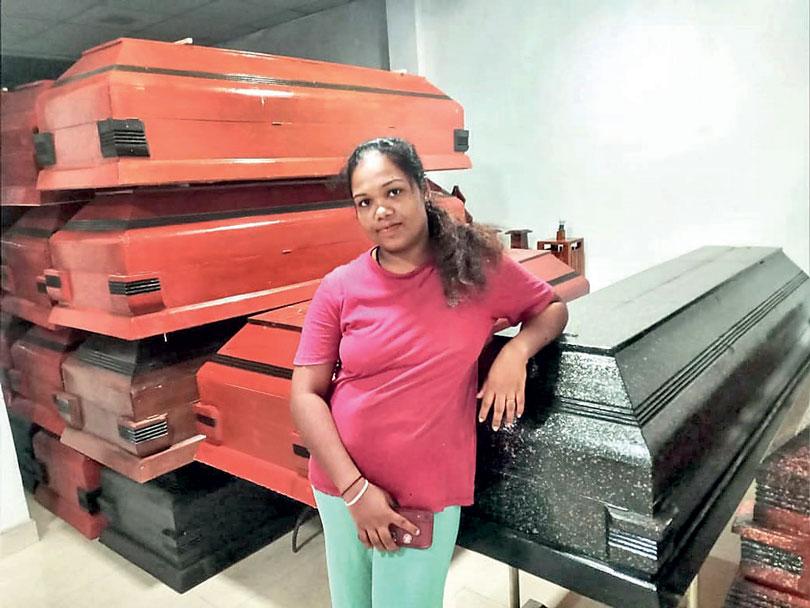
Sneha is the only female embalmer in Sri lanka
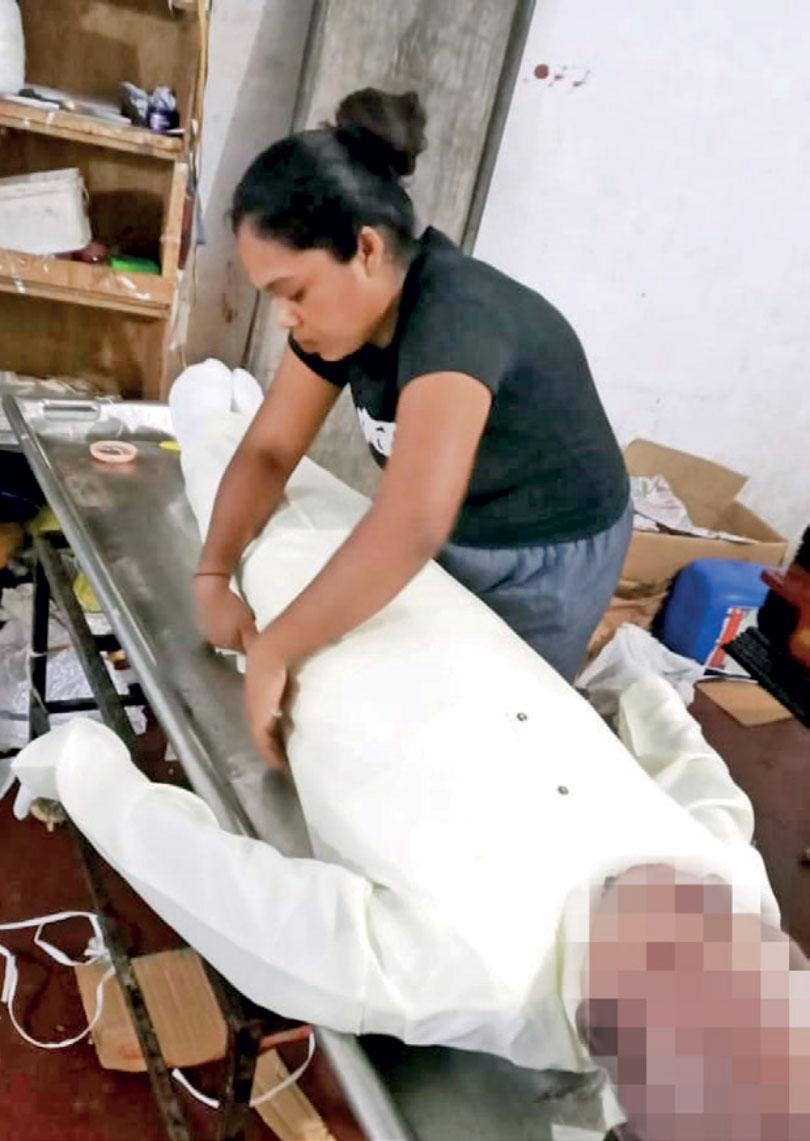
Putting the final touches on a body
Over the years, the young mortician has realised the bitter reality of this world and its follies and vanities, specially regarding those rich and powerful. “I have come across so..so.. many dead bodies of elderly parents whose children are extremely rich. Sometimes, their pampers have not been changed for weeks and months no one has attended to their cleanliness. They had been isolated in backyards of houses, storerooms and attic rooms. Sometimes, I can’t bear the smell even with the betel I use. But once a parent is dead, the children demand to have the most beautiful corpse and order the most expensive coffins, and fill itwith fresh flowers,” she says with a grin
Some occupations, professions and jobs are decided by gender. But there are some male-dominated jobs even males find too hard to handle. Many men find dealing with the dead to be a somewhat scary and abhorrent task. But 19-year-old Sneha Udyani Nethra Kumari from Giriulla off Kuliyapitiya has taken up embalming as her profession. Going beyond just embalming the dead, young Sneha has made a name as a beautician of corpses. Though there are thousands of women who take up the job of beatifying living people, we would hardly come across someone like Sneha who is dedicated to beautifying the dead.
The month of March, dedicated to women with the International Women’s Day celebrated on March 8, is an appropriate time to highlight the dedication and the courage of women like Sneha. Her choice of profession makes her extraordinary because, for many it is dismal and depressing to talk about the dead and how their bodies are dealt with.
“I used to visit funeral parlors from the age of eight. My father Sanjeewa Kumara (40), whose job is embalming, used to pick me from school and keep me at the office of the funeral parlour until he finished his work. The people there used to be very kind and friendly. One day, the owner of the parlour told me that if I am not scared, I could have a look at what my father was doing; and in case if I could learn it, it would be immensely helpful. That was when I was 13 years and I was watching what my father was doing from a distance; I didn’t feel scared at all,” says Sneha, describing her first embalming experience.
“Since then, I wanted to join my father whenever he’s doing his job; initially, he was dead against it. But due to my insistence, he allowed me to accompany him when I reached age fifteen.”
“I have been observing how my father does his work, and was secretly learning by watching him. One day, I told him to teach me how to do the ‘packing’- the polythene wrapping done on a corpse before dressing it. Since there was no dead body available, I practised it on my father who always has with him a set of items used for embalming,” said Sneha, Sri Lanka’s one and only female embalmer at present.
Her first embalming job
“It was at the age of 16 that I did my first embalming job,and it was on a Buddhist monk, One, day my father was sleeping after a drink and the corpse of the monk was waiting to be completed. As it was getting late, the owner of the parlour asked whether I could do it which I was glad to do,” says Sneha with gleaming eyes.
“Now my father performs a set of rituals when he gets a monk’s body for embalming -- first, he would worship the body and request permission from the spirit, saying: “This is my job and if I commit any sin by touching your body, please forgive me”.
“I did the same before carrying out the embalming. And I have never draped a body with a robe, but I did it to the best of my ability”.
“When my father woke up and got ready to do the embalming, he found that the body had gone missing. By that time, I dressed up as a boy and accompanied the parlour owner to handover the body in its coffin. My father was so upset and scared that something might go wrong with my very first embalming job because the body was to be kept for four days before the cremation. I could remember he would make several visits to the temple where the funeral was taking place and check whether the body was Ok; finally, he said that I had done a good job”.
However, to be born to a family of undertakers -- her mother is involved in making the dresses for the dead and doing flower arrangements – has sometimes been a depressing experience for Sneha.
“I felt that, wherever I went, my family and I were cornered and insulted because of what we did for a living. In the village, and even in my school, I didn’t have many friends and I was always isolated. Some parents didn’t allow their children to be with me saying that my parents are dealing with dead bodies and we were therefore unhygienic.
“Some said I smelled corpses. At school, my desk was kept at a distance from the others,” young Sneha lamented.
Having seen dissection, or opening up bodies for embalming , Sneha began dreaming of being a coroner.
“Having seen embalming, and the work of an undertaker throughout my life, I was determined to go to university and become a coroner one day. But that dream slowly faded away as I was bullied both by children and sometimes even by teachers in the school. The amount of bullying was so bad, it was like I was carrying a heavy load on my head,”she added.
“Once a month, every family had to bring breakfast to the class; but I was never given that option.”
“I disliked the school so much I used to keep my eyes downcast whenever entering it. Even the prefect would not bother to check my bag as if it was highly infectious. Sometimes, I was asked to stand outside the class room for no reason. If there was some stain on my uniform even accidently, I would be bullied or scolded for coming with bloodstains of the dead,” Sneha said with a sigh.
“As my father used to take me to the funeral parlour where he works, school principals scolded my parents,” Sneha added. ““I felt very sad as my parents got scolded because of me. Gradually, I lost interest in school and my education and therefore I stopped going to school. Even when I stopped, nobody bothered to ask me why I stopped and it was as if they were waiting for that. However, on the day I went to collect my birth certificate from the school, the school principal, a religious nun, seemed to have realised the wrong that was done to me, and spoke apologetically.
“Puthe Sneha, now only I realised the importance of your job. If not for people like you, dead bodies would pile up and it would be a terrible problem,” the Principal told me. When I heard the principal herself saying that, I was surprised and elated. It was a great relief to me and I worshipped her.
Mortician vs Beautician
Having done nearly 60 to 70 embalming jobs so far, Sneha is now a seasoned embalmer. In addition, she has made a name for her restorative art, which is a specialised branch of mortuary science focused on reconstructing, rebuilding, and repairing human remains disfigured due to various reasons.
Sometimes she gets special requests to handle bodies damaged by accidents because of her expertise in restoring the person’s looks as much as possible to what they were prior to death.
“One day, I got the body of a girl who died after falling from a building. When I saw it, how the face was totally distorted, I got so upset that I immediately sat on the ground. I was given her photograph. I didn’t have much equipment and cosmetics, but managed to make a foundation using a flour to do the repair. The family was glad see the final result.”
Sneha has mastered the make up techniques by watching You Tube videos by Indian and Chinese beauticians, and from other websites. Though make-up artistes and beauticians use expensive cosmetics, Sneha has managed to replace them with non-expensive, sometimes experimental alternatives home-made ‘beauty products’ of her own.
“Even though I hardly use make up, I make sure that the bodies of ladies sent to me get a good overall appearance,” Sneha says with conviction.
Ensure the rights and respect of women
As the embalming is a hundred percent male dominated job, Sneha is well aware about its obscure and darker side.
“At present, embalming of both males and female ares done by males. Some men do it under the influence of liquor. Sometimes, some of them could not be trusted. Initially, when I started this job, I had to undergo severe criticism and face insults. Some people even made up stories about me; but now they have realised that my service is indispensable, especially when it comes embalming female bodies. As a result, I am now being specifically asked to do embalming of female bodies”.
Sneha says that it is important that we maintain the respect of women whether they are young or old.
“As a woman, whenever I get a female body, I make it sure that the respect of that woman is maintained even if she’s dead. I always keep the body covered even during my work.”
However, over the years she has noticed the darker side of the trade where men with lurid and morbid interests gather whenever there is a female body in an embalming room. When my father is embalming a woman’s body, he would not allow anyone to hang around there.
“Sometimes, I see that some men claiming to be relatives want to see the body; but I would not allow them in until my job is done and the corpse is completely dressed up. When we respond firmly like that, I was often scolded by these men. I get a lot of temporary work in Colombo as some families want me to handle the bodies of deceased family members. I am also known for my expertise in beautifying the dead, specially those disfigured due to bad accidents. Sometimes, when I do a good job and hand over a pleasing body, I get an extra payment. I usually get around Rs. 5000 for normal embalming but I get Rs. 7500 for bodies that come after postmortem, and Rs. 10,000 for extremely rotten bodies like those drowned in water.
“Sometimes, when I get bodies that are completely disfigured due to accidents, the family members asked me to give a rate. I’m invited to work in some well-known funeral parlours. Sometimes, people have requested my services”.
Life partner
Her husband Krishan Dhanushka too, is working at a funeral parlour. He is not an embalmer but makes coffins, flower arrangement and drives a hearse. Earlier, he worked in the police department, but gave it up.
“I actually met him at a funeral parlour where I accompanied my father,” said Sneha. “He was doing the bar set (metal design around the coffin) and my father left me there and went to the embalming room. While I was waiting, I saw him doing his work and got interested in him. With great difficulty, and without getting noticed by my father, I wrote in a piece of paper: “I Like you, ” and dropped it there. He collected it and said that he would let me know later.
“Days later, I got the happiest news in my life when he said ‘yes’. But there were many obstacles as my parents, especially my father, didn’t like him and even his family didn’t like me because I was not an ‘ordinary or traditional girl.’ My father didn’t like him because he was poor. He was so poor that when his father died in an accident, there was no money for funeral, and they had to sell the only piece of land they were living in to do the final rites. However, I waited, and had to run away from home and hide in my elder brother’s home until I reach 18 years, the marriageable age. On the very day of my 18th Birthday, on January 2, 2007, I got married to my soul mate,” Sneha giggles.
“ Though even today my father doesn’t show his approval, we live happily together, and he protects me and is always ready to support my job. He would wake up at any time of the night as sometime I get work in the middle of the night. He would get up and go with me and wait at the door of the embalming room until I finish my job and then take me back home. He has to go to his job early morning, if not he would lose that day’s work which he doesn’t want to do.
“Though my father was against me marrying someone working at a funeral parlour, he too, got married to my mother whose family occupation was undertaking. My uncles have their own funeral parlours, and my mother used to sew and prepare clothes for the dead and do the coffin decorations.
In my parent’s case, unlike me, it was my father who first got interested in my mother Chandani Hettiarachchi. He went after my mother and proposed,” giggles Sneha heartily.
But Sneha says it’s very hard to bear the deaths of children no matter how mentally strong one may be.
“Even though I don’t have children, I find it hard to touch the body of a child. Even though I am not yet a mother, that breaks my heart. Not only me, even my husband doesn’t want to deal with the deaths of children, and he takes an off if he knows he has to deal with a death of a child. Once in Chilaw, while my father and I were working in a funeral parlour, a small bag was brought. I thought it contained some edibles, and my father asked me to bring it. I handed it over to him and soon I felt the smell of formalin; then only I realised it was dead body of a still born baby. The worst was, the mother of the child who had gone through a caesarian operation was crying from the upper floor of the hospital, as she could not have her baby. That day both my father and I were so upset, we returned home , and boss cut our salaries as well.
“I cannot do an embalming job of a child; even if I do, won’t charge for it because I can’t accept money doing that,” said Sneha referring to one funeral parlor in Chilaw which doesn’t charge for embalming children’s bodies.
Financial expert
After all the hard work, the young couple’s life has been not so happy financially. Yet Sneha meticulously manages whatever little she and her husband earn, and they make it a point not to give up any work that comes their way. “
“Every day, I divide the money we earn,” Sneha says. “Sometimes, we get Rs. 3000 and I divide it as Rs. 1000 for house rent, Rs. 500 for food, transport, fuel for the motorcycle, and another part to realise our dream of doing our own undertaking business. As life is hard, we won’t give up any work that come our way.”
Asked whether she is aware that the job of a mortician is also a field of study which offers degrees, she responded positively. “Once I was offered help by a Madam at Raymond funeral parlour. But I need to have a license to get a degree and I don’t have it; I need my own funeral parlour to get one”.
Over the years, the young mortician has realised the bitter reality of this world and its follies and vanities, specially regarding those rich and powerful. “I have come across so..so.. many dead bodies of elderly parents whose children are extremely rich. Sometimes, their pampers have not been changed for weeks and months no one has attended to their cleanliness. They had been isolated in backyards of houses, storerooms and attic rooms. Sometimes, I can’t bear the smell even with the betel I use. But once a parent is dead, the children demand to have the most beautiful corpse and order the most expensive coffins, and fill it with fresh flowers,” she says with a grin.
Questioned as to how she managed during the time of corona, she says with a laugh that she got the chance to go around the country to do the embalming with a special pass. “Neither me nor my father got infected, but all the others in my family got it and they were even quarantined. My father used to say that we get infected with diseases only when we get scared of them. Otherwise nothing to worry about any disease”.
“Even though our job is indispensable and one day, our bodies too, would end up in a funeral parlour, we are being treated as worse than dust. One day I accompanied my father to a house, and my father badly wanted some water as he started coughing. So I rushed and asked for some water from a lady in the house. She brought it and my father quickly emptied the glass. But when I handed over the empty glass the lady threw it to a nearby shrub, as if she had touched the dirtiest object in this world. My father too, got so upset that he cried. Since then, I would make a point to take two bottles of water wherever we go, and would never ask for water from anyone.
Dream of her own funeral parlour
Sneha’s one and only dream is to open her own funeral parlour.
“I want to open my own funeral parlour, and I want to get my father to sit in a revolving chair while I handle the work. Despite all the humiliation they went through, I want to bring my parents to a respectable place and show the people who looked down on them what we have achieved,” Sneha said. “Over the last few years, I have handled various types of dead bodies, old, young, sometimes decomposed corpses, and some bodies beaten to death; sometimes I find it hard to see them, and there are instances where I have cried in the embalming room. I appeal and plead to people -- look after your parents when they are alive and give them the best you can. You will never know when you can do it.
“I can see most people are scared of the dead, but what I have realised is that we should be scared of those alive, not the dead. And If you want to see the reality of life, you must visit an embalm rooming ,” Sneha shared the bitter experience and hard philosophy she had learnt so young.
Sneha could be reached via 0741746917 or 0777786917
The writer could be contacted on [email protected]