 Kamanthi Wickramasinghe
 Reply To:
Name - Reply Comment
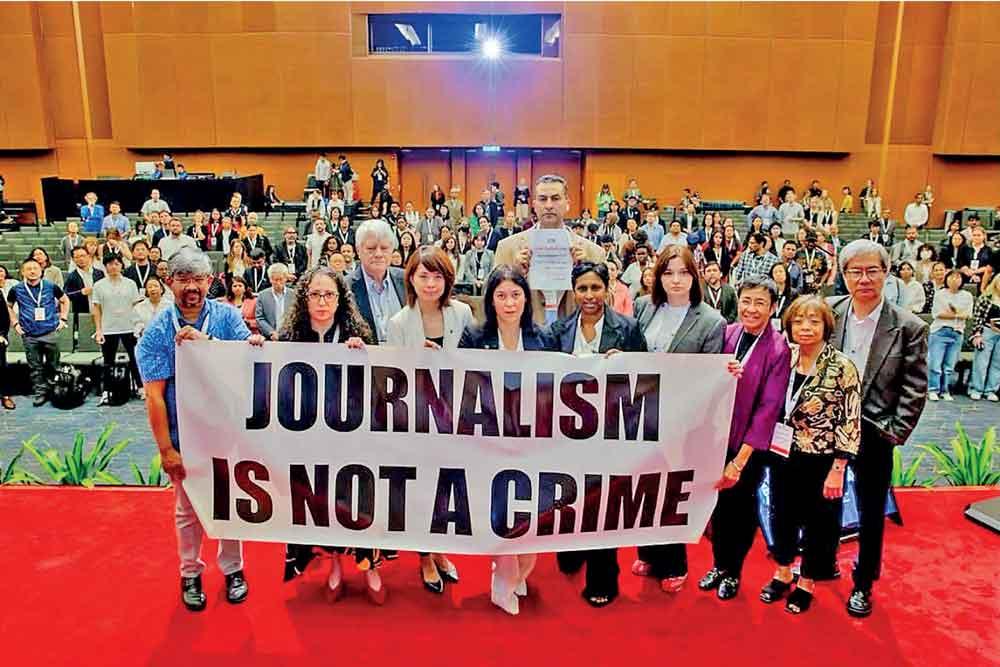
Ressa posing for a photograph to express solidarity with journalists under attack worldwide
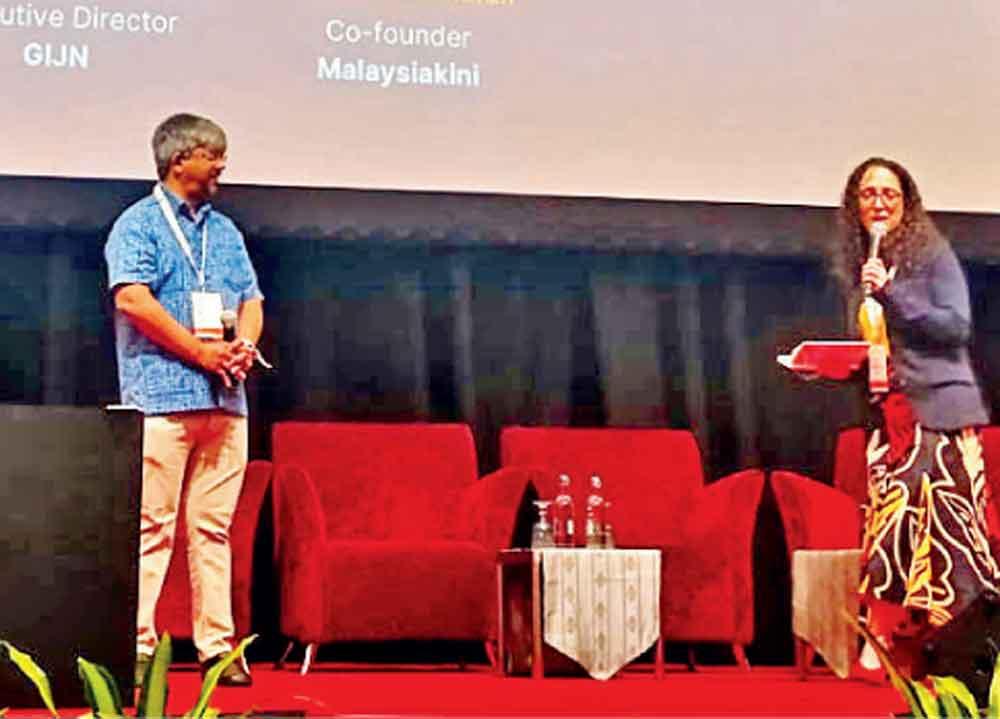
Pramesh Chandran (left) and Emilia Díaz-Struck speaking at GIJC 2025.
Photo credit : Suzanne Lee/Alt Studio
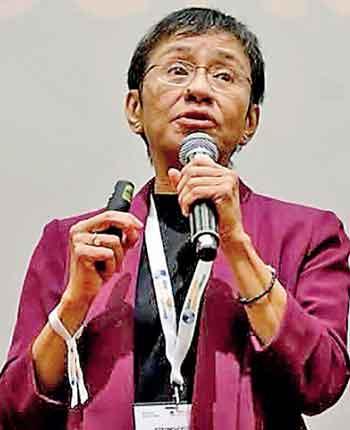 |
| Maria Ressa delivering her keynote speech |
The 14th Global Investigative Journalism Conference (GIJC) co-hosted by the Global Investigative Journalism Network and Malaysiakini kicked off at Kuala Lumpur Convention Centre with the participation of over 1500 attendees from 135 countries.
Known to be the world’s largest international gathering of investigative journalists, this year’s conference included several eye-opening sessions on various topics from crime and corruption to war crime reporting, environmental investigations, data journalism and new focus areas such as ethnographic journalism, AI tools, platforms for journalists in exile and so on.
A Call for Radical Collaboration
The keynote speaker for this year’s event was Maria Ressa, 2021 Nobel Peace Prize laureate and co-founder of the pioneering investigative reporting outlet ‘Rappler’. During her keynote speech, her key message for the investigative journalists community was to embrace ‘radical collaboration’ and use the crisis as an opportunity for impact and survival.
Drawing examples from her own personal experience of persecution in the Philippines, Ressa showed how her commitment to hold powerful actors accountable even amidst repression could lead to sustainable revenue and justice. Her presentation included the extent of online harassment she faced as a result of her investigative reporting.
“I had 11 arrest warrants in 2019 and that was the year Rappler became profitable,” she said while adding that arrests of newsroom leaders was not exactly a sustainable business model for others to emulate. However, Rappler’s journey of making profits is an example of how audiences could rally around a courageous press.
Referring to the arrest of Rodrigo Duterte, the former president of the Philippines, Ressa explained why she remains optimistic about the future of investigative journalism. “I want to tell you why I remain optimistic, why I think we can do this. It’s because the man who tried to jail me and close Rappler down was arrested in March this year, and he’s now at The Hague for crimes against humanity. So if you keep doing your jobs and collaborate together, impunity ends,” she added.
In her speech, she didn’t forget to mention about several existential threats currently faced by the media and civil society today. “This is the deadliest year for journalists — 250 killed in Gaza alone,” she noted.
She also warned that 2026 could present a crucial, one-year window for many independent newsrooms to secure their rights, their partnerships, and their new sustainability models.
“The best advice we in the Philippines can give to those Western countries is: you fight now, when you still have your rights, because those rights will decrease, and clawing them back later on is near impossible,” she warned.
Growing kleptocracy
Ressa also referred to growing kleptocracy around the world, fuelled by the normalisation of lies through feedback loops amplified by decentralised networks of influencers and reinforced by platforms that reward emotionally charged content.
She underscored the fact that reporters should also investigate and expose the epidemic of online harassment of women journalists, and those who enable it. Ressa pointed out that 73% of women journalists experience online abuse, and 25% receive threats of physical violence — some of which transform into physical harm.
“My dream is a global federation of news organisations. I think we can do it — the code is there already. All we have to do is work together while we still have strength. Otherwise, we will be depleted — and I think we only have a year,” she said in her concluding remarks.
Ressa also joined in a moment of solidarity with journalists under attack worldwide, organised in partnership with the Committee to Protect Journalists.
A Global Movement
Speaking at the event, GIJN Executive Director Emilia Días-Struck said that this year, the organisers were able to increase the presence of colleagues and speakers. “We have doubled our speakers from Africa, MENA and Latin America, and tripled speakers from Asia, while keeping the representation from all other regions. We are a global movement and more voices means that the movement has grown. More voices means that, despite all these challenges that we are facing -- democracy going backwards, wars, more journalists in exile -- despite all that, we are alive, we are resilient and we are doing the investigative journalism that is key for society, holding powers accountable,” she added.
Having received over 500 proposals for panels and sessions, she said that it was proof that investigative journalism was more alive than ever. “We were inspired because we found traditional voices that have inspired us all these years, and we also found many new voices, great journalists doing amazing work in their countries,” she added.
With over 150 sessions around sustainability, war crimes, AI, technology, climate, reporting from exile, crime and corruption, and with over 50 workshops on various topics, involving close to 400 speakers from nearly 100 countries and territories speaking and sharing their knowledge, plus over 1500 attendees, this year’s conference was a resounding success. In addition, nearly 130 journalists from over 80 countries received fellowships to attend the GIJC 2025 and a majority of them were first timers.
Forming collaborations
The event also witnessed various collaborations and networks being formed to broaden the scope of investigative journalism across the globe. Indigenous journalists launched the Indigenous Journalists Association aiming to gather and strengthen all indigenous journalists from around the world with the same vein and spirit as GIJN. Other collaborations such as the initiation of a collective for South Asian journalists was discussed.
In fact, the conference explored possibilities of cross-border collaborations among journalists which was a main highlight in several panel discussions. Speakers discussed possibilities of collaborating with journalists from different regions, tips for finance models, funding newsrooms, writing grant proposals and how such collaborations would present more effective news reports.