Reply To:
Name - Reply Comment
By Dr Kenneth De Zilwa, Global Business Cycle Analyst
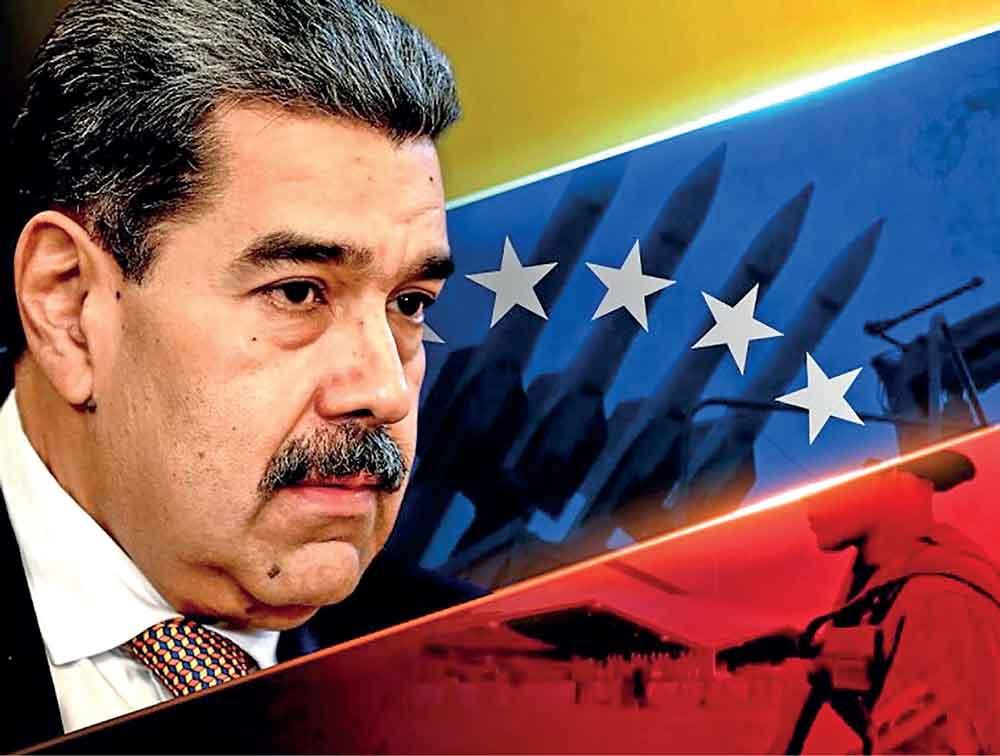
The capture of President Nicolás Maduro signals a violent evolution in global power dynamics. By weaponizing the “Narco-Democracy” framework, the United States has bypassed the traditional constraints of the UN Charter, replacing international law with a doctrine of criminal indictment and maritime blockade. Beneath this moral veneer lies a brutal strategic calculus
The capture of Venezuelan President Nicolás Maduro by US special forces marks not just a dramatic escalation of a long-standing conflict, but the culmination of a strategic shift from economic coercion to unilateral military intervention. For over two decades, the United States has applied escalating pressure on Venezuela, beginning with sanctions in 2005 and culminating in a full oil embargo and asset freezes by 2019. The public justification has consistently framed the Maduro government as an illegitimate “narco-terrorist” regime. However, this final military step has been explicitly condemned by United Nations leadership as a clear violation of international law.
In this context, a nation like Venezuela, possessing the world’s largest proven oil reserves and vast mineral wealth, becomes a focal point of systemic global competition and a battle ground for resources. Measures framed under doctrines such as “narco-democracy” can be interpreted as efforts to deny rival economic systems access to these resources, or to ensure they remain within a financial and geopolitical orbit amenable to traditional capitalists’ of the Global North. Therefore, the Global South’s pursuit of alternative partnerships, in turn, is a direct effort to assert sovereign control over natural endowments and to leverage them for industrial development within emerging multipolar networks.
From IMF Conditionality to Criminal Indictment: The Evolution of Coercion
For decades, the primary instrument for influencing resource-rich but capital-poor nations was conditional finance. Venezuela’s experience is archetypal. Between 1964 and 1996, the country entered 16 International Monetary Fund (IMF) programs, each demanding austerity and liberalization. The social consequences peaked in 1989 with the “Caracazo” riots, a violent public backlash against IMF-mandated reforms that left hundreds dead and shattered the political establishment’s legitimacy. A decisive break came in 2007 when Venezuela, under Hugo Chávez, prepaid its IMF debt to reclaim policy sovereignty. The Fund’s return to the Venezuelan story in 2019 was not as a lender, but as a politicized gatekeeper. Following the U.S. led recognition of opposition figure Juan Guaidó, the IMF’s Executive Board blocked the Venezuelan state from accessing $400 million in emergency reserve assets (SDRs), transforming the institution into an instrument of financial warfare. This paved the way for a more aggressive doctrinal shift by the USA. In March 2020, the U.S. Department of Justice indicted sitting President Nicolás Maduro and his inner circle on “narco-terrorism” charges, placing a $15 million bounty on his head. Unlike conditional loans, this “Narco-Democracy” framework does not negotiate policy changes; it criminalizes the state itself, providing a moral and legal pretext for comprehensive sanctions, asset seizures, and diplomatic isolation. “It’s the 21st-century version of the ‘civilizing mission,’” notes Dr. Elena Sandoval, a geopolitical economist at the Universidad Central. “The language of law enforcement replaces the language of empire, but the objective remains similar: to delegitimize a government and justify extreme measures to control or change it.” Former U.S. National Security Advisor John Bolton lent credence to this view, stating in 2019 that U.S. policy aimed to allow “American oil companies to invest in and produce the oil capabilities in Venezuela.”
The Core Objective: Controlling Resources in an “Asianizing” World
This coercive diplomacy unfolds within a far larger macroeconomic and strategic rebalancing: the competitive scramble for resources essential to modern manufacturing/Industrialization and an era of AI technology, that requires low-cost energy to power its International Data Centers (IDC’s). As the global economy enters a new long business cycle centered on AI Industrialization supremacy and energy transitions, control over critical minerals, hydrocarbons, and integrated supply chains has become a paramount strategic concern for the USA and its Tech businesses.
It is in this context, that a new and potent doctrine is reshaping the toolkit of international geopolitics with coercion and invasion as a base tool of choice, moving beyond traditional sanctions to a legally charged framework that analyst’s term “Narco-Democracy” and “Rule Based Global Order”. This construct, labels countries that does not heed or succumb to US demands as failed states or criminal enterprises and is the key emerging geopolitical weapon. Its deployment is occurring not in isolation, but within the defining macroeconomic shift of our era where global market share is shifting towards Asia, thereby increasing the intense global competition for mineral and energy resources that power modern manufacturing and the green transition. At the intersection of these trends lies Venezuela, a nation whose vast reserves have made it a focal point in the struggle between a receding unipolar order and an ascendant, multipolar “Asianization.”
Beneath the “narco-democracy” narrative, the strategic calculus appears directly tied to global economic realignment.
Venezuela holds the world’s largest proven oil reserves and significant mineral wealth. As the global economy enters a new cycle defined by the digital and green transitions, a process driven by Asian industrial power, control over these resources is paramount. US officials have openly connected the intervention to resource control. President Trump stated the US intended to “run Venezuela” and that US oil companies would modernize its infrastructure “to make money for the country”. Venezuelan officials argue the true target is clear, “It’s not drugs, it’s not security, it’s not freedom; it is oil, it’s the mines, it’s the land”.
This intervention disrupts the emerging multipolar order, often called “Asianization,” where Global South nations led by China, India, Russia and others along with resource suppliers such as Venezuela seek to build alternative financial settlement systems as well as trade systems. Initiatives like bilateral local currency i.e. CNY settlements, breakaway from SWIFT payments and the expansion of the BRICS bloc are designed to reduce dependency on Western-controlled financial systems, currencies and payment networks. Venezuela’s resources, if aligned with the de-dollarized systems, would significantly fuel the industrial and technological ambitions of US strategic competitors, particularly, China and India’s push for advanced “Industrialization 6.0” and the energy-intensive development of artificial intelligence.
Global South Reaction: A Unifying Breach of Sovereignty
The unilateral military action has triggered a powerful, unifying response from the Global South, centered on the inviolable principle of sovereignty and the UN Charter. The core legal objection is unanimous: Article 2(4) of the UN Charter prohibits the threat or use of force against the territorial integrity of any state. UN experts stress that enforcing unilateral sanctions through an armed blockade is itself an illegal “armed attack”. This creates a stark dichotomy, while the US may cite domestic legal precedents for extraterritorial enforcement, the international community sees a fundamental breach of the post-World War II legal order.
UN Secretary-General António Guterres stated the action “constitute[s] a dangerous precedent,” emphasizing that “the rules of international law have not been respected”. In December 2025, UN human rights experts were even more direct, denouncing the US maritime blockade of Venezuela as illegal armed aggression under the UN Charter and a crime under international law. The international debate now centers on whether this event represents a serious erosion of this rule, as unilateral military action for regime change without Security Council authorization is a clear violation of the UN Charter.
Concluding thoughts
The convergence of financial weaponry, legal pretexts, and resource competition defines a new and volatile phase of international relations. For nations of the Global South, the imperative is one of ‘strategic navigation’. The goal is to leverage resource endowments to build developmental partnerships that enhance, rather than diminish, sovereignty.
The case of Venezuela illustrates that the stakes have evolved. It is no longer merely about repayment conditions on a loan, but about the fundamental right to choose one’s economic partners and development path. The “Narco-Democracy” framing reveals that when a nation seeks to exercise that right outside prescribed boundaries of loan conditionalities, the tools of coercion and invasion will adapt.
The outcome of this struggle between the enforcement of a waning unipolarity and the disorderly rise of a multipolar, resource-conscious order will define the geopolitical economy of the coming decade. The long business cycle of Asianization is underway, and its course will be charted by who controls the material foundations of the future. The Venezuela invasion represents a pivotal moment. It demonstrates the willingness of countries with Nuclear weapons capability to bypass multilateral institutions and international law to achieve their own strategic economic objectives.
For the US, this may be framed as a necessary disruption to secure vital resources and counter rival powers. For the Global South and advocates of a rules-based order, it is a destabilizing precedent that validates their pursuit of de-dollarization, de-coupling of payment systems and strategic autonomy, and non-aligned partnerships. The incident accelerates the very fragmentation it may seek to prevent, pushing nations to deepen South-South cooperation and strengthen alternative structures to protect against future unilateral coercion. The long-term consequence may not be a restored unipolar order, but a more defiantly multipolar world, forged in reaction to the breach of its most fundamental rule.