Reply To:
Name - Reply Comment
 In Sri Lanka, we love sharing family moments and children’s photos on social media to celebrate milestones, stay connected, get likes and sometimes even earn through monetization earn some money.
Last few weeks our Facebook feeds, Instagram Reels, TikTok videos, and WhatsApp statuses were full of “child’s first day at school” photos, and people share private class images, school trips, kids pool day and family outing pictures.
While these posts capture pride and joy, there is a disturbing reality: digital predators can quietly collect, archive, and stalk children through the content you share so freely.
With latest technology and the rise of AI “Deepfakes” has turned a simple photo into a potential weapon. This isn’t 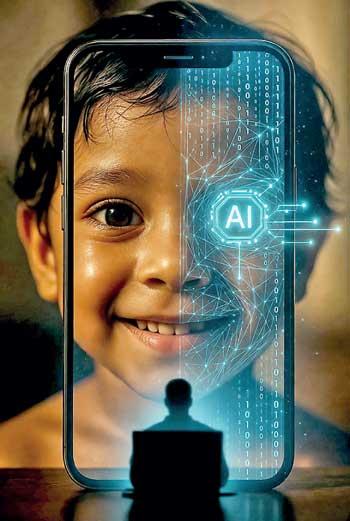 just a tech trend in the West; it is a clear and present danger to Sri Lankan families right now.
“In simple terms, a Deepfake is a video, photo, or audio that looks or sounds real but is actually fake, created using artificial intelligence (AI). It can make someone appear to say or do something they never did.” The “Nudify” Ecosystem: Darker Than You Think.
A recent investigation by WIRED (US) highlighted the terrifying scale of this issue, revealing an ecosystem of over 50 websites dedicated to creating explicit deepfakes. These aren’t just crude edits; they are high-definition, realistic videos.
As WIRED article noted, these platforms are often a “menu of horrors,” allowing users to transform a single, innocent photo into a sexualized video clip with just a couple of clicks.
For years, we’ve worried about “Photoshopping,” but AI has changed the game. It has automated the abuse. There are now Telegram bots and apps where anyone without any technical skill can “undress” a person or place them in degrading scenarios. It’s Not Just a “Girls’ Issue”
In our culture, the “shame” associated with such images often falls heavily on women and teen girls, leading to devastating social consequences. However, we must realize that boys and men are being targeted too. Whether it is for schoolyard bullying, workplace harassment, or “sextortion” (using fake images to blackmail victims for money), no one is immune.
In a small, interconnected society like Sri Lanka, where reputation is everything, the impact of a leakeddeepfake can destroy a life before the victim even realizes it’s fake.
 “In a future where deepfakes are commonplace, societies will face a critical double bind: genuine evidence will be questioned as synthetic, while deceptive content will circulate and be believed as truth” The “First Day of School” Trap - A Note to Parents
If you aren’t very digitally savvy, you might not realize that a single “My Child’s First Day at School” post is a goldmine for strangers.
This is called OSINT (Open-Source Intelligence) - where people collect publicly shared info to “connect the dots.”
From just one photo of your child in their shcool uniform, a stranger can learn the school’s name, your child’s grade, and even the specific class section.
They see the color of their school bag, shoes, hair style and water bottle, making it easy to identify them in the physical world. Worse yet, these photos often contain “metadata” hidden digital footprints that reveal your exact location, phone model and the time the photo was taken.
Keep in mind, you are not just sharing a memory, you are sharing a short map of your child’s life, with large amounts of data released into the public domain. The School Dilemma: Safeguarding or Social Media?
Many prestigious schools in Sri Lanka maintain active Facebook and Instagram pages, posting hundreds of photos of students daily with numerous activities. While intended to showcase school spirit, we have to ask: Is this safe anymore? Do you consent to this?
The Digital Footprint: We are creating a permanent digital trail for children before they are old enough to consent to it.
 The Source Material: Predators no longer need to follow a child home; they just need to scroll through a school’s photo album or your teacher’s social media page school albums to find high-quality images to feed into AI bots.
Leading by Example: If we tell children to be careful online, but schools and parents post their every move and daily life stories, we are sending a mixed message.
Some call the sudden urge to delete photos “panic.” In reality, it is a necessary realization. The internet has changed. Once an image is uploaded, you lose ownership of it and the platform becomes the owner of your content.
“In Sri Lanka, we frequently post “First Day at School” pictures, kids birthday photos, or wedding clicks on public social media profiles. For a predator, these are not just photos, they are the “source code” for abuse. One innocent profile picture is now all it takes to create a life-altering video. Modern AI can now generate a high-quality, 8-second explicit video using only one single photo of you.”
How to Protect Your Family
We don’t need to live in fear, but we do need to live with digital discipline.
Audit Your Privacy: Set your social media profiles to “Private” or “Friends Only.” Stop accepting requests from “strangers” who have mutual friends.
Think Before You Post: Ask yourself, “Could this photo be misused if it fell into the wrong hands?” If the answer is yes, keep it in the family gallery, not on the cloud.
Demand School Policies: Parents should engage with school media boards to discuss social media consent. Schools and teachers (private classes or public/private schools) should prioritize student safety over “likes” and marketing.
Understand the Law: While Sri Lanka is still catching up on specific AI legislation, harassment and the distribution of non-consensual explicit content remain crimes (Personal Data Protection Act and the Online Safety Act).
A New Digital Responsibility
As parents and educators in an AI-driven world, we face challenges no previous generation did.
The old rule of “don’t talk to strangers” is no longer enough. Today, we must safeguard our
children’s digital lives their photos, videos, their voice clips and personal data with the same care we take for their physical safety.
Every post, share, or upload can unintentionally reveal personal information. In the wrong hands, this data can have serious consequences. Our children’s dignity and safety are far more valuable than a “LIKE” on social media. It’s time we treat it that way.