Reply To:
Name - Reply Comment
 The international system we inhabit today is not an accident of history. It is the product of deliberate design, forged in the aftermath of the most destructive conflict humanity has ever known.
The Second World War was not merely a geopolitical rupture. It was a civilizational shock. It demonstrated, beyond dispute, that a world governed by unrestrained nationalism, militarism and the unchecked pursuit of power would inevitably descend into catastrophe. The response of the international community was not incremental reform, but a conscious and principled reordering of global conduct.
That reordering found its most authoritative expression in the United Nations Charter of 1945.
The Charter did something unprecedented. It sought to subject power itself to law.
Article 2(1) affirmed the sovereign equality of all states, large and small. This was a direct rejection of centuries of hierarchical international relations where influence dictated legitimacy. Article 2(3) required disputes to be settled by peaceful means. Most critically, Article 2(4) prohibited the threat or use of force against the territorial integrity or political independence of any state.
These provisions were not aspirational. They were corrective. They were designed to ensure that the tragedies of the early twentieth century would not be repeated.
The Charter did not eliminate power from international relations. It constrained it. It placed legal and moral limits on its exercise and, in doing so, redefined legitimacy in global affairs.
For nearly eight decades, despite undeniable inconsistencies, this framework has held.
It has prevented direct war between major powers. It has enabled decolonization and the emergence of sovereign states across Asia, Africa and beyond. It has provided smaller nations with a legal identity, a diplomatic voice and a measure of protection in an otherwise unequal world.
It has also created an expectation that conduct must be justified within a framework of law, even when that framework is strained.
For countries such as Sri Lanka, this order has not been theoretical. It has been foundational.
We are not a nation defined by military dominance or economic scale. Our security, our sovereignty and our strategic autonomy are closely tied to the strength of international law and the credibility of multilateral institutions.
Sri Lanka has therefore consistently aligned itself with the principles of the Charter, not as a matter of convenience but of conviction.
Our leadership within the Non-Aligned Movement was an assertion that independence of judgment could be preserved even amidst great power rivalry. Our role in advancing the 1971 United Nations General Assembly resolution declaring the Indian Ocean a Zone of Peace reflected a forward-looking commitment to preventing militarization in a region inhabited largely by developing states.
Our continued participation in United Nations peacekeeping operations and our advocacy for multilateral engagement demonstrate a consistent belief that dialogue must prevail over coercion.
In many respects, Sri Lanka has sought to punch above its weight not through force, but through principle.
It is precisely for this reason that current global trends are deeply concerning.
What we are witnessing is not the collapse of the Charter-based order, but its gradual circumvention.
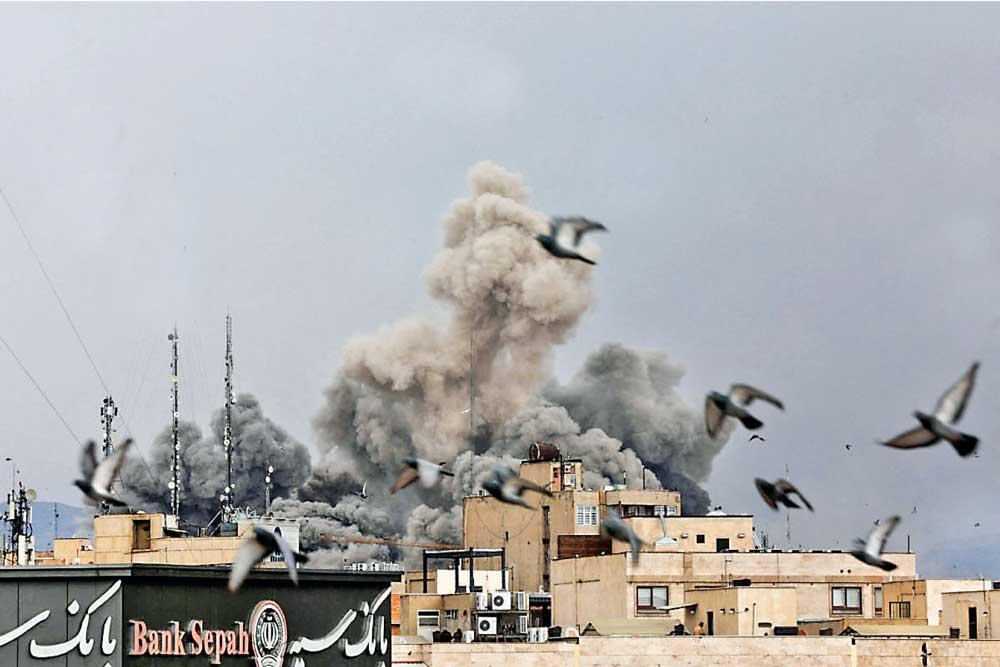
Recent developments in the Middle East illustrate this shift with troubling clarity. On 28 February 2026, the United States and Israel commenced coordinated military strikes against Iran, targeting strategic, military and infrastructure sites. These operations have continued through March, including attacks on key energy facilities and military installations, and have triggered a cycle of retaliation across the region.
The legal and normative implications of such actions have been widely debated. A number of international law experts and United Nations special procedure mandate holders have raised concerns regarding their compatibility with the prohibition on the use of force under the Charter.
The purpose here is not to adjudicate the merits of any particular conflict.
The concern is more fundamental.
When the use of force occurs outside the clear framework of the Charter, when sovereignty is overridden by unilateral determination, and when legal justifications are stretched beyond recognition, the integrity of the system itself is weakened.
This is how erosion begins.
Not through formal abandonment, but through selective application.
If the prohibition on the use of force can be diluted through repeated exception, it loses its normative force. If sovereignty is respected in some cases and disregarded in others, it ceases to function as a universal principle. If accountability depends on power rather than conduct, the system shifts from legal order to political expediency.
At that point, the distinction between a rules-based order and a power-based order begins to disappear.
What emerges in its place is not order, but hierarchy.
And beyond that lies something more dangerous.
A world in which law no longer constrains power does not become neutral. It reverts to something far more primitive. It becomes a system in which outcomes are determined by capability, pressure and influence. It becomes, in essence, a return to the law of the jungle.
In such a system, smaller states are not merely disadvantaged. They are exposed.
Sovereignty becomes conditional. Territorial integrity becomes uncertain. Strategic autonomy is eroded not through formal loss, but through constant pressure.
History offers a clear warning.
The early twentieth century was marked by economic interdependence, technological advancement and diplomatic engagement. Yet, in the absence of effective constraints on power, rivalries escalated and conflict became inevitable. The failure of collective security mechanisms led directly to global catastrophe.
The United Nations Charter was designed to prevent precisely this trajectory.
To weaken it now is to reopen that risk.
The stakes today are even higher.
Modern conflict is not geographically contained. It disrupts global energy markets, destabilizes supply chains and creates cascading economic consequences. It introduces risks that extend far beyond the immediate theatre of conflict.
At the same time, humanity faces challenges that cannot be addressed unilaterally. Climate change, pandemics, financial instability and the governance of emerging technologies all require cooperation anchored in trust and structured through multilateral frameworks.
Without such frameworks, these challenges become unmanageable.
How concerned should we be?
We should be sufficiently concerned to recognize that we are at an inflection point.
International orders rarely collapse suddenly. They decay gradually through tolerated exceptions, selective enforcement and the normalization of deviation.
The danger lies in the quiet acceptance of this process.
Yet this trajectory is not inevitable.
The United Nations Charter remains the most authoritative legal framework governing international relations. Its principles retain both legal validity and moral force.
What is required is reaffirmation.
Reaffirmation of sovereignty as a universal and non-negotiable principle.
Reaffirmation of the prohibition on the use of force as a binding legal rule.
Reaffirmation of multilateralism as a practical necessity for an interdependent world.
For Sri Lanka, the path forward is clear.
We must continue to stand firmly for a rules-based international order. We must deepen engagement with multilateral institutions and strengthen cooperation with states that share a commitment to principled conduct.
Our strength lies not in power, but in credibility.
We must continue to be what we have long been, a peace loving nation that believes in law over coercion, dialogue over confrontation and cooperation over conflict.
At the same time, major powers must recognize that the durability of the international system depends on their adherence to it. Power exercised without principle does not strengthen order. It undermines it.
The question before the international community is not whether power will shape international relations. It always has.
The question is whether power will be constrained by law, or whether law will be subordinated to power.
The twentieth century answered that question at immense human cost.
We would be unwise to test it again.
The writer is M. U. M. Ali Sabry, PC, former Minister of Justice, Finance and Foreign Affairs of Sri Lanka