 Kamanthi Wickramasinghe
 Reply To:
Name - Reply Comment
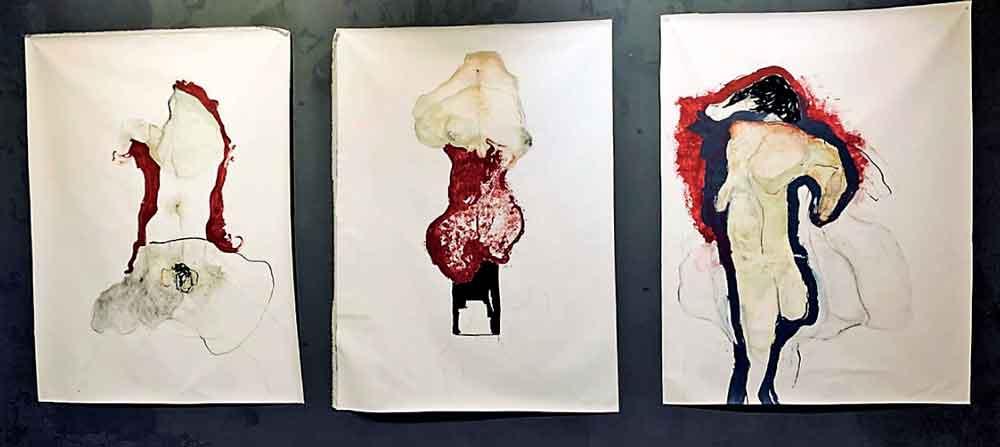
Some of the artworks on display
Fabienne’s work depicts human vulnerability. Since 2016, she has observed various social issues present in the country, from education to religious tolerance to the business of sex
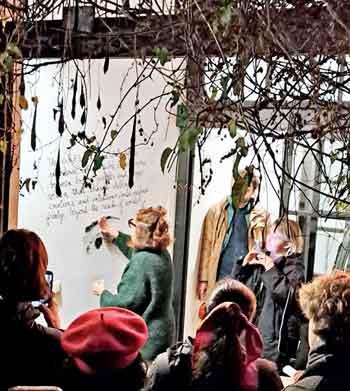 |
| Fabienne doing a live painting at the exhibition titled ‘We Don’t Need to Talk’ |
When Belgium-born artist Fabienne Francotte first came to Sri Lanka on a holiday in 2013, she had never imagined settling down in this destination. But three years later, she decides to call Sri Lanka home. From calligraphy to painting on canvas to exploring various themes on fabric, metal and clay, Fabienne has come a long way, developing her works of art over the years touching on complex themes.
Her love for maintaining diaries is one of her earliest habits in trying to express herself. “I was quite trapped in a chapter in my life and the only way out was to write something or to start drawing,” she said in an interview with the Daily Mirror. “I wrote my first diary in 1972 and have many diaries stored in Brussels. Initially, the diaries included photographs and text only. But when I go through them, it helps me explore my own transformations, navigating through heavy chapters in life,” she added.
While teaching Dutch for children back in Belgium, Fabienne slowly developed an interest towards calligraphy. She studied calligraphy at Maison du Livre in Brussels. “I was fascinated by ink pens which had to be reloaded all the time. So every Friday afternoon we would copy words and text between the lines, in complete silence. It was magic for me. I then worked in advertising and I was commended for my handwriting,” she recalled.
Since she grew up in a Muslim neighborhood in Brussels, Fabienne then mastered the art of Arabic calligraphy and blended very much into the culture. But sometime later she decides to abandon it as she describes it as a strict discipline. Then, at 42, Fabienne began her journey as an artist.
“My art is about expressions; the untold stories that we keep inside,” she said when asked to describe her work. “It took a long time to analyse this process. I thought it was randomly coming and one day it would stop. But it wouldn’t stop and it’s a flow. The more I work I can feel the volume inside the work growing. When I see my first portraits in 2017 and when I process the artworks today, it’s still like it’s not me and it’s a part that I cannot control,” she said.
Fabienne’s work depicts human vulnerability. Since 2016, she has observed various social issues present in the country, from education to religious tolerance to the business of sex. “By speaking about these topics we don’t want to mention, I’m not bringing solutions or blaming anybody. I see that people are attracted to my work. After 30-40 seconds you can see them making some sort of connection. People seem to be appreciating how I address these topics through art and it’s not harming anybody,” she stressed.
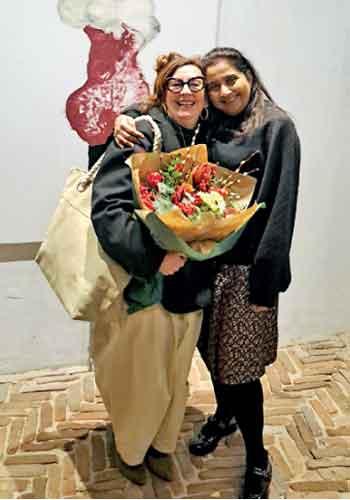 |
| Fabienne (left) with Tasneem Hatimbhai, Founder of SAC Art Amsterdam. Image courtesy - SACART Amsterdam |
From working with survivors of the Easter Sunday bombings, to deaf children and adults while volunteering at the National Institute of Mental Health (Angoda) to working with deaf and blind girls in Mahawewa to Rohingya refugees and people affected by the 2015 earthquake in Nepal, her work is often inspired by observations and experiences with people. “I was trying to understand society. Sri Lankans do not talk and we need to think about why they are not talking. When working with deaf and blind children I had to touch them to be in contact. So all these experiences made me love this country and its people,” she added.
Fabienne’s work has been showcased at various solo and group exhibitions in Belgium, Greece, France, Italy and South Asia. Recently, her exhibition titled ‘We Don’t Need to Talk’ was showcased at SAC Art Amsterdam. Several of her artworks from embroidery to drawings to sculptures are featured at this exhibition which will conclude on February 13. She describes this exhibition as one that “lingers in the terrain of the unspoken, inviting viewers into a form of communication that depends on presence rather than speech.” “Tasneem, who heads SAC Art Amsterdam once came to Brussels and went through my work,” Fabienne continued. “She was then interested in doing an exhibition and subsequently Saskia Fernando and I selected some artworks to be showcased there. Tasneem is a great communicator and she’s trying to bridge the South Asian continent through her art space in Amsterdam. We had young people coming to the exhibition in addition to adults and Indian people living there and it was great to hear their feedback,” she added.
Fabienne believes that her work is now being accepted. “The language changed and I’m much more subtle trying to express what I want to convey. When I started, I was much more raw and straightforward. I don’t think it’s gone but it’s concentrated in a different way,” she said.
Her next series of artworks is based on the theme of love and she’s busy working through the process. When asked about the Sri Lankan art scene, Fabienne said that there’s much more hope now and that it’s growing compared to what it was 10 years ago. “Thanks to initiatives such as Colomboscope, Kalā platform, Galle Literary Festival and the Bawa Trust. There are more galleries coming up and there’s more visibility as well. Therefore we now need more energy to create artworks. Perhaps something that we are really missing is an open art space with a café; a place where people could come, meet and discuss ideas, with art books and magazines for people to read and appreciate art in a relaxed manner,” she said in conclusion.