 Kamanthi Wickramasinghe
Reply To:
Name - Reply Comment
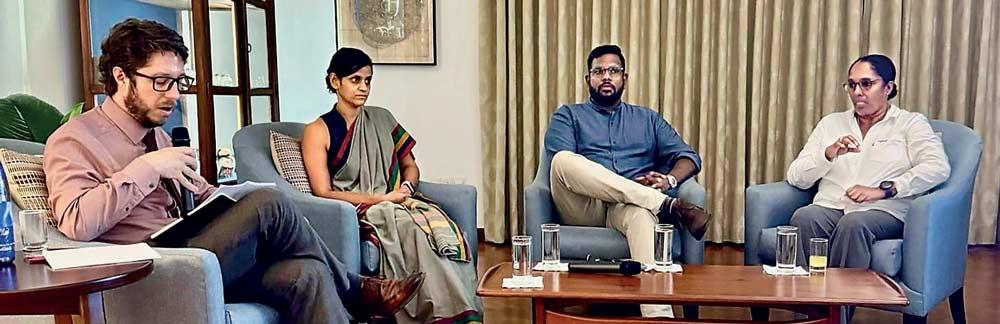
L-R - Dr. Jamie Johnson, Dr. Chathurangi Wickramaratne, Anushka Wijesinha and Prof. Sevvandi Jayakody
 Sri Lanka’s mangrove cover has reduced from 30,000 hectares to an approximate extent between 17,000 and 19,000 hectares
|
British High Commissioner to SL Andrew Patrick |
The importance of international partnerships and support from organisations such as the Commonwealth to support the restoration and conservation of marine ecosystems was discussed at a recent event organised by the British High Commission, Sri Lanka, in view of the Commonwealth Day. This year’s Commonwealth Day theme, ‘Together we strive for collective strength and resilience of the Commonwealth family’ applies to the area of climate change as well. The main highlight of the event was a thought-provoking nature photography exhibition that revealed the threats faced by birds, land mammals, moss and fungi and marine species.
Speaking at the event, British High Commissioner to Sri Lanka Andrew Patrick stressed on how the UK is supporting the Commonwealth’s Climate Finance Access Hub, which helps vulnerable member states access funding to address climate change. In his welcome remarks, he also spoke about how the UK has extended its support to several programmes in Sri Lanka to support marine biodiversity, combat pollution, and help address issues of disaster risk management and disaster risk forecasting.
An expert-led panel discussion on ‘Mangroves, Wetlands and Marine Ecosystems in Climate Resilience: A Commonwealth Perspective’ shed light on the importance of integrating communities in restoration and conservation activities. The three panelists were Prof. Sevvandi Jayakody, Senior lecturer at Wayamba University, Dr. Chathurangi Wickramaratne, Freshwater Ecologist at International Water Management Institute and Anushka Wijesinha, Director for Centre for Smart Future. The discussion was moderated by Dr. Jamie Johnson, Senior Integrated Marine Manager at UK’s Marine Management Organisation.
Over the past 20 to 30 years, Sri Lanka’s mangrove cover has reduced from 30,000 hectares to an approximate extent between 17,000 and 19,000 hectares. According to Prof. Jayakody, one of the reasons for the loss of coastal ecosystems is through development coming from elsewhere. In her work, she explores what could be given back to people when they come forward to protect and conserve ecosystems, sometimes going beyond monetary benefits.
She works with youth to make them understand the importance of ecosystems around them. “We need to look at what people need if we want to have vibrant, homely coastal ecosystems. I like to go back and look at models where we could work with communities while conserving blue carbon ecosystems and also look at direct and indirect benefits. At the same time, what can we give in return to those who commit? What we give in return can be multiple. The work we do with WNPS has made us understand that it is not always the monetary benefits that people are looking for. It could be as simple as empowering knowledge; it could be a requirement for their children to go to the next level and so on,” she added.
Prof. Jayakody further said that Sri Lanka is about to introduce the National Biodiversity Policy. “Sri Lanka has many specific policies, such as the National Mangrove Policy. What is required at the moment is to ensure that policies between various sectors are taken together and see what could be done realistically,” she underscored.
In her observations working on urban and semi-urban wetlands, Dr. Wickramaratne spoke about how wetlands are great sources of Greenhouse Gas emissions. “The more you disturb them, the more they release these emissions. Therefore, they are best left undisturbed. Restoration also involves an element of disturbances. The priority should be conservation because we don’t have a lot of wetland areas in the country. We don’t know the distribution of wetlands. We need to update the national inventory on wetlands, look at the diverse types of wetlands we have, their ecological status—whether they are degraded or pristine or somewhere in between and prioritise wetlands for restoration. We work with communities and youth and sensitise them on certain aspects while looking beyond the services that wetlands provide and recognising the fact that these wetlands have a right of their own to exist. Identifying the intrinsic value of nature and instilling this in the public and youth have been a strong focus area for us,” she added.
In his comments, Anushka Wijesinha shed light on the financial and debt distress faced by Commonwealth countries. He said that certain countries that experienced macroeconomic distress had to cut off public finances substantially. “One of the areas that have been affected has been around public finances towards conservation and climate change resilience. Within that broader context, we have the context of climate finance where the majority of climate finance globally goes to mitigation and hardly to adaptation. With mitigation, it’s becoming easier to get finance that is for rooftop solar, renewable energy, transport sector and so on. Whereas, for adaptation, it is still challenging. A lot of adaptation finance is debt. Therefore, we have to focus on innovative financing mechanisms. At CSF, nature, climate and economy is one of our thematic pillars, and we work closely with other conservation organisations around what it takes to shift Sri Lanka’s growth model,” he added.
Wijesinha said that an analysis of decades of policies based on climate change indicates a lot of cross-referencing to other policies. He said that it is becoming increasingly harder for individual ministries to deliver a policy or plan of action without effective coordination.
Guests were also able to catch a glimpse of ‘The Tree Left Standing’, an exhibition that explored the interconnectedness of humanity and nature through a series of photographs captured by Anushka himself and Nishan Perera, Co-founder of Blue Resources Trust. The exhibition was originally displayed at the Art Trail of the 2025 edition of the Galle Literary Festival. Each photograph highlighted the pain and suffering endured by wildlife at the hands of human disturbances.
One image titled ‘Epic Journeys’ was a photo of Brown-headed Gulls captured by Anushka. These Gulls travel around 7000 kilometers all the way from the Arctic via the famed Central Asian Flyway, seeking refuge from a harsh winter. Mannar is a crucial stopover for these Gulls and many other migratory birds. But in recent times, this destination has had an uncertain future with looming renewable projects. Anushka stresses the fact that Sri Lanka’s path to renewable energy shouldn’t come at the cost of its natural heritage.
Another heartbreaking photo was that of a shark captured by Nishan. The photo was titled ‘Dead on arrival’ and warns people about the collapse of fisheries and the threat to livelihoods and food security. Sharks and mobula rays have traditionally been a notable bycatch in the fisheries industry. But the rising demand for shark fins and mobula gill plates has driven large-scale, export-oriented fisheries for these species. Nishan underscores that the first step towards policies that promote sustainability is to change the widespread belief that fish are an unlimited resource while calling for urgent reforms.
Pics courtesy – BHC SL