 Kamanthi Wickramasinghe
 Reply To:
Name - Reply Comment
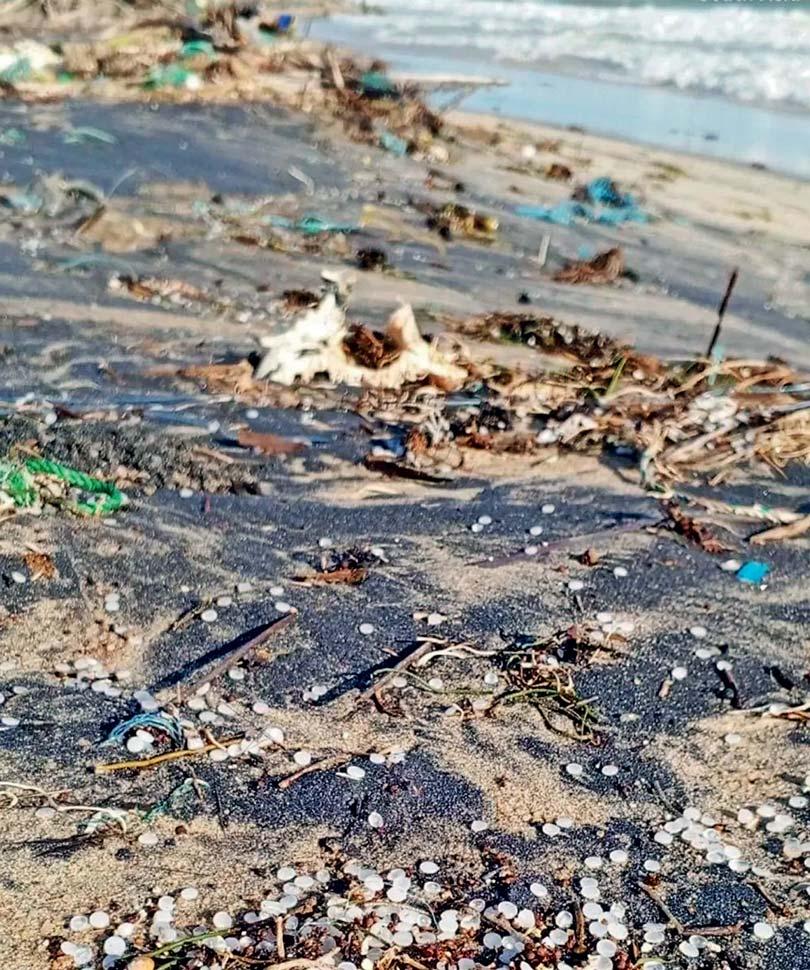
The Invasion of the Plastic Pellets: The Pristine shorelines of the Western front of Sri Lanka are scattered with these Toxic Nurdles
Environmental activists have observed a rise in Plastic Pellets taking over the coastlines, as a result of the May 24 and June 9 Coastal Disasters, both in the Southern Indian Seas
Withanage states that the MSC ELSA 3 includes 13 containers with hazardous materials, whereas the MV WAN HAI 503 includes 143 cargo with toxic chemicals such as methoxy propanol, pesticides, and environmentally hazardous substances and so on
Mannar’s ecosystem, which accounts for 30% of the fish harvested in the area, could face a significant risk as a result of the events that have transpired
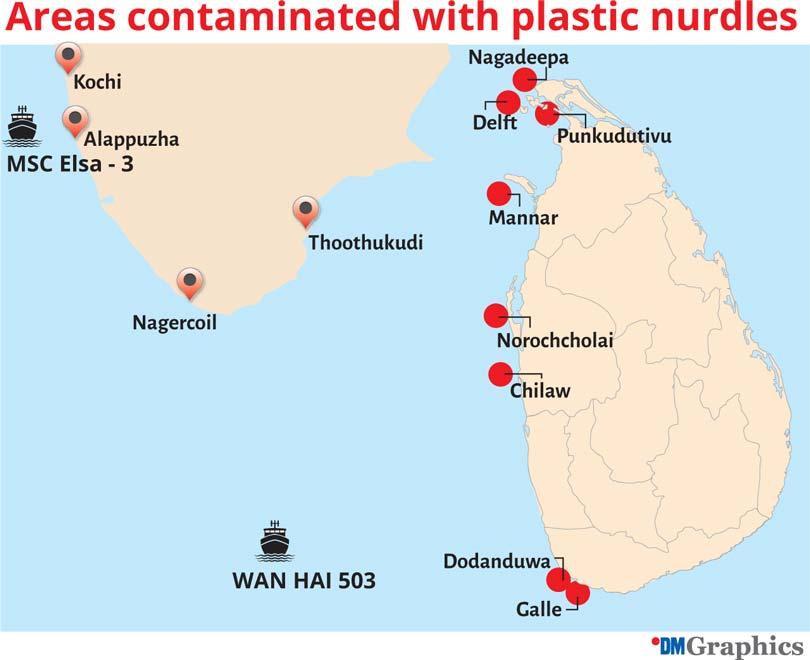
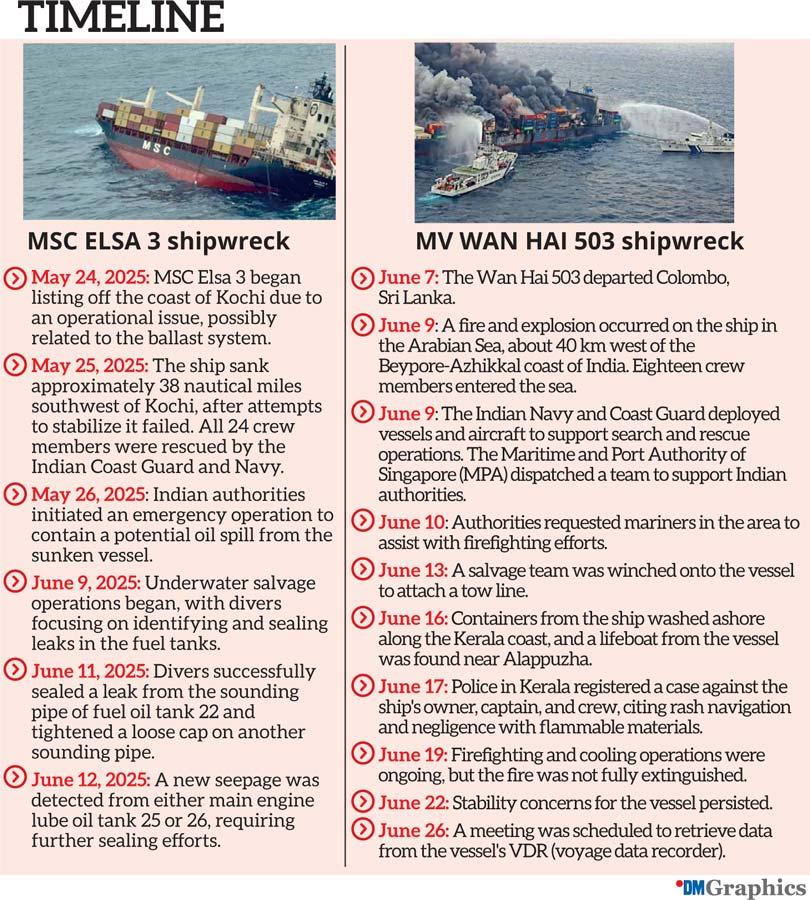
Environmental groups and civil rights activists have raised concerns about two shipwrecks that occurred in the Indian Ocean in close proximity to South India recently. On May 24, MSC ELSA 3, a container ship sailing under the flag of Liberia, sank off the coast of Kochi, reportedly due to an operational problem. On June 9, Singapore-flagged merchant vessel MV WAN HAI 503 caught fire off the Beypore coast in Kerala. Following the two incidents, environmental groups observe a spike in plastic pellets (nurdles) spreading along the coastline from Jaffna to Galle in addition to a possible oil spill that would move towards Sri Lanka with the prevailing monsoon weather. As such, environmentalists are demanding accountability from polluters as island states such as Sri Lanka can no longer bear the brunt of irreversible maritime disasters.
Result of deeper structural failures
Speaking at a media briefing to raise awareness on the importance of accountability when such maritime disasters occur, Anita Perera, Campaigner for Greenpeace South Asia, said that when a team visited Mannar on June 19, they noticed a significant number of plastic pellets even after one round of cleanup operations. “The Mediterranean Shipping Company (MSC) is responsible for cleaning up the oil spill, but so far, they haven’t communicated their response to expedite the cleaning of nurdles or the oil spill. This isn’t an isolated incident but a result of deeper structural failures in how we are governing our oceans and environmental safety. These are critical ecosystems, and there are people whose daily livelihoods would be affected as a result of such disasters. We need to hold these companies accountable for such incidents,” she underscored.
Why Sri Lanka requires adequate laws and guidelines for transporting plastics
In his remarks, Hemantha Withanage, Chairperson at Centre for Environmental Justice, said that the X-Press Pearl shipwreck occurred in May 2022 and completely burned down in June of the same year. “The recent two incidents also occurred around May-June this year. Annually, around 60,000 ships travel across Sri Lankan waters, and around 200 ships travel near Sri Lankan shores on a daily basis. MSC ELSA 3 includes 13 containers with hazardous materials, whereas the other ship includes 143 cargo with toxic chemicals such as methoxy propanol, pesticides, and environmentally hazardous substances and so on,” he explained.
He further said that the cargo in the second ship would eventually be destroyed in the fire and that there’s a threat of these toxic substances penetrating into the ocean. “The rich biodiversity in marine ecosystems near Mannar would be impacted by these two shipwrecks. This ecosystem generates over 30% of the fisheries harvest in the area. Following the X-Press Pearl disaster, the Marine Environmental Protection Authority (MEPA) brought forward a proposal to the International Maritime Organisation (IMO) requesting the latter to implement a law on the transportation of plastic nurdles. But so far, there’s no such law being implemented, but we believe that plastic nurdles should be identified as a hazardous substance and there would be mechanisms implemented for the safe transportation of these substances,” he added.
Withanage further said that these nurdles are transported in plastic bags, and during an accident, these bags would burst and the nurdles would spread all over the ocean. “This is why these nurdles pose a threat to coastal ecosystems and would be harmful to fish. There were 1680 metric tonnes of nurdles collected from Sri Lankan shores following the X-Press Pearl disaster. But there’s no estimation of the number of nurdles from the shipwreck involving WAN HAI 503,” he observed.
Urgent call to manage oil spills
Speaking about the importance of managing oil spills, Withanage further said around 550 metric tonnes of oil spilt into the ocean following the X-Press Pearl disaster. “Indian authorities have so far failed to manage the oil spill following the two shipwrecks. Therefore, countries such as Sri Lanka and India need a mechanism to respond in such situations. During the X-Press Pearl disaster, the authorities used water to douse the fire without using chemicals such as sodium hydroxide. But water is not the best substance that should be used to extinguish fires that occur from toxic substances. An emergency response unit needs to be established to respond to such situations. Even though there is a mechanism to respond to a sudden oil spill, the facilities are still not in place,” Withanage further pointed out, while adding that toxic substances would eventually penetrate into the food web if proper investigations are not being done.
Withanage further underscored the fact that stronger regional mechanisms are needed to hold polluters accountable.
Plastic pellets as toxic substances
Transboundary pollution is not a new phenomenon for Sri Lanka. Shedding light on this crisis, Melani Gunathilaka, representing Climate Action Now Sri Lanka, said that plastic pollution is a growing environmental and health crisis in the world. “But regulations with regard to transporting plastics are at a primitive level. The impact of MSC ELSA 3 is an example of transboundary pollution. These plastic pellets are raw materials used in the production of plastics but they are not yet been identified as marine polluting substances or toxic substances,” she said while adding that 400 million tonnes of plastics are being produced every year and out of these at least 14 million tonnes of plastics are dumped into the ocean every year.
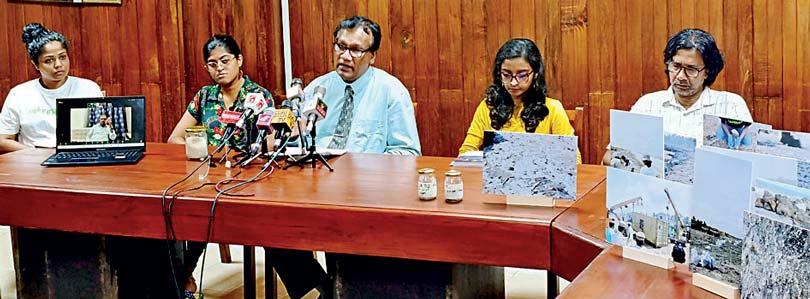
L-R:- Anita Perera, Kasumi Ranasinghe, Hemantha Withanage, Melani Gunathilaka and Krishan Wewalwala
 When questioned about the spread of plastic pellets following the recent shipwrecks, Prof. Sanath Hettiarachchi, Chairman of the National Aquatic Resources and Research and Development Agency (NARA), said that they started observations as soon as the incident occurred. “We have noted that areas such as Jaffna, Mannar and Puttalam were affected around seven days after the incident. The plastic nurdles are drifting towards Delft, Nagadeepa and Punguditivu areas quite prominently, and the South Bar area in Mannar has also been affected. We are continuing our Environmental Damage Assessment, and we are analysing samples. We have observed that shoreline vegetation is contaminated with nurdles, but any effect from this contamination is yet to be assessed. The nurdles are there, but whether it would cause any long-term impact is not assessed, but we do not foresee such a long-term impact,” he added.
Cleaning operations are being conducted by authorities dedicated to protecting marine ecosystems. As such, MEPA, NARA, the Coast Conservation Department (CCD) and the Central Environmental Authority (CEA) have formed an Incident Management Team to observe and assess the situation. “From last week to date, there are more nurdles coming into the Norochcholai and Uduppu areas. However, the tendency of nurdles drifting towards Muthukandiya and Chilaw areas has reduced, and it all depends on how the currents are operating during the monsoon period. In the south, Dodanduwa is heavily contaminated, and cleanup operations have been intensified in these areas. Galle too has been affected, but not that seriously. Until we complete the assessment, we can’t be sure about the impacts, but in our opinion, we don’t see a long-term impact. We observed a small number of fish being killed in the Puttalam area, but we couldn’t link it to plastic nurdles being washed ashore. Apart from that, a socioeconomic survey is also being carried out. Most people are unaware of this new shipwreck. But they knew about the X-Press Pearl disaster. They haven’t observed any nurdles inside fish as well. So we are continuing to monitor the situation. We don’t foresee a big impact on our oceans like the X-Press Pearl disaster, but we need to intensify cleanup efforts,” Prof. Hettiarachchi said while adding that tri-forces personnel have also extended their support towards cleanup operations.