Reply To:
Name - Reply Comment
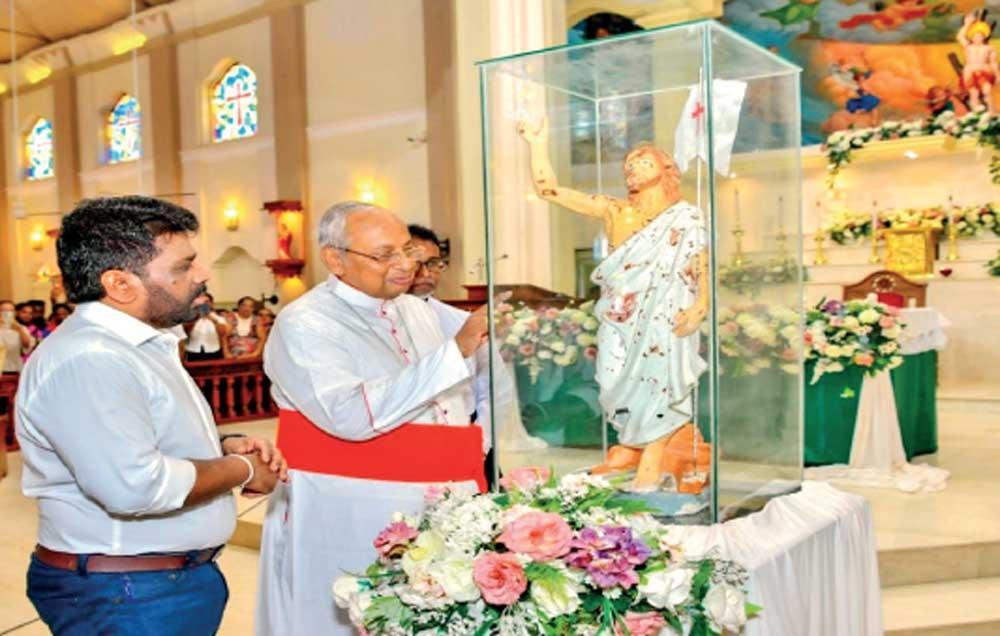
Malcolm Ranjith the Cardinal-Archbishop of Colombo (right) is seen with President Anura Kumara Dissanayake while inspecting some monuments at St. Anthony’s Church Kochcikade, Colombo which were damaged during the Easter Sunday carnage
Seven years is long enough to forget, but it is also long enough to realise that our duties are far from satisfactorily fulfilled
 Seven years ago today, the bells of St. Anthony’s Shrine, Kochchikade, St. Sebastian’s Church, Katuwapitiya and Zion Church, Batticaloa were silenced by a roar that changed the trajectory of Sri Lankan history forever. On April 21, 2019 the tranquility of Easter Sunday was shattered by a coordinated campaign of terror, leaving 269 or more lives lost and over 500 injured.
Today, as the nation observes the seventh anniversary of these attacks, the black flags have mostly faded, and the frantic news cycles have moved on. Yet, for thousands of survivors, the ‘blast’ never truly ended. It continues in the silence of a prosthetic limb being strapped on every morning, in the empty chair at the dinner table, in the enduring psychological scars etc. that time has failed to cauterise.
As a nation, our duty to these survivors has shifted from the immediate adrenaline of emergency response to the long-term, often invisible, obligation of sustained restoration. Seven years is long enough to forget, but it is also long enough to realise that our duties are far from satisfactorily fulfilled.
The Role of the Church and
the State
In the harrowing days following the attacks, the response was not merely bureaucratic; it was deeply pastoral. The Catholic Church in Sri Lanka, under the steadfast patronage of His Eminence Malcolm Ranjith the Cardinal-Archbishop of Colombo, emerged as the primary bulwark against despair. The Church did not merely offer prayers; She turned out to be a massive humanitarian engine.
Under the leadership of His Eminence, ‘Seth Sarana’ (Caritas Internationalis) the main social service wing of the Catholic Church and various Parish committees throughout Sri Lanka became the hands and feet of the relief process. From immediate funeral expenses to the reconstruction of homes and the provision of daily sustenance for those affected, the Church’s intervention was granular and deeply personal. His Eminence’s vocal advocacy served as a shield for the community, preventing retaliatory violence and channelling the collective grief into a disciplined demand for truth and care. “The cry of the victims is not for revenge, but for the truth and for the healing of their shattered lives. We cannot claim to be a civilised society if we leave the broken among us to fend for themselves while the lessons of history are swept under the carpet.”-His Eminence Malcolm Cardinal Ranjith
Parallel to this, the state has contributed significantly to the recovery framework. Through the Office for Reparations (OR) and various ministry-led initiatives, substantial financial compensation was disbursed to the families of the deceased and the injured. The state played a critical role in the physical restoration of the bombed places of worship – St. Anthony’s, St. Sebastian’s and Zion – ensuring that these symbols of faith were rebuilt as bastions of resilience. This synergy between the spiritual leadership of the Church and the administrative machinery of the state provided a foundation, but as the seventh year passes, we must look beyond, acknowledging that a foundation is not a finished house.
The Crisis of long-term
medical care
For many survivors, the physical injuries sustained in 2019 are not static relics of the past; they are evolving medical challenges. Shrapnel remains embedded in tissues, causing chronic pain and neurological complications that surface years later. Children who were injured have grown, requiring repeated surgeries to adjust prosthetic devices or treat bone growth issues.
Consequently, as a nation, we owe the survivors a seamless, lifelong healthcare guarantee. A survivor should never be forced to fundraise for a surgery necessitated by a national security failure; for while the Church is doing Her level best to provide long-term care and spiritual guidance.
Normalising mental
health support
If physical wounds are visible reminders, the psychological trauma – Post-Traumatic Stress Disorder (PTSD), survivor’s guilt, and chronic anxiety – remains a silent predator. In the immediate aftermath, counselling was plentiful. Seven years later, many of those programmes have tapered off, yet trauma has a long half-life. The trauma of the Easter Sunday Attacks is intergenerational; children who witnessed the carnage are now adolescents navigating a country they perceive as unsafe.
To address this, a transition is highly recommended from ‘crisis counselling’ to ‘building sustained community-based mental health ecosystems’. This involves training local practitioners specifically in trauma-informed care and ensuring that survivors have access to confidential, high-quality psychological and psychiatric support for as long as they require it.
Economic sovereignty and the right to flourish
The attacks did more than taking lives; they dismantled livelihoods. Breadwinners were lost, and many survivors were left with disabilities that prevented them from returning to their previous vocations. While the initial state compensation and Church grants were vital, the subsequent economic crises and inflation in Sri Lanka have rendered those initial sums insufficient for long-term survival.
Our national obligation is to move from ‘charity’ to ‘economic empowerment’. Furthermore, preferential credit facilities for survivor-led micro-businesses could also be established. True justice includes the right to be economically independent and to live with dignity rather than in a state of perpetual dependence.
Education over oblivion
As the years pass, there is a natural tendency for a nation to want to ‘move on’. However, moving on without remembering is a disservice to those who suffered. Memory is the only preventative medicine against the recurrence of such evil.
We must integrate the lessons of the Easter Sunday Attacks into our national consciousness and educational curricula. Memorials should not just be cold stone or annual ceremonies; they should be living centres of peace-building and dialogue, supported by both religious institutions and the state, serving as a constant reminder of our shared humanity.
The pursuit of a safer tomorrow
The survivors live with a strong feeling that their suffering is, in part, a result of systemic lapses. Therefore, the greatest duty we owe them – and the duty most emphasised by His Eminence – is the pursuit of ultimate accountability and the assurance that no other family in this land will ever have to endure the same agony.
This involves the unwavering strengthening of national security frameworks and the fostering of an intelligence culture that prioritises the safety of citizens above all types of other interests. Furthermore, it requires a collective societal rejection of the ideologies that fuelled the attacks. Our national safety is the only true monument we can build to their loss.
Social integration
Survivors often go through a sense of ‘othering’ – the feeling that they are defined solely by their tragedy or, conversely, forgotten once the cameras leave. As the collective memory of the nation dims, survivors can feel isolated in their ongoing struggle, as if their pain is an inconvenience to a country eager to look forward.
Thus, every citizen has a role in reweaving the social fabric of our nation. This means checking in on affected families in Negombo, Batticaloa and Colombo.
A Sacred Covenant
The 07th anniversary of the Easter Sunday Attacks is a milestone of resilience. It marks seven years of mothers raising children alone, of youth navigating life with altered bodies, and of a community that has shown remarkable grace in the face of unimaginable horror. We must recognise that while the Church has provided the soul of the recovery and the state has provided the skeleton of the relief, the flesh and blood of this restoration must come from all of us!
Our duty to the survivors is not just a matter of political policy or a checkbox on a human rights report. It is, above all, a ‘Sacred Covenant’!
Our prayers honour their struggle, but our persistence secures their future. We must not only plead their cause to the Heavens, but we must also demand justice for them here on earth!
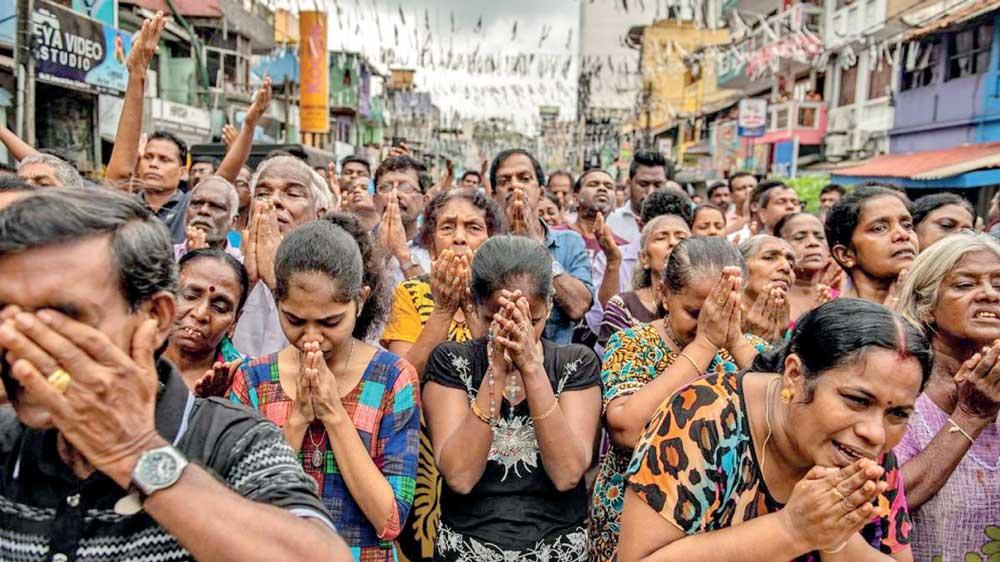
Emotional devotees pray for justice