Reply To:
Name - Reply Comment
By Shantha Jayawardena
LL.B (Col), LL.M (Col) Attorney-at-Law
 If education is to be treated as a justiciable entitlement rather than a policy aspiration, constitutional reform is required
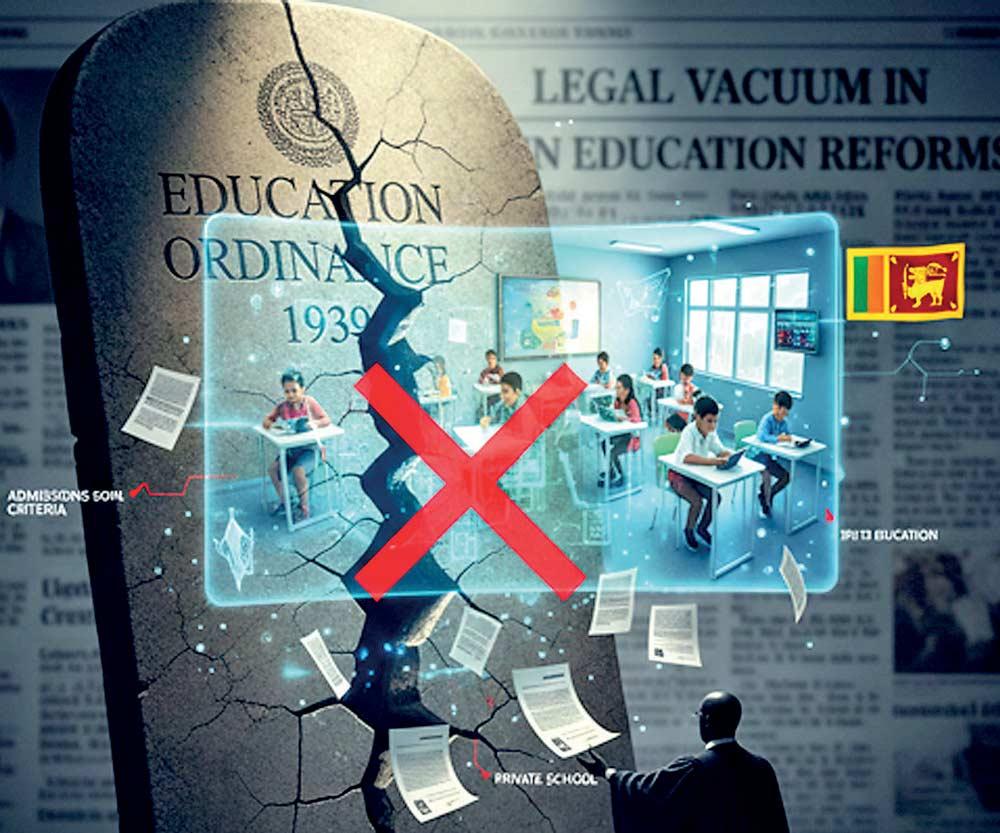
The Supreme Court has previously observed that the Education Ordinance and its regulations have fallen into disuse, resulting in a legal vacuum in which education has operated without an effective statutory framework
Because circulars lack the force of law and do not provide for penalties, violations by school authorities have been common... an effective reform programme must include the formulation of transparent admission criteria
Many of these [international] schools appear to fall outside the legal framework governing school education. Yet, they are not subject to effective regulation or supervision... This regulatory vacuum raises serious concerns
Sri Lanka’s latest educational overhaul aims to modernize the classroom, yet it remains anchored to a century-old legal framework. While the government pledges to treat education as a fundamental right, Attorney-at-Law Shantha Jayawardena argues that such promises lack teeth without constitutional amendments. To move beyond ad hoc circulars and administrative fragmentation, the reform must transition from changing textbooks to enacting binding legislation that addresses admissions, private schooling, and the right to education.
Education is an integral aspect of modern democratic life. From early political theory to modern constitutional practice, education has been understood as a public concern that shapes citizenship, social mobility and equality. For that very reason, education has been a sensitive political issue in Sri Lanka since the early twentieth century. Any attempt at educational reform must therefore engage not only pedagogical concerns, but also legal and institutional realities.
The first phase of the National People’s Power government’s education reforms is to be implemented through a new curriculum for Grades 1 and 6. The Ministry of Education, Higher Education and Tertiary Education has published a booklet titled Transforming General Education in Sri Lanka 2025, which outlines these initial reforms. According to the booklet, the first phase is confined to curriculum change and human resource development, areas described as raising fewer complex questions. More difficult structural and institutional issues are deferred to a later stage. This article examines aspects of the existing legal framework and institutional structure that must be addressed in a future phase if educational reform is to result in meaningful social change.
Constitutional recognition of the right to education
The foreword to the reform booklet states that the government recognizes education as a fundamental right. As the law presently stands, such recognition has no legal effect. The Fundamental Rights chapter of the 1978 Constitution does not include the right to education. If education is to be treated as a justiciable entitlement rather than a policy aspiration, constitutional reform is required.
Although a comprehensive constitutional reform process has not yet commenced, recognition of the right to education could be achieved through an amendment to the Fundamental Rights chapter. Such an amendment is unlikely to require a referendum. It is also not without precedent. Both the 1997 and 2000 draft constitutions included the right to education, albeit in limited form, guaranteeing access to free education for children between the ages of five and fourteen. These proposals demonstrate that constitutional recognition of education has previously been accepted in principle within Sri Lanka’s constitutional discourse.
International human rights standards
Sri Lanka is a State Party to the International Covenant on Economic, Social and Cultural Rights. Article 13 of the Covenant contains the most widely accepted formulation of the right to education in international law. Educational reform processes should therefore ensure that the domestic legal framework and institutional structure are aligned with Sri Lanka’s treaty obligations.
The Committee on Economic, Social and Cultural Rights has clarified the normative content of the right to education through General Comment No. 13. It identifies four interrelated features that must be satisfied: availability, accessibility, acceptability and adaptability. Availability requires functioning educational institutions with adequate infrastructure and trained staff. Accessibility extends beyond non-discrimination to include physical and economic access. Acceptability relates to the form and substance of education, including curricula and teaching methods, which must be acceptable to students and parents. Adaptability requires education systems to respond to social change and the diverse needs of learners.
These standards indicate that access to education is a broader concept than equal treatment alone. They also support demands for public engagement in curriculum development, as acceptability under international law includes responsiveness to social, cultural and linguistic contexts.
The Education Ordinance of 1939 and institutional fragmentation
General education in Sri Lanka is formally governed by the Education Ordinance No. 31 of 1939, last amended in 1973. The Ordinance established a centralized administrative structure, with a Department of Education operating under the authority of the Minister, supported by advisory councils and a system of inspection and regulation. In practice, this framework no longer functions.
The introduction of the Thirteenth Amendment to the Constitution in 1987 fundamentally altered the administration of education by devolving significant powers to Provincial Councils. Education and educational services became a devolved subject to the extent specified in the Provincial Council List, while matters not expressly devolved fell within the concurrent jurisdiction of Parliament and the provinces. Higher education was placed in the concurrent list. National schools remained under the purview of the central government, while most other state schools and education personnel came under provincial control.
Although education is not included in the Reserved List, the central government retains the power to formulate national policy on all subjects. This permits Parliament to legislate on national education policy. However, the unified administrative system envisaged by the Education Ordinance no longer exists. Advisory councils provided for in the Ordinance have not been constituted, and there is no single Director General of Education exercising nationwide authority. Instead, education is administered through a fragmented structure involving a central ministry alongside nine provincial ministries and directors.
The Supreme Court has previously observed that the Education Ordinance and its regulations have fallen into disuse, resulting in a legal vacuum in which education has operated without an effective statutory framework. This fragmentation undermines accountability and coherence in educational governance. Any serious reform programme must therefore include the enactment of new legislation governing general education, consistent with the constitutional structure created by devolution.
Regulation of admissions to government schools
The first phase of the current reform programme does not address the issue of access to education through school admissions. Admission to Grade 1 of government schools has been one of the most contentious education-related issues over the past two decades, affecting children, parents, administrators and courts.
The Education Ordinance does not prescribe criteria for admission to government schools, although it empowers the Minister of Education to make regulations on admissions. Despite this authority and longstanding controversy, no such regulations have been promulgated. Instead, admissions are governed by annual circulars issued by the Secretary to the Ministry of Education. These circulars have remained largely unchanged for many years.
Because circulars lack the force of law and do not provide for penalties, violations by school authorities have been common. This has led to a large number of fundamental rights applications before the Supreme Court, alleging violations of the constitutional guarantee of equality and equal protection of the law. Although the Constitution does not recognize education as a fundamental right, the Court has held that admissions must comply with the criteria set out in the relevant circulars and that both the criteria and their application must be fair, rational and non-discriminatory. An effective reform programme must therefore include the formulation of transparent admission criteria, enacted through legally binding regulations.
Private and international schools
International human rights law recognizes the liberty of parents to choose schools other than those established by public authorities, subject to minimum standards set by the State. Domestic law, however, reflects a more complex and restrictive position.
The Education Ordinance recognizes three categories of schools: government schools, assisted schools and unaided schools. The law does not expressly recognize private schools, and subsequent legislation significantly restricted their establishment. Since 1961, private schools may not be established for children between the ages of five and fourteen, while schools for older students require prior approval from education authorities and remain subject to regulation.
Despite these restrictions, a large number of international schools of private ownership have been established, particularly over the past two decades. Most cater predominantly to Sri Lankan students and operate as commercial entities registered under company law, often with approval from investment authorities. Many of these schools appear to fall outside the legal framework governing school education. Yet, they are not subject to effective regulation or supervision by the Ministry of Education. This regulatory vacuum raises serious concerns regarding standards, accountability and equity.
Private universities
The existing legal framework does not permit the establishment of private universities in Sri Lanka. The Universities Act allows only for the recognition of foreign degrees and qualifications. Attempts by successive governments to introduce legislation enabling private universities have been met with strong political opposition, particularly from university students, on the ground that access would be limited to those who can afford to pay.
In practice, students with sufficient financial resources already pursue higher education abroad. From the perspective of Sri Lanka’s international obligations, particularly under the Covenant on Economic, Social and Cultural Rights, the issue of private universities remains unresolved. Addressing it will require difficult political decisions, but cannot be avoided if higher education policy is to be aligned with international standards.
Medium of instruction
The Constitution guarantees the right to receive education in Sinhala or Tamil at primary and secondary levels, reflecting the status of these languages as national languages. English may be used as a medium of instruction in higher education. Regulations made under the Education Ordinance further reinforce the obligation of the State to provide instruction in Sinhala and Tamil in government schools.
At the same time, the growing importance of English as an international language has generated increasing demand for English-medium education. Studies indicate that graduates educated exclusively in Sinhala or Tamil often face disadvantages in employment and further education, particularly in the private sector. The expansion of English-medium instruction raises complex questions relating to equality, access and social stratification. Balancing linguistic rights, global competitiveness and social equity remains one of the most politically sensitive challenges in education reform.
The first phase of current education reforms focuses on curriculum change and human resource development. Without a modern legal framework, however, such reforms cannot deliver lasting results.
A future phase must address deeper structural issues, including constitutional recognition of the right to education, replacement of the obsolete Education Ordinance, lawful and transparent school admission criteria, regulation of private and international schools, the future of private universities and the medium of instruction in a globalized context.
Education is too important to be governed by outdated laws and ad hoc administrative measures. If Sri Lanka is to build an equitable and internationally aligned education system, legal reform must be an integral part of the education reform programme.