Reply To:
Name - Reply Comment
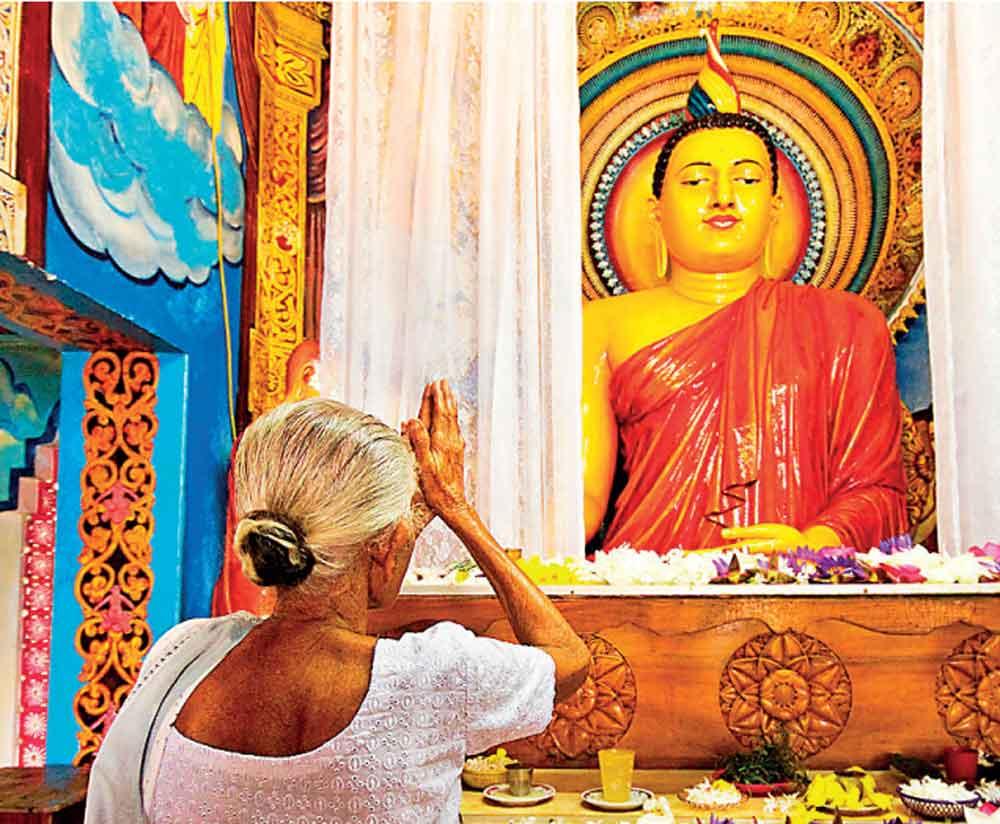
Prayer is an appeal to a higher, unseen power, for guidance or for intervention in situations where individuals find themselves helpless in resolving their problems on their own will.
Photo Credit: ©Sander Groen
“For a noble disciple who wishes to have beauty, happiness, fame, and rebirth in the heavens, it is not befitting that he should pray for them or take delight in doing. He should rather follow a path of life that is conducive to beauty, happiness, fame, and rebirth in the heavens. By following such a path, he will obtain rebirth in the heavens”
- Anguttara Nikaya
 It is a fundamental instinct of human nature to seek solace through prayers in times of despair and need. Prayer is a supplication to a higher, often unseen power, either for guidance or intervention in situations where individuals find themselves unable to resolve their problems on their own. Most people pray with the hope of attaining some form of benefit. Prayers manifest in various forms with many people praying for worldly gains such as wealth, health, prosperity, success in business or examination, electoral victories or longevity. Those who are spiritually inclined may pray for forgiveness of their sins and the general welfare of humanity. However, Buddhism presents a distinct perspective on prayer and its efficacy, particularly concerning the ultimate goal of liberation, known as Nibbana.
In Buddhism, reliance on an external agency for assistance through prayer is considered futile. Unlike many other religions, Buddhism does not support petitionary and intercessory prayers, as no external power can confer any assistance or true liberation. Instead, the teachings of Dhamma are intended as a guide for individuals to liberate themselves from suffering through personal effort. This fundamental belief contradicts the idea that one can attain purity or receive favours simply by appealing to God or any other deity.
On one occasion Buddha addressing Anathapindika declared “There are five desirable, pleasant and agreeable things which are rare in this world. What are those five? They are long lives, beauty, happiness, fame, and rebirth in the heavens. But of these five things, I do not teach that they are to be obtained by prayers. Or by vows. If one could obtain them by prayers or vows, who would not do it?
“For a noble disciple who wishes to have beauty, happiness, fame, and rebirth in the heavens, it is not befitting that he should pray for them or take delight in doing. He should rather follow a path of life that is conducive to beauty, happiness, fame, and rebirth in the heavens. By following such a path, he will obtain rebirth in the heavens”. (Anguttara Nikaya)
The Buddha’s legacy is rooted in helping individuals discover their paths to freedom from suffering, emphasising that deliverance ultimately stems from personal responsibility and effort. Thus, the essence of Buddhist practice lies in cultivating one’s potential and leading a life aligned with ethical principles, rather than relying on external sources for relief or support. External agency for assistance in such matters is regarded as futile. The teachings of Dhamma are not meant to secure mundane benefits through prayer; rather, they serve as a means for individuals to liberate themselves from suffering. Ultimately, the path to liberation is achieved through personal effort; prayer alone cannot facilitate this final liberation.
The theistic beliefs that one can attain purity merely by appealing to an invisible God or a deity contradict Buddhist teachings, as no deity possesses the power to grant favours. Even the Buddha despite his profound wisdom and intellectual achievements cannot grant or bestow worldly favours or facilitate attaining liberation no matter how much one prays to him. We have to accept the responsibility for what we experience in the world. Instead, Buddhism offers guidance on how individuals can achieve liberation through their efforts and practices.
The Buddha, revered as the supreme teacher, was neither a creator nor a distributor of favours or punitive power. Buddha was born as a human being and lived as a human being and eventually passed away as a human being. Although he attained remarkable heights of mental and intellectual achievement through relentless perseverance—without the guidance of any teacher—he never claimed divinity to whom one could pray for the solution of his problems. Buddha exemplified the best qualities of human nature, embodying compassion and wisdom. His teachings guide individuals toward liberation through diligence and ethical living, rather than through prayer. He demonstrated to the world that individuals possess infinite latent potential to achieve what he achieved, reaffirming the supremacy of humanity and teaching that deliverance can only be attained independently of external agency. Therefore, when Buddhists express reverence for the Buddha, they do so in recognition of him as the supreme teacher of all beings.
Buddha has clearly expressed the view that no amount of prayers hymns, incantations, or supplication of an unseen power can obtain real happiness, desired results, or the supreme bliss of Nibbana, and such benefits must be earned by leading an ethical life in thought, word, and deed. In Buddhism, the act of worship of images is often misunderstood. Buddhists do not worship those images and idols with the expectation of receiving worldly or spiritual favors but rather in gratitude for the qualities the Buddha embodied. Similarly, when Buddhists prostrate before Buddha statues or idols and offer flowers and burn incense reciting stanzas, it is not an act of idolising the image itself but rather about paying homage to what it represents—the virtues and teachings of the Buddha. These practices serve as a profound expression of gratitude, allowing practitioners to reflect on the impermanence and ephemeral nature of life and inspire individuals to emulate the Buddha’s virtues and embody the qualities of the Buddha. Even practices involving the veneration of the Bodhi tree—a symbol of enlightenment— are rooted in deep respect, acknowledging its significance without elevating the Buddha to the status of a deity. Although such external forms of worship and the practice of appealing to deities and the Buddha are prevalent among some Buddhist adherents, the Buddha is not worshipped as an omnipotent deity capable of granting worldly favours. What the Buddha expected from his adherents, was not such homage or obeisance but the actual observance of his teaching, as the essence of dhamma lies in its emphasis on individual effort and dedication. Nevertheless, it should be uppermost in the minds of Buddhist practitioners that one cannot attain liberation simply through prayer to the Buddha, as he is incapable of dispensing such worldly favours. Instead, the Buddha’s teachings illuminate a path for individuals to pursue liberation through their diligent efforts and practices.
The Dhamma serves as a means to attain freedom from suffering rather than a vehicle for achieving mundane benefits through prayer. The liberation is something one must achieve through his efforts.
Buddha proved to the world that man has infinite latent potential to achieve what he achieved. He showed the world the supremacy of man and taught the world that deliverance could be achieved independently of external agents.
An intellectual could dispense with these objects of idols when paying homage to Buddha as he could easily focus his attention on the Buddha by visualising it, and it would be necessary only for a person who cannot concentrate his attention without such visualisation. It is only through the committed practice of Buddha’s teachings true liberation is achieved, rather than through the ritual of prayer.
In analysing societal attitudes toward prayer, we often find two distinct perspectives. In this world, some people believe in the efficacy of prayer and declare that prayer to God or other supernatural divinity would be useful to get what they ask for while the other class denies the existence of God, nothing can be achieved by appealing to such supernatural entity who cannot hear prayers, and prayers are unnecessary. Those who belong to the former class are identified as theologians, theists, dualists, and so forth. The latter class includes philosophers, sceptics, scientists, and agnostics. As scientific understanding continues to expand, there is increasing scepticism regarding the effectiveness of prayer; many view those who hold firm beliefs in its power as misguided. Nevertheless, virtually all religions, with their rich diversity of creeds, sects, and denominations, assert the necessity and importance of prayer in their spiritual practices.
According to most theological teachings, God has a predetermined plan for all of us that is considered immutable, unchangeable, and eternal, and praying is only for aligning ourselves with that predetermined plan. It is believed that a plan cannot be changed by human actions and no amount of praying will change God’s mind. If that is so praying to God for change of circumstances would be of no use.
The efficacy of intercessory and petitionary prayers to God and other deities has been a contentious issue among many scientific researchers for a long time. The efficacy of prayers has been subject to scientifically rigorous investigations and experiments to determine whether it had any discernible impact on the cardiac health of a person being prayed for. One of the largest studies of the therapeutic effects of intercessory prayers, done by Dr. Herbert Benson at Harvard Medical School concluded that it did not affect the outcome of the cardiac patients for whom praying was done. There was no difference in the rate of complications for patients who were prayed for and those who were not. It was revealed that patients who knew they were being prayed for had more complications than those who were not. The scientific evidence does not prove praying on behalf of others is effective. According to current scientific understanding, the existence of God is a matter of belief, not provable or disprovable through scientific evidence, as science primarily studies the natural world. Science deals with observable phenomena and natural laws, belief in God is typically considered a matter of faith rather than scientific evidence. The concept of God falls outside the scope of investigation and testing.
If the desired outcome happens after praying, it does not necessarily mean that the prayer directly caused the outcome, as other factors could have been at play, and attributing it solely to prayer might be overlooking potential coincidences or natural causes. It is difficult to prove a direct causal link between prayer and a specific event, as many other variables can influence the outcome. However, unanswered prayers far outnumber answered prayers. The belief prevalent among certain theistic religious adherents that praying would call on the power of their God to provide positive effects on the person receiving the prayer is not tenable, as there is no definitive relevant, and tangible proof of the existence of God. There is only speculation and no demonstrable proof, and a method to test and establish God’s existence empirically. Replacing accepted medical treatment for curable somatic illnesses with prayer can lead to countless preventable deaths and injuries. However, prayers can strengthen one’s mind and can contribute to psychological well-being by reducing stress and anxiety. Nevertheless, it cannot be considered an alternative to accepted conventional psychiatric medical treatment. In place of prayer, Buddhists should practice meditation for mental purification and spiritual development. Most of the troubles which we are confronting today are due to the unretained mind of the people. Buddha did not seek divine power through prayers to achieve Buddhahood.
According to Buddhism, man is his own master. No higher being sits in judgment over his affairs and destiny. Our life, our world is what we make it to be not what some superhuman being wants it to be, and cannot be changed by prayers to such superhuman beings.