Reply To:
Name - Reply Comment
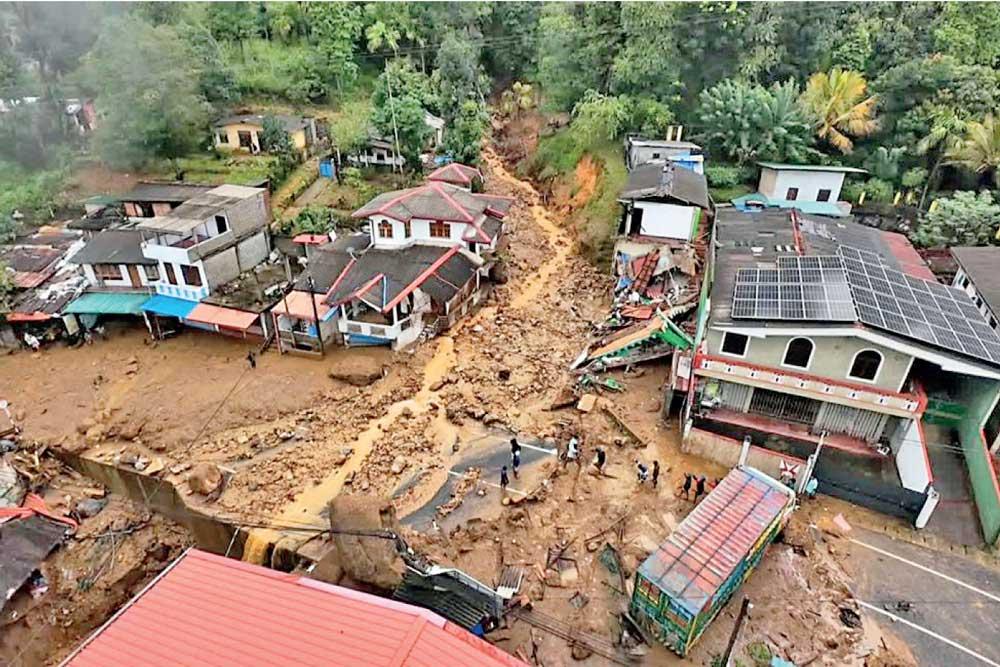
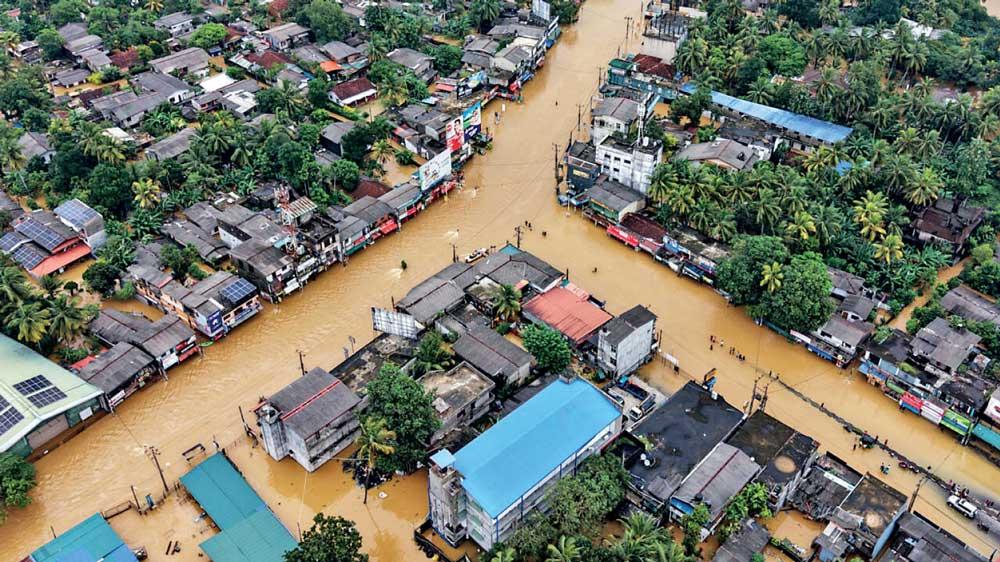
 The rising death toll and widespread infrastructure ruin from the latest deluges serve as a brutal, unmistakable warning: Sri Lanka’s socio-economic progress is fundamentally at risk. Climate change is no longer a future threat; it is a present danger. With the island facing a surge in extreme rainfall and crippling heatwaves -threatening food security and livelihoods- there is simply no time to waste.
It is once again proven that climate change poses a major risk to Sri Lanka’s socio-economic progress. What happened this time in terms of floods and landslides is a reminder that Sri Lanka is vulnerable to unexpected, climate events.
This time, the entire country was affected, more or less. Enormity of devastation is still unfolding with the death toll rising.
Climate events, be it droughts, heatwaves or cyclonic storms like Ditwa, make a huge socio-economic impact.
For example, as a phenomenon of global warming, temperature rise in Sri Lanka is there though it is projected to be marginally lower than the global average.
Sri Lanka faces a significant threat from extreme heat, with the number of days surpassing 35°C, potentially rising from a baseline of 20 days to more than 100 days by the 2090s, under emissions pathway RCP8.5, according to a World Bank study.
Extreme heat threatens human health and living standards, particularly for outdoor labourers in urban areas.
Without adequate cooling systems; this will particularly impact communities in Sri Lanka’s northern region, the World Bank says.
Temperature rise is likely to put downward pressure on agricultural yields, including key staples such as rice. This may impact negatively on national and household
food security.
In fact, it can even impact cultivation patterns. People will find it increasingly difficult to work in fields for long hours. What is needed now is to focus more on research work into these areas.
Yet, rising temperature is not the only phenomenon Sri Lanka faces.
The country faces a growing climate vulnerability that warrants urgent and pragmatic policy attention.
Without credible adaptive action and better disaster response preparedness, the rise in both the frequency and intensity of extreme rainfall events will expose lives, livelihoods, and vital infrastructure to heightened risk, as happened this time.
High intently rain battered most parts of the country triggering floods and landslides that buried people alive. Torrential downpours that lashed through the country caused riverine flooding, flash floods and landslides. It suggests that disasters are widespread and destructive in the country.
In the aftermath of the disasters, the potential for faster and broader transmission of diseases is also high.
Now, strengthening early-warning systems, local-level health surveillance, and community-based response mechanisms should become integral components of Sri Lanka’s climate adaptation agenda.
For Sri Lanka’s economic recovery, the current disaster is bound to place hurdles. It is now common knowledge that Sri Lanka suffered an enormous loss.
Yet, enormity is yet to be assessed in financial terms. The country will require huge allocations of money to rebuild infrastructure damaged in floods and landslides.
First, the network of highways and access roads should be reconstructed for mobility. Then comes the challenge of restoration of the country’s irrigation system. It is a priority for the government as otherwise it will affect the food security of the country. Another immediate priority is to facilitate farmers to re-cultivate croplands washed away in floods.
In the upcountry, the government will be compelled to relocate people in hazard-
prone areas.
There are such areas already identified. Besides, landslides occurred this time in areas which were not designated as hazard-prone in the past.
Now, there is no time for Sri Lanka
to waste.
Its future economic development plan should be coupled with climate-smart growth. In fact, the disaster took place in the immediate aftermath of the World Bank releasing a report on Sri Lanka.
The disaster is like a reminder that Sri Lanka should act on such recommendations without any further delay.
In its latest report , the World Bank has taken note that the government has signalled a clear commitment to a low-carbon, climate-smart future.
The recently launched National Climate Finance Strategy (2025-2030) outlines how Sri Lanka plans to attract investment for green infrastructure, sustainable agriculture, and better water management.
The World Bank has outlined key plans for Sri Lanka’s climate-smart growth.
Building rural resilience and prosperity is one among them. It involves supporting farmers with climate-smart practices, modern irrigation systems, and access to new markets.
Secondly, it has highlighted expanding green spaces, improving public transport, and reducing pollution to make cities safer and more efficient.
Expanding clean, domestic energy is the next area outlined in this case.
Harnessing solar, wind and other renewable sources to lower energy costs, reduce dependence on fuel imports,
and cut emissions.
These priorities align closely with Sri Lanka’s national plans, including the country’s Nationally Determined Contribution, National Adaptation Plan, and Climate Prosperity Plan.
The World Bank highlights the importance of integrated landscape management. This approach looks at interconnected systems -water, agriculture, forests, infrastructure, and tourism, as part of a single, holistic landscape.
By managing these systems together, Sri Lanka can strengthen climate resilience, protect its natural capital, and support inclusive economic growth. Integrated landscape management connects urban and rural areas, enhances ecosystem services, and ensures that investments in resilience benefit communities across regions and sectors.
It is both an environmental imperative and a strategic opportunity to unlock new sources of long-term growth and stability, the World Bank says.
With public resources constrained and the economy still recovering, public funds alone will not be enough to meet Sri Lanka’s climate and
development goals.
The Climate Finance Strategy outlines how to mobilize private capital and international investment through innovative tools such as green bonds, public-private partnerships, risk-sharing facilities, and carbon market mechanisms.
Between 2025 and 2053, Sri Lanka will need about US$220 billion—or roughly 4.3 percent of GDP each year -for “no regrets” investments that strengthen resilience and drive long-term growth.
If well-sequenced and efficiently managed, this could offset up to one-quarter of potential climate-related losses by mid-century, the World Bank added.
No matter what Sri Lanka remains a resilient nation that can bounce back from any disaster as proven in the past. The country recovered from natural disasters such as tsunamis. Also, it recovered from the economic crisis that hit the country in 2022. The current crisis can also be made into an opportunity.
It is now questionable whether the government has a coherent national plan in responding to the
disaster this time.
Even Sri Lanka Air Force has four helicopters that can be used for rescue operations, according to Deputy Defence Minister Aruna Jayasekara.
The Meteorology Department has warned of heavy rains exceeding 150 mm. Yet, it is now questioned in Parliament by the Opposition whether the government agencies carried out an impact assessment to prepare for the impending disaster better.
What is required now is not fragmented action but a coherent national commitment to resilience -integrating climate science with development priorities, mobilising investment, and strengthening institutions.
Delay will only worsen the situation with
further losses.