Reply To:
Name - Reply Comment

 The increasing arrests of foreign nationals linked to cybercrime operations in Sri Lanka should no longer be treated as isolated criminal incidents. It has become a dangerous and deeply organised pattern. Almost weekly, reports emerge of Chinese, Korean and other foreign nationals being taken into custody for cyber fraud, online scams, financial crimes, cryptocurrency-related rackets and sophisticated digital deception schemes operating from luxury apartments and high-end office spaces in Colombo.
Yet despite the seriousness of the threat, public discourse appears to be drifting toward an unfair and misplaced narrative, attempting to hold apartment owners and landlords criminally liable merely because these suspects rented their premises. This is not only legally questionable but dangerously distracts attention away from the real institutional failures.
The first and most important question is this: How did these individuals enter, establish themselves and operate so freely within Sri Lanka in the first place?
The responsibility begins with immigration control, regulatory monitoring and national security oversight.
Foreign nationals do not simply appear inside luxury apartments overnight. They arrive through airports, obtain visas, extend permits, lease office spaces, establish communications infrastructure, move funds and begin operations. Every one of these stages should leave a regulatory footprint.
If large groups of foreign nationals are suddenly occupying expensive apartments, paying unusually high rents in cash, maintaining multiple communication devices, operating round-the-clock digital systems and engaging in suspicious financial activity, why were these not identified earlier as serious red flag indicators?
Was this due to incompetence, negligence or systemic failure by design?
Apartment owners are already complying with the law to the extent practically possible. Most landlords request copies of passports, visa documentation and work permits before renting out their premises. Beyond that, they possess neither the legal authority nor the technical capability to investigate or monitor activities taking place privately within apartments or offices.
Sri Lanka cannot expect ordinary civilians to perform the functions of intelligence officers, cyber investigators or immigration surveillance units. The danger arises when authorities attempt to transfer accountability downward because institutional systems higher up have failed.
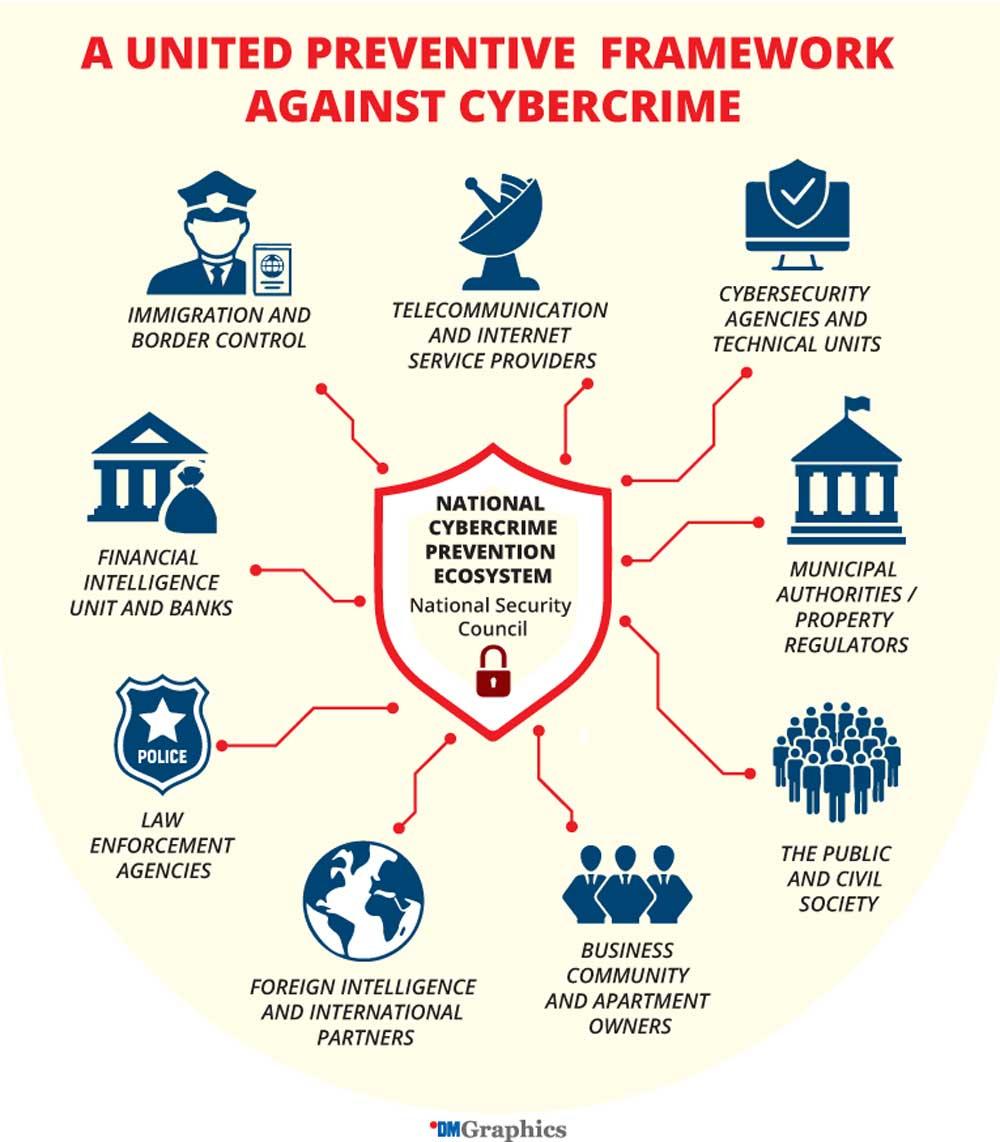
The real issue lies in the absence of coordinated monitoring between immigration authorities, financial intelligence units, cybercrime investigators, telecommunications regulators and law enforcement agencies.
Cybercrime today is no longer confined to isolated online fraudsters operating from laptops. Many of these groups function as highly organised transnational criminal cartels with international linkages, encrypted communications, financial laundering systems and sophisticated operational structures. Some possess direct or indirect connections to organised crime syndicates involved in online gambling, narcotics trafficking, money laundering, identity theft and digital financial manipulation.
This is precisely why the national response cannot remain limited to reactive police raids and post-crime arrests. What matters most is not detection after the crime has already occurred but prevention before these networks become operationally entrenched within the country.
The failure to identify and disrupt such operations at an early stage creates serious national security consequences. Once these syndicates establish operational infrastructure, digital platforms, financial pipelines and local facilitators, they can rapidly evolve into larger clandestine criminal ecosystems that become increasingly difficult to dismantle.
Sri Lanka therefore urgently requires an integrated intelligence-led national security framework where law enforcement agencies operate in close real-time coordination with:
Domestic intelligence services,
Immigration and border control authorities,
Financial Intelligence Units,
Telecommunications regulators,
Cybersecurity agencies,
International law enforcement organisations,
Foreign intelligence and counter-cybercrime agencies.
Information sharing must move beyond bureaucratic silos and fragmented institutional rivalries. Real-time intelligence fusion, predictive threat analysis and proactive disruption capabilities are no longer optional. They are essential national security requirements.
Countries confronting sophisticated cyber threats have already recognised that cybercrime syndicates operate through compartmentalised clandestine networks using tourist visas, shell companies, cryptocurrency channels, online gaming fronts, remote employment claims and luxury accommodation to camouflage illegal operations.
Sri Lanka still appears to be reacting after the damage is done rather than proactively identifying suspicious behavioural patterns before criminal activity matures. The Financial Intelligence Unit, cybercrime divisions and immigration authorities must immediately establish a coordinated monitoring mechanism capable of identifying:
Unusual concentrations of foreign nationals in specific apartment complexes,
High-volume internet and digital communication activity,
Large unexplained financial transactions,
Repeated short-term visa extensions,
Suspicious company registrations,
Virtual office structures,
Cash-heavy rental arrangements,
Cryptocurrency-linked financial movements,
Frequent movement patterns linked to organised networks.
At the same time, Sri Lanka’s legal framework remains outdated and fragmented when confronting modern transnational cyber syndicates. Stronger laws are urgently required to:
Enable rapid intelligence sharing,
Expand lawful digital surveillance capabilities,
Strengthen cyber forensic investigations,
Freeze suspicious financial assets immediately,
Facilitate expedited deportation of foreign nationals linked to cyber-enabled crimes
Prevent abuse of visa sponsorship mechanisms and shell company operations.
Foreign nationals directly connected to organised cybercrime operations must face swift deportation procedures following due legal process. Sri Lanka cannot afford to become a comfortable operational base for international cybercriminal syndicates exploiting weaknesses in governance, intelligence coordination and law enforcement.
Breaking these networks also requires far more than conventional policing. Modern cybercrime syndicates function through hidden compartmentalised cells protected by digital anonymity and transnational financial systems. Penetrating such structures requires the integration of physical surveillance, human intelligence, cyber intelligence, telecommunications analysis, digital forensics and covert operational capabilities.
The country must invest aggressively in both technological capacity and specialised intelligence capabilities to identify and dismantle these clandestine networks before they become deeply rooted.
Equally important, Sri Lanka must avoid creating xenophobic hysteria against all foreigners residing in the country. Many foreign professionals, investors and tourists contribute positively to the economy and society. The target must remain organised criminal networks, not innocent foreign residents or law-abiding property owners acting in good faith.
However, the present trend should serve as an unmistakable national warning.
Sri Lanka is confronting a new generation of organised transnational crime that exploits digital technology, weak regulatory systems, institutional complacency and outdated laws. Attempting to criminalise landlords who merely rented apartments after obtaining the required documents is not only unjust but also a dangerous diversion from the systemic failures that allowed these networks to flourish.
The country has already paid a devastating price in the past for ignoring intelligence warnings, institutional fragmentation and failures in preventive security architecture. Repeating those mistakes in the cyber domain would be a catastrophic strategic failure.
Cybersecurity is no longer simply an IT issue. It is now a core pillar of national security, economic stability and sovereign protection.
Sri Lanka must therefore decide urgently and decisively whether it intends to remain a reactive state that merely arrests criminals after the damage is done, or whether it will finally build the intelligence, legal, immigration and cybersecurity architecture necessary to prevent the country from becoming a regional sanctuary for organised transnational cybercrime.
The time for excuses, blame-shifting and fragmented responses is over. If the state fails to act now with seriousness, coordination and strategic foresight, Sri Lanka risks becoming not merely a victim of cybercrime but an international operational hub for organised digital criminal cartels.
Mahil Dole, SSP (Retired), is the former Head of the Counter-Terrorism Division of the State Intelligence Service of Sri Lanka, and has served as Head of the Sri Lankan Delegation at three BIMSTEC Security Conferences. With over 40 years of experience in policing and intelligence, he writes on regional security, interfaith relations, and geopolitical strategy. He is also Managing Director Smart Security Solutions Pvt. Ltd