 Kamanthi Wickramasinghe
Reply To:
Name - Reply Comment
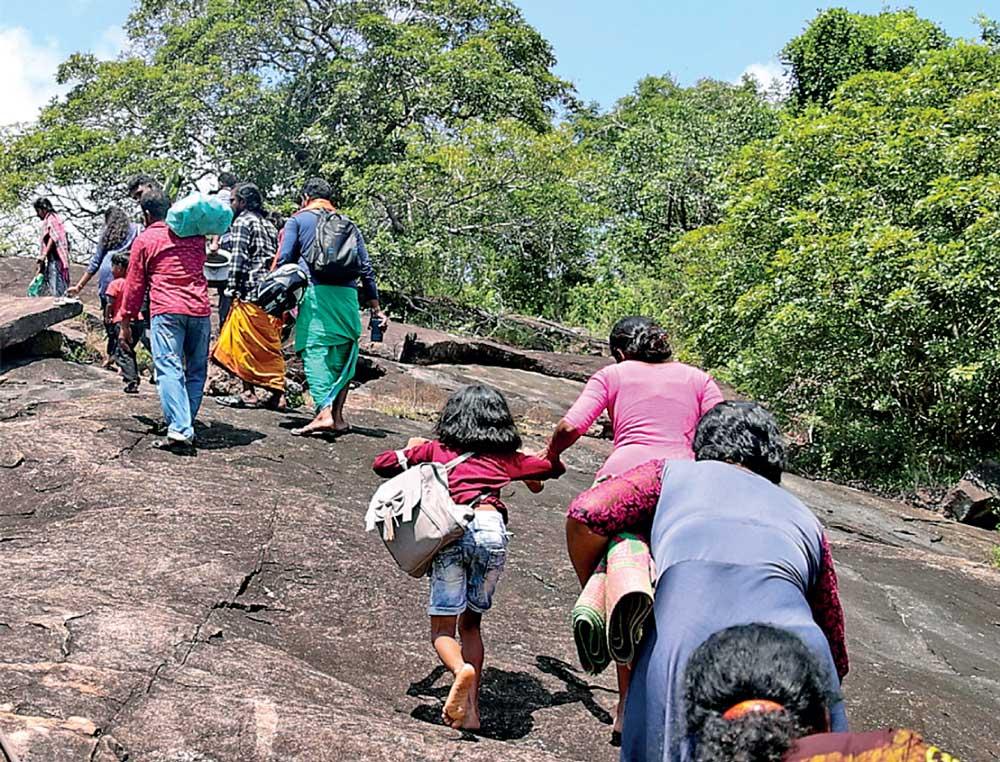
Devotees traveling by foot to attend a Hindu festival which has become inaccessible over time. “Image courtesy - CPA
When incumbent President Anura Kumara Dissanayake visited Jaffna in January this year, he said that land belonging to people should rightfully remain with them and that the issue of land disputes in the Northern province is being reviewed. However, in March, the government issued a gazette notification (No. 2340) which gave three months’ time for people to claim their lands in what was termed as a land settlement gazette. If the ownership of 5941 acres listed in the schedules was not confirmed within three months, such land will be taken over by the state, warned the Department of Land Titles Settlement through this Gazette. But due to strong opposition by Tamil politicians, communities and civil society groups who termed this attempt as a ‘state-sponsored land grab,’ this gazette was revoked on Tuesday (27). Yet, the issue of land rights remains unresolved.
 We understand that many of these families have fled their ancestral lands during the height of the conflict and some don’t have copies of deeds. Even if they have these documents, they are not clear”
- Deputy Minister of Land and Irrigation, Dr. Susil Ranasinghe
Fierce opposition
While land conflict is a sensitive issue for people who had grappled with the extremities of the war, many families remain displaced even after 16 years since the war ended. Tamil politicians questioned the basis of issuing this gazette while criticising the government for requesting land ownership documents from families who fled these lands at the height of the conflict. But speculation is rife whether the government would continue their efforts to reclaim these lands through other bureaucratic means.
However, when MPs representing the North and East met with Prime Minister Dr. Harini Amarasuriya on May 23, they pointed out that there is a prevailing suspicion among the public due to the procedures followed by previous governments in clarifying land ownership in these regions and that many rightful landowners lack proper documentation to prove ownership. They emphasised the need for a structured process that regained public trust. Following this discussion, Dr. Amarasuriya assured that the government has no intention of acquiring the lands owned by the people of the Northern and Eastern provinces and that the aim of the government is to promptly return land ownership to those who rightfully own them
A call to resolve outstanding land issues
Speaking to the Daily Mirror, human rights lawyer and former Commissioner of the Human Rights Commission Ambika Satkunanathan appreciated the government for taking note of the protests and concerns raised by civil society and Tamil political parties and for withdrawing the gazette. However, she said that it was concerning that it was issued in the first place, as it would have only exacerbated existing land issues in the north. “It has also created mistrust of the government amongst the Tamil people. It is hoped that the government understands that land-related issues, such as colonisation and land appropriation, are the root causes of the ethnic conflict. Hence, any action regarding land in the North and East has to be taken in light of historical factors, the impact of state action on the war-affected populations in these areas and a consultative and transparent manner. The first order of business should be to resolve outstanding land issues,” she underscored.
‘Kuchchaveli’
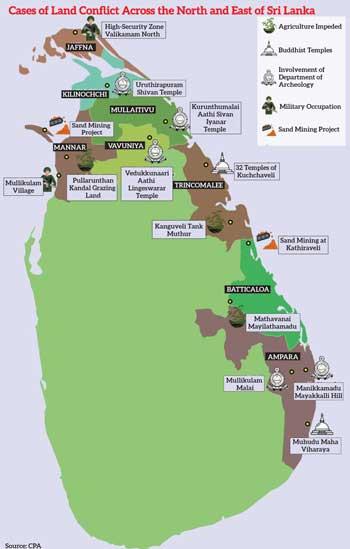
A recently filmed documentary titled ‘Kuchchaveli’, led by the Centre for Policy Alternatives (CPA) with the support of Australian Aid on land conflict in the Northern and Eastern provinces, delves into the depths of how majoritarian policies have disrupted the relationship between people and their lands. In these provinces, land is more than just a resource. It is a source of identity, livelihood, beliefs and heritage. Directed by Selvaraja Rajasegar, the videography by Noopura Liyanage reveals numerous incidents of religious sites and lands used by the Tamil and Muslim communities being uprooted, renamed and reclaimed as sacred Buddhist areas. The growing involvement of the Department of Archaeology, the Forest Conservation Department and the Mahaweli Authority has added to the tensions in land conflicts. The documentary underscores how these agencies often act without prior notice or consultation with locals.
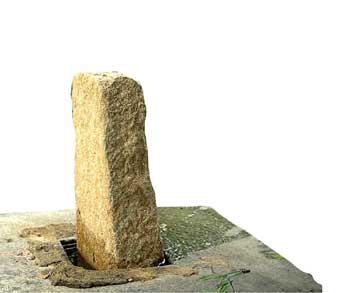 |
| A remaining structure of a Hindu place of worship |
Statistics indicate that the Kuchchaveli division in Trincomalee has witnessed the construction of over 32 Buddhist temples, often claimed as ‘purana viharaya’ despite little to no evidence. According to locals, the construction of these temples has involved the appropriation of over 2500 acres of private land. Much of these lands belong to Tamil and Muslim families who have worked on them for generations. For them, this is not just an economic loss but a matter of identity, heritage and survival.
Many places of worship have been renamed and devotees have been barred by the police, Special Task Force and military from entering these sites except on special occasions. One such example is the Kandaswami Kovil in Thennamaravadi, which was renamed as Sankamale Purana Raja Maha Viharaya. Ceremonies done in view of Hindu religious ceremonies were stopped, declaring the site an archaeological reserve.
The documentary reveals how lands on which Hindu temples and mosques were built prior to the ethnic conflict are being reclaimed and declared as lands for Buddhist temples under the Pooja Bhoomi grant laws, mainly under the guise of heritage preservation claims. It had been identified that Buddhists constitute under 5% of the population in these areas.
 “It is hoped that the government understands that land-related issues, such as colonisation and land appropriation, are the root causes of the ethnic conflict”
- Human Rights Lawyer and former Commissioner of the Human Rights Commission, Ambika Satkunanathan
 Certain other families who returned fled their homes at the height of the ethnic conflict and returned in 2004 realised that many of their lands were occupied by the military. Residents in Ponmalaikuda faced a similar plight and they were forced to return to temporary shelters. This displacement affected their lives and severed their connections with ancestral lands.
Resolving disputes in lands with contested religious histories and addressing claims made in the name of national heritage must become a priority. The documentary proposes that a clear and impartial review of current policies that disproportionately favour one community over others is required. The inability or unwillingness to address these issues will not only exacerbate existing conflicts but also impede Sri Lanka’s efforts in rebuilding and reconciliation.
An assurance from
the govt.
When inquired about land appropriation under heritage preservation claims in the North, Deputy Minister of Land and Irrigation Dr. Susil Ranasinghe said that even though he is not aware of such complaints, authorities are determined to investigate such matters. Speaking about the gazette which was revoked, Dr. Ranasinghe said that land issues in the North and East cannot be resolved according to procedures applied in other provinces. “We understand that many of these families have fled their ancestral lands during the height of the conflict and some don’t have copies of deeds. Even if they have these documents, they are not clear. Therefore, we are planning to have discussions with grama niladhari officers in respective areas, civil society groups and communities to expedite this process in an efficient manner. The main purpose of this gazette is to provide documentation for people who claim ownership of their lands so that they would have clear deeds,” he explained.
Dr. Ranasinghe further said that they have received complaints about people cultivating on lands coming under the purview of the Forest Department. “However, we later found out that the margins of certain forest reserves were marked using coordinates from Google Maps. Therefore, we will establish a committee to ensure that the margins of these forest reserves are properly demarcated so that they don’t overlap with lands that are being cultivated by farmers,” he added.
Several attempts made by this writer to contact Archaeology Department Director General Prof. Thusitha Mendis to inquire about claims made in the documentary pertaining to the Department’s intervention in land appropriation attempts in the
North and East proved futile.