 Kamanthi Wickramasinghe
 Reply To:
Name - Reply Comment
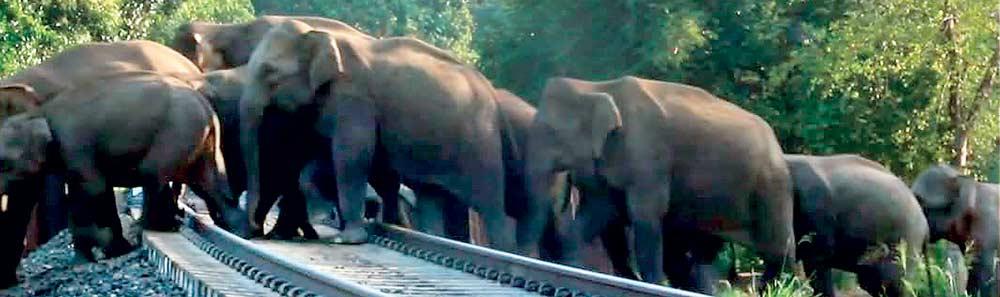
Herd of elephants crossing a railway track in Kasikote, Galgamuwa (Image courtesy - R. M. J Bandara)
At least nine elephants succumbed to injuries as a result of elephant-train collisions by March 2025. The frequency of elephants colliding with trains traveling towards Mannar, Batticaloa and Trincomalee have raised concerns among the wildlife fraternity. Even though many solutions have been proposed, none of these interventions proved to be successful. But in a bid to reduce the probability of elephant-train collisions along these railway routes, the Railways Department recently revised the train schedules for the trains ‘Udaya Devi’, ‘Pulathisi’ and ‘Meenagaya’ in addition to trains 7083 and 7084. The new schedules came into effect from March 7.
Adherence to speed limits critical until more effective solutions are found: Dr. Pilapitiya.
A combination of factors contribute to trains colliding with elephants at night. However conservationists opine that revising the train schedule would reduce the probability of elephant-train collisions and that locomotive drivers should adhere to speed limits when traveling through elephant crossings. Speaking to the Daily Mirror, elephant ethologist Dr. Sumith Pilapitiya explained how successive regimes have failed in implementing a practical solution to minimise elephant-train collisions and why a coordination between departments is required at this point.
Excerpts:

 Elephant-train collisions have been a regular occurrence over the past few years. Why did past regimes fail to address this issue?
Every time there is an elephant-train collision, the government, the public and NGOs get activated and committees are appointed to explore solutions to the problem of elephant-train collisions. The committees prepare reports with proposed solutions. It takes a few weeks or months for such reports to be prepared. However, we Sri Lankans have short memories and by the time the reports are prepared, the issue of train-elephant collisions is no longer in the news. Then successive governments raise the issue of a lack of funds to implement the recommended actions, so the mitigation measures are never implemented. This is an example of the lack of political and institutional will to address this issue.
Seven elephants succumbed to injuries when they collided with the Meenagaya train. The railway department is now taking steps to revise the train schedule. Is this a feasible solution?
Revising the train schedule to avoid travel in the areas of elephant movement at night will certainly contribute towards reducing the probability of elephant train collisions. But this action alone is not a solution—it is one among many actions that need to be taken to minimise the probability of elephant train collisions.
It has been revealed that there are several elephant corridors falling via the railway tracks. What could be done to save the remaining elephants from colliding with trains and succumbing to injuries?
To the best of my understanding, the section between Kekirawa and Hingurakgoda has been an area of many such accidents. This is largely due to the elephant population in this area moving between Minneriya National Park, Kaudulla National Park, Hurulu Eco Park and Gal Oya Eco Park and the surrounding areas of these protected areas. Radio collaring data and observations show many such crossing points. Elephant mobility is largely due to habitat requirements, so such movements need to occur for the elephants’ long term survival. In some countries overpasses and underpasses have been used to facilitate elephants crossing linear transport infrastructure like railroads. But it appears from radio tracking data that there are many crossing points, so a proper feasibility study of potential crossing points for considering overpasses and underpasses should be undertaken before large public investments are made.
In the short term, according to what some railway engine drivers have told me, visibility on either side of the rail track is not very good. They suggest that the clearance of the shrubs on either side within the railway reservation may help in better visibility. But creating grasslands on either side of the railway track is also a concern as grasslands may attract elephants to the side of the railway track. The sections where frequent elephant crossings have been observed have been designated with lower speed limits. Strict adherence to speed limits in these sections is critically important, as it may provide the engine driver adequate time to stop the train if elephants are crossing. From what I have heard, at 35 kmph it takes over a 100 meters for the train to stop, whereas at 60 kmph it takes almost 500 meters for the train to stop. Early warning systems using thermal cameras etc., would be futile if the train is going at high speeds because of the required stopping distances. So adherence to speed limits is critical until more effective solutions are found.
There also seems to be a lack of coordination between the Railways Department and Department of Wildlife Conservation. Your observations?
I think that there could be much better coordination between Railways and DWC. Coordination was somewhat limited in the past. But I attended a meeting on March 3 which was called by the Attorney General to discuss HEC issues, which included elephant-train collisions. The General Manager Railways and Director General of DWC were both present at the meeting. I was very encouraged by the tone of the meeting because I felt that there was genuine interest among the two agencies to work collectively to address this problem. Some immediate steps to be taken were discussed and agreed upon by the two heads of agencies. Hopefully, this time there will be some concrete action taken to address this problem.
More interventions to reduce elephant-train collisions
According to the Railway Trade Union Alliance, several practical measures have been taken to reduce the probability of elephant-train collisions. “For instance we have taken steps to clear the shrubs on either side of the railway tracks; particularly near elephant crossings so that the drivers could have more visibility,” said Co-convener of the Railway Trade Union Alliance, S. P Vithanage. “Revising the train schedule is just one step to address this issue. These efforts are taken in collaboration with the Railways Department, Transport Ministry, Department of Wildlife Conservation (DWC), Environment Ministry and Ministry of Digital Infrastructure,” Vithanage said.
When asked about speed limits, Vithanage said that train drivers do adhere to speed limits along the Colombo-Mannar, Colombo- Trincomalee and the Northern Railway line to some extent. “Speed limits depend on the terrain they travel on. They have a different speed limit when traveling through hilly areas and a different speed limit when traveling on flat ground. In addition we have installed signboards near elephant crossings to alert the train drivers,” Vithanage added.
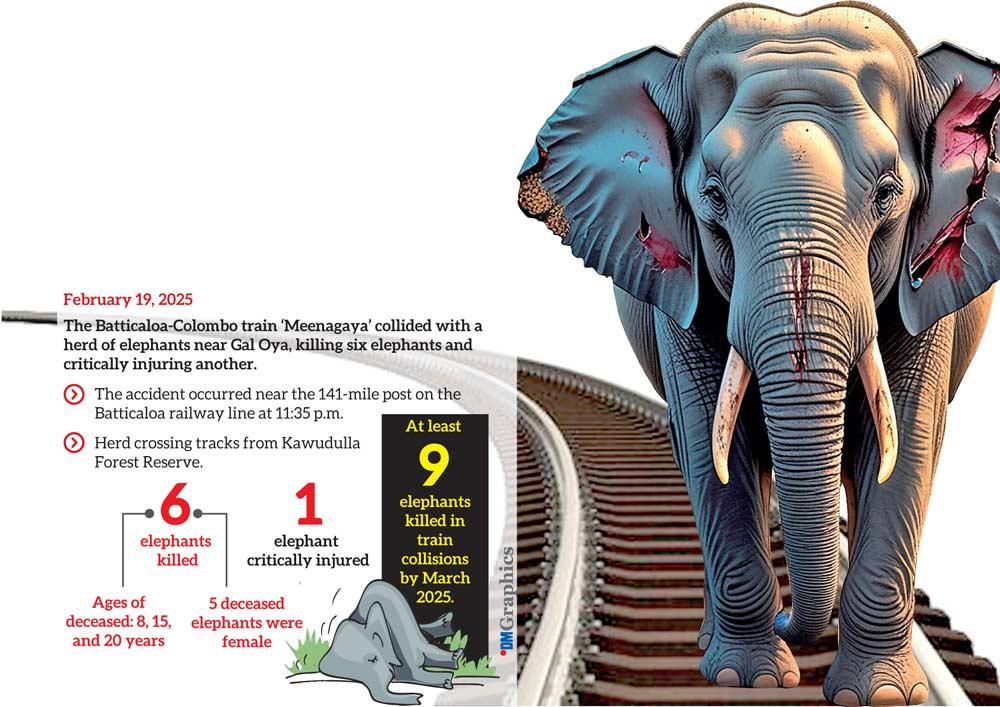
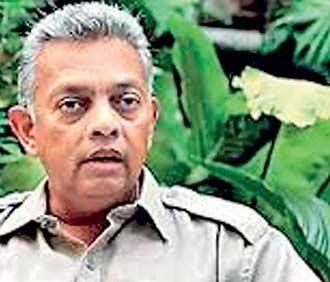
 To the best of my understanding, the section between Kekirawa and Hingurakgoda has been an area of many such accidents. This is largely due to the elephant population in this area moving between Minneriya National Park, Kaudulla National Park, Hurulu Eco Park and Gal Oya Eco Park and the surrounding areas of these protected areas. Radio collaring data and observations show many such crossing points”
- Dr. Sumith Pilapitiya Elephant Ethologist
A pilot effort for the time beingIn his comments, DWC Acting Director General Ranjan Marasinghe said that a plan should be initiated to minimise the frequency of elephant-train collisions. “Therefore we decided to revise train schedules as a pilot intervention. It is said that train drivers shift their focus during the fourth hour of their journey and therefore the schedules have been revised accordingly. We have a presumption that this effort would be successful but we have to implement it and see the results for ourselves,” he added. |