Reply To:
Name - Reply Comment
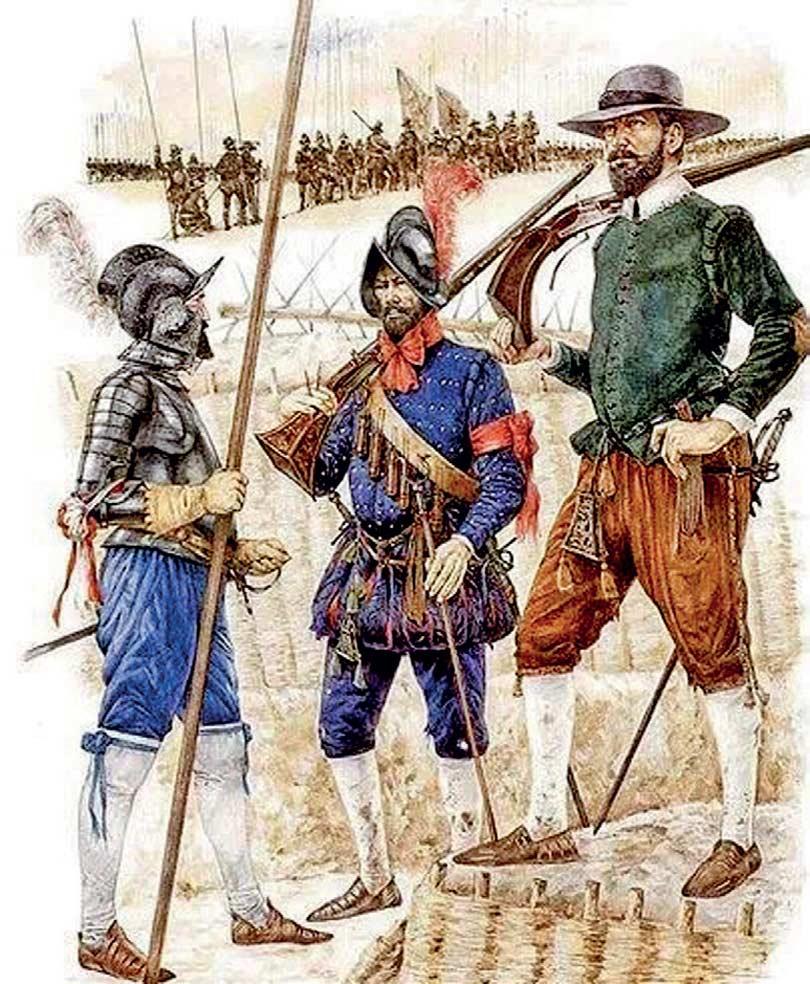
Portuguese soldiers who engaged in combat
 Captain General De Sa was eventually doomed by his dreams of capturing Kandy
Kandy was seen a perpetual threat, inciting rebellions in Kotte and other lowland areas
In 1619, De Sa attacked Mayadunne again, torching his mountain capital of Maddegama Nuwara
 As we have seen, the Portuguese were saved from king Senarat’s siege of Colombo in 1630 with their artillery firepower and help sent from Goa. But their suffering was great, undergoing starvation, disease and a crippling loss of revenue.
The siege came in the wake of the disastrous Portuguese defeat in the battle of Randeniwela, when captain general Don Constantino de Sa and almost his entire army were wiped out in a single day.
But Diego de Mello de Castro, appointed the new captain general of Colombo in 1633, chose the path of war even though the peace treaty signed between Senarat and the Portuguese the same year was advantageous to them. De Mello seems to have forgotten all about what happened to his predecessor. To understand this, we must look at Portuguese policy since they established a fort in Colombo in 1517.
It was one of conquest. The first stage was gaining control of the kingdom of Kotte, and then over the maritime provinces, with forts guarding the principal ports. Kandy was seen a perpetual threat, inciting rebellions in Kotte and other lowland areas. As Lancarote de Seixas, who became acting captain general after De Sa, argued: ‘No man is safe with an enemy in his own house.’
‘If we do not conquer Kandy,’ wrote Luis Teixeira de Macedo, ‘all the Portuguese will one day be killed in their sleep.’ He even argued that once Kandy was conquered, the island could after a few years provide money and material to support other Portuguese conquests in the East.
It was the dream of every Portuguese captain general of Colombo to go down in history as the conqueror of Kandy and the whole island. Conquest of Kandy would have been the jewel in the Portuguese crown.
Besides, by the 1620s, the Dutch and the English were threatening Portuguese colonies in South and South East Asia. This convinced the viceroy in Goa that domination of Sri Lanka (Ceylon then) should be completed before the Dutch managed to get a foothold. King Senarat had already met a Dutch ambassador.
As historian C. R. de Silva puts it in his ‘Portuguese in Ceylon 1617-1638,’ Constantino de Sa de Noronha who took over as captain general of Colombo in 1618 ‘was a natural leader of men.’ According to Portuguese historian De Queyroz: ‘He has gallant disposition and manly frame and stature, tall and robust along with great strength, firmness and perfect health won him respect.’
De Sa’s career depended on proving himself, and he left Portugal for the East out of economic necessity. As C. R. de Silva puts it: ‘He had inherited little. His marriage in 1607 to Dona Luiza da Silva de Medonca was merely a union between two impoverished households.”
As captain general, De Sa set about re-organising the Portuguese forces in the island energetically. He appointed Felipe de Oliveira as their captain major. He even established a spy network to counter the excellent intelligence services of Sinhalese rebels in Sabaragamuwa and built a new stockade there. He tried diplomacy, too, realising that peace with Kandy was essential to defeating rebels fighting him in the lowlands.
In 1618, he led 300 Portuguese and 300 lascarins to eliminate the power of Mayadunne and Kuruvita Rala, a rebel leader waging guerilla warfare. While this was not fully achieved, the conquest of Jaffna in 1619 strengthened De Sa’s power a great deal. Communication between India’s Malabar and the Coromandel coasts became safer, and isolated the Dutch settlement at Pulicat. Control of Jaffna gave De Sa greater control over the supply of elephants from the Vanni, and also over the pearl fishery in Mannar.
In 1619, De Sa attacked Mayadunne again, torching his mountain capital of Maddegama Nuwara. As Mayadunne was King Senarat’s enemy as well, there was military co-operation between the king and De Sa, and Senarat’s soldiers joined the Portuguese force on one occasion to fight Mayadunne, who was once forced to take refuge aboard a Dutch ship.
Mayadunne’s trusted General Kuruvita Rala was killed in 1620, and he was forced to leave the island after this blow. The Portuguese were alarmed by growing Dutch power as the latter established themselves in Indonesia under Jan Pieterzoon Coen. But there was no immediate Dutch threat to Sri Lanka. Threats to Kotte and Jaffna were pacified and an uneasy peace was maintained with Kandy.
At this point, De Sa was recalled to Goa and a new captain general appointed. But his rule was corrupt and a disaster. Once De Sa was re-instated in his post, he began his interrupted work of consolidating Portuguese power vigorously. As stronger coastal defences were needed to counter the Dutch threat, he strengthened existing forts and built a new fort at Kalutara.
The treaty of 1617 had given the ports of Batticaloa and Trincomalee along with the entire eastern seaboard to Senarat. De Sa now began to build a fort in Batticaloa to forestall any Dutch attempt to seize it. This risk renewed war with Kandy. But the king of Portugal himself had chosen war over peace. A letter dated February 8 1622 decreed that peace be made only on condition that Batticaloa belonged to the Portuguese. It was decided to build a fort in Trincomalee as well.
Due to rebellions in Kandy, Senarat’s power was weak. De Sa arrived in Trincomalee with a strong force and started building a fortress. The Kandyans were not in a position to wage war, and peace was maintained.
As 1624 ended, De Sa asked the viceroy permission to resume war with Kandy. He was alarmed by Senarat’s idea of marrying the daughter of Sankili, the late ruler of Jaffna, to his eldest son. The Portuguese rejected this plan, but two of Sankili’s nieces from Tanjore were chosen as brides for Senarat’s two sons.
In March 1630, Kandyan forces blockaded Batticaloa. This, plus Senarat’s new Tanjore connection, convinced De Sa that his side was losing control of the situation.
After putting down a plot to hand over the fort of Colombo to Senarat’s forces by stealth, De Sa began his ambitious invasion of Kandy on August 3 1630 with high hopes (to be continued).