Reply To:
Name - Reply Comment
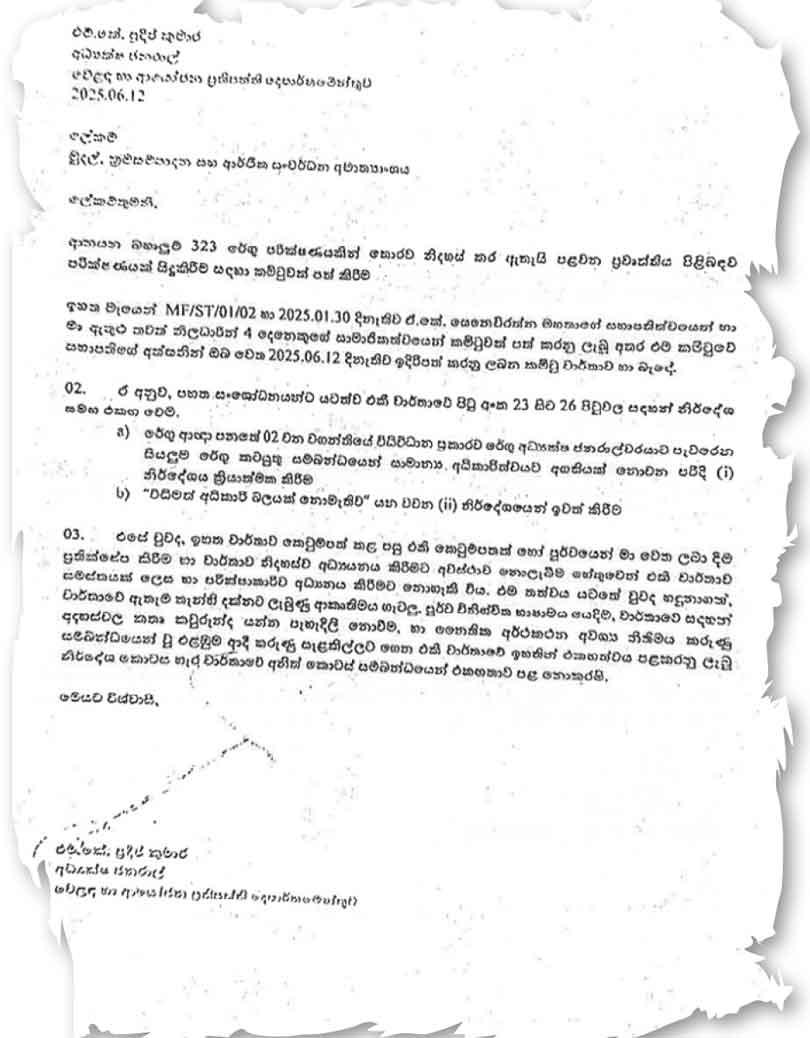
The following is a copy of a report, produced by a committee appointed by the President Anura Kumara Dissanayake to investigate the issue where 323 containers were released from
Sri Lanka Customs without being subject to regulations
By Prageeth Sampath Karunatilake
On 18 January 2025, Sri Lanka Customs released 323 shipping containers in its custody without conducting inspections. The release of these containers raised concerns among Customs Trade Unions, civil society groups, and the general public, because this whole procedure left room for individuals representing the above mentioned categories to speculate that some of the containers have contained illegal, harmful, or misdeclared items. In response, the Secretary to the Treasury directed that the release process be reviewed and a report submitted. Accordingly, by letter No. MF/ST/01/02 dated 30 January 2025, the Treasury Secretary appointed a four-member inquiry committee headed by a Deputy Secretary to the Treasury. This committee was appointed by order of the President. Although it was initially reported that 323 containers had been released from the port, according to the committee report, the actual number was 309. The opposition members of the parliament alleged that certain facts in the committee’s report were being suppressed or concealed. Nevertheless, the committee’s report on the release of the 309 containers is available and identifies those responsible for releasing them without inspection.
The Director General of Customs has been granted powers under the Customs Ordinance to resolve container congestion within the Customs premises. However, in exercising those powers, the Department has acted outside the accepted procedure of the Risk Management System established for container clearance. Specifically, 309 containers, including red flagged containers were released without physical inspection.
High-risk containers
The committee concluded that this action exceeded the extraordinary powers granted to the Director General under the Customs Ordinance and was therefore unlawful. It further emphasised that bypassing established procedures and releasing high-risk containers without inspection posed serious risks to state revenue, national security, and public health.
Although the release of the containers was justified as a measure to resolve customs congestion, the committee appointed to oversee this process did not act transparently within its mandate. The committee investigating the release of these containers relied on primary data, secondary data, and scientific methods. A letter sent to the Ministry of Finance confirms that this committee, appointed with the approval of the Treasury Secretary, did not receive support from some individuals involved in the investigation.
The letter specifically notes that the contribution of M. P. K. Kumara, Director General of the Department of Trade and Investment Policies and a committee member, was minimal. While the active participation of all committee members was essential for its proper functioning, the report indicates that M. P. K. Kumara did not actively contribute to the committee’s work.
The other committee members made their full contributions and submitted their recommendations, as noted by the Chairman of the Committee, Deputy Secretary to the Treasury A.K. Seneviratne, in a letter to the Secretary to the Treasury. Subsequently, M. P. K. Kumara informed the Secretary of the Ministry of Finance, Planning, and Economic Development in a letter that he had not received a draft of the report. As a result, his recommendations were submitted separately, and it was noted that he disagreed with certain points in the committee’s report.
The committee report points out that the containers classified as red, which were released by Sri Lanka Customs on January 18, 2025, had been released without legal provisions. Procedures to be followed in performing any duty within the government machinery are clearly established, and deviations should occur only in special cases. Such actions should not be taken at the discretion of any officer or the state.
In terms of Departmental Order No 1531, approval was granted to establish a Risk Management Directorate within the Customs. The objective was to enhance risk management operations to an internationally acceptable level, as stipulated under Article 7.4 of the World Trade Organization (WTO) Trade Facilitation Agreement. Its functions include identifying risks that hinder the achievement of the objectives of the Sri Lanka Customs Department, developing risk profiles, and classifying containers into high, medium, and low risk categories through an automated system, followed by the adoption of appropriate risk mitigation measures.
Accordingly, if the above containers were released, those identified by the system as high-risk ‘red’ containers should have been subjected to both physical and scan inspections. Containers classified as ‘yellow’ undergo sample and/or scan inspection; and those classified as ‘green’ are released solely on the basis of documentary inspection, without physical or scan inspection. A committee appointed by the Director General of Customs released high-risk red containers to resolve port congestion without physical inspection, while some containers were released only after a scan inspection. According to the committee report, it is confirmed by the written statement provided by the Director General of Customs that the release was carried out under the discretionary powers vested in him. The Director General justified his decision by citing the judgment in case no. CA 664/2001, Navarathna v. Director General of Customs and others.
Inadequate management
Sri Lanka Customs was compelled to release containers outside proper procedures due to inadequate management. The committee report highlights that conducting releases outside the established procedures has eroded public confidence in the Customs. The Director General of Customs, however, attempted to justify the action by invoking his powers under Section 2 of the Customs Ordinance, which states: “The Director-General of Customs shall throughout Sri Lanka, have the general superintendence of all matters relating to Customs.” This section does not provide exceptions for public policy or national security. The committee report clearly states that releasing containers classified as “red” without physical inspection was not a correct decision.
Section 2 designates the Director General as having general superintendence over all customs affairs, which entails overall responsibility for supervising, directing, and controlling the functioning of the Customs. This general superintendence implies high-level leadership and oversight to ensure that systems, staff, and procedures operate effectively, consistently, and in alignment with national objectives.
In CA 664/2001, Navaratne v. Director General of Customs and Others, the central issue concerned the Director General’s power to revise decisions made by subordinate officers. Several other cases have addressed the authority of customs officers, including Premachandra v. Jayawickrama (1994) 2 SLR 90, Jayawardena v. Ministry of Health (1984) 2 SLR 555, Balasingham v. Dissanayake (1982) 2 SLR 410, Sugathapala Mendis v. Chandrika Bandaranaike and Others (2008) 2 SLR 339, and Janath Withanage v. Pujitha Jayasundara SCFR 163/2019.
In particular, the case of Janath Withanage v. Pujitha Jayasundara emphasised that releasing high-risk red-classified containers without physical inspection constitutes a serious lapse and a high level of negligence. The committee report states that the release of these containers represented a deliberate neglect of duty by the Customs.
The Director General of Customs acted beyond his powers by releasing containers classified as red, which had been identified by the legally established risk management system within the Customs, without physical inspection, in an attempt to alleviate container congestion. The committee report emphasises that this action exceeded both the express and implied powers granted under the Customs Ordinance. By bypassing the risk management system established under departmental order No 1531, the standard procedures of the Customs were violated. Although the release was reportedly intended to reduce congestion, it represented a clear deviation from legally mandated processes.
Accordingly, high-risk red-labeled containers, identified by the risk management system—a legally mandatory process—were released without physical inspection. The committee report repeatedly points out that these were carried out only through scanning, without a physical inspection. The committee report confirms that the Director General of Customs has no authority under the Customs Ordinance to authorise such releases. The report further notes that his decision exceeded the legal powers granted and should have been justified through proper risk analysis, documentation, or procedure. Arbitrary action, as occurred, renders the legality of the release challengeable in court.
Under Section 2 of the Customs Ordinance, and pursuant to DOPL 1531, the risk management system was established in 2021 to replace the previously operating Screening Unit. Under this system, containers are classified as red (high risk), yellow (medium risk), and green (low risk).
Since July 2024, as a measure to ease container congestion in Customs, the top management decided that a four-member committee would handle container releases. This was stated in a written declaration submitted to the committee by the Director General of Customs. According to a written statement submitted by Seevali Arukgoda, then Additional Director General of Customs, authority had been delegated by the top management to two senior officers to minimise port congestion on 18 July 2024. However, no authority had been delegated to appoint three officers.
According to the written statement provided by the Additional Director General of Customs, it was recommended that a three-member committee releases the high-risk containers with red labels without subjecting them to physical inspection. It was stated that the release was carried out with the approval of the Director General and that he supervised the committee’s activities. The statement also indicates that three officers, along with the Director General overseeing the committee, were responsible for ensuring accountability and transparency in the committee’s work. Furthermore, the statement notes that, in making decisions on the release of goods, the participation of at least two officers was expected.
However, only one committee member participated in the release of 309 containers on 18 January 2025. Seevali Arukgoda, who acted as the supervising officer of the committee, also participated directly in the release process. Although two officers participated in the process, the committee report points out that since Seevali Arukgoda, who was the supervising officer of the committee, was involved in the container release process, no actual supervision took place. Accordingly, the report further indicates that these containers were not subject to the supervision of any officer.
The committee report further observes that the committee acted outside its designated objectives, functions, and criteria. The committee was given the authority to re-route containers classified as red under the risk management system after a scan inspection, without conducting a physical examination. However, the committee released 158 containers classified as yellow using the same procedure. Although scan inspections were required for containers classified as red, 151 red containers were not scanned. By not scanning these red containers, the opportunity to verify that they did not contain hazardous items was lost.
Because 37 red-labeled containers were not scanned, there is no certainty regarding the contents of 114 scanned containers, creating doubt about the safety of all 151 red-labeled containers that were released. Moreover, no authorization was given for the release of yellow-labeled containers, but 158 yellow labeled containers were released without physical inspection, of which 103 were not scanned.
The letter issued by the committee for the release of containers included five criteria in its third paragraph. According to the third criterion, the customs records related to the released containers should not exceed seven lines. However, the committee report shows that, for line 10 of the customs records, entries from line 07 to 74 were inspected.
It was reported that containers were released without physical inspection on 13 previous occasions. A total of 2,218 containers were released in this manner, of which 999 were classified as red and 1,219 as yellow.
The 309 containers released have been referred for post-audit. These containers were imported by 65 importers. Although the committee heads have provided written information on this matter, no report has yet been submitted regarding the risks identified during these audits. Consequently, it has not been possible to assess the economic losses or irregularities caused. The committee has also instructed that a forensic accounting report be prepared in this regard. It has been observed that the containers released by the committee on 18 January 2025 were physically removed from customs premises on the following dates: 17 January – 2 containers, 19 January – 55 containers, 20 January – 46 containers, and 21 January – 6 containers.
Not acting within scope
Most containers were not removed for more than two days from the date of release. In particular, the removal of 2 containers released on 17 January without physical inspection before 18 January raises questions. The committee report recommends that an internal customs investigation be conducted regarding this release. The committee met on 13 occasions prior to 18 January, during which containers were released without physical inspection. On some days, only a small number of containers were released. Thirteen (13) containers were released on 26 November 2024 and 63 containers on 14 January 2025. Details of the containers present in customs premises on the dates the committee met and authorized releases were provided to the investigation committee. The report notes that it was not possible to determine whether these releases relieved container congestion on those dates.
When questioned about the presence of drugs, weapons, gold, or other security-hazardous materials in the red-classified containers, Seevali Arukgoda indicated that no such items had been reported. However, the committee report notes that Arukgoda confirmed that cases of drug importation had been detected during routine customs checks.
According to the investigation report on the container release process, the method used to release containers was unlawful and violated established procedures. It has been confirmed that removing high-risk containers without physical inspection could have serious consequences for state security, state revenue, and public health. The committee report also highlights concerns about the transparency of the Container Release Committee and whether the release of containers actually resolved congestion at Customs. The observations indicate that the committee did not act within the scope of its assigned duties and that the current risk management system does not accurately reflect true risks. It is also questionable whether the powers granted to the Director General of Customs under the Customs Ordinance to resolve container congestion were properly exercised. The release of 309 red-classified containers exceeded the general superintendence vested in the Director General.
A total of 309 containers were released outside the approved procedures. Accordingly, the committee report states that the release of containers classified as red constituted a violation of the prescribed release procedure. Since this was carried out with the Director General’s approval, he too exceeded the powers granted to him under the law. Furthermore, the committee failed to take adequate follow-up measures to mitigate risks arising from the release of red-classified containers, putting the Customs’s role at risk. The executive summary of the committee report recommends that an internal investigation be conducted regarding containers identified during scan checks but not subjected to physical inspection.
|
Seevali Arukgoda |
When inquired about these matters, Director General of Customs, Seevali Arukgoda, stated: “Since an investigation is underway regarding the 309 containers that were released and the other two containers, I cannot comment on them. I will make a statement after the investigation is completed.”
When asked whether he had received the committee report regarding the 309 containers that was released and what he had to say about it, the Director General of Customs said, “I don’t know. We haven’t received any such committee report.”