 Kamanthi Wickramasinghe
 Reply To:
Name - Reply Comment
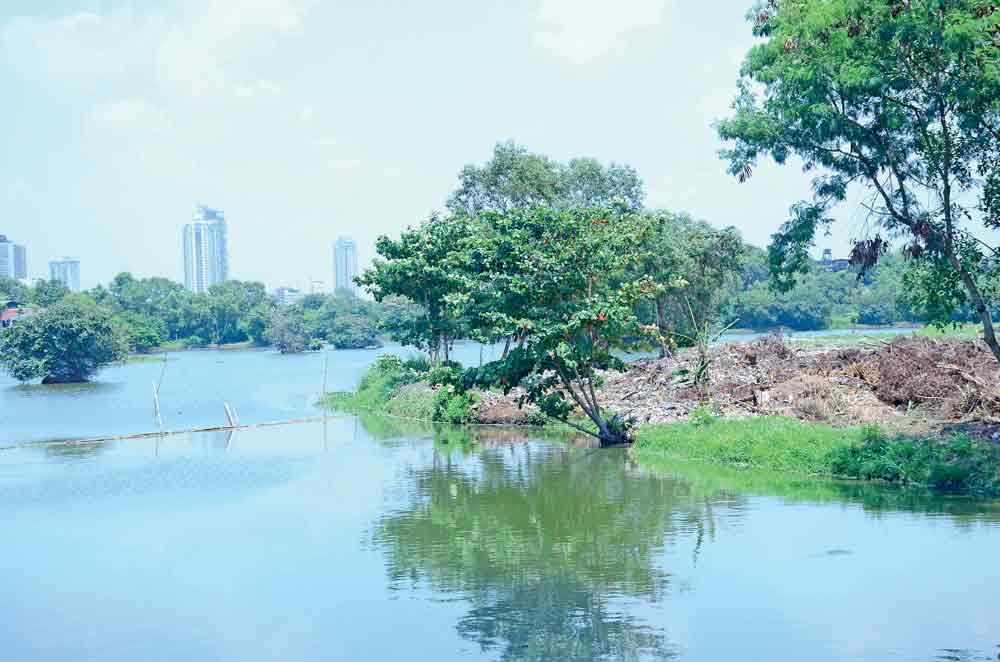
Heen Ela sanctuary following recent clearances
Jayantha Wijesingha

Prof. Sevvandi Jayakody
 Residents claim that prior to 2013 the area didn’t get flooded during the rainy season. But during the recent cyclone, the ground was flooded and it had impacted the neighbourhood which is located in a lowland area
Residents living near the Heen Ela sanctuary in Nawala have raised concerns regarding development activities happening in its surroundings. According to them, several trees and vegetation adjoining the Sri Lanka Land Development Corporation (SLLDC) ground were cut down and burned in early March, perhaps in an attempt to expand the ground area. Events taking place at the ground during weekends have become a public nuisance for most residents as they claim that the music and noise continue throughout the day.
Significance of the Metro Colombo Canal system
According to a 2018 study done on floods and countermeasures impact assessment for the Metro Colombo Canal system, the history of this canal system dates back to the times of King Parakramabahu VII. During his period, in the 15th century, Sri Jayawardenapura Kotte was established as the country’s capital. Between the 16th and 17th century, the Portuguese who ruled the country improved the canal system for efficient transportation. At present, it acts as a passage to drain out flood water from the Metro Colombo area. This canal system includes three main marshlands which act as flood detention areas. These include the Kotte Ela marsh, Heen Ela marsh and the Kolonnawa Ela marsh.
Destruction at Heen Ela sanctuary
The Heen Ela marsh was declared a Sanctuary in 2021 under the Flora and Fauna Protection Ordinance (FFPO) Section 2 sub-section 2, which allows the subject minister to declare any specified area of land as a sanctuary. Within a Sanctuary, activities like hunting, killing, taking or molesting any animal, as well as destroying nests/eggs, are prohibited. This means that the area falls under the purview of the Department of Wildlife Conservation (DWC) as well.
However, the Daily Mirror learned that the cricket ground in question was constructed in 2013. What was initially developed as a practice ground is now being outsourced for private events such as cricket matches. Residents claim that prior to 2013 the area didn’t get flooded during the rainy season. But during the recent cyclone, the ground was flooded and it had impacted the neighbourhood which is located in a lowland area.
With drainage systems blocked and due to low water absorption capacity, the residents are now facing inconveniences living in a once pristine location with an abundance of wildlife prior to 2013.
Gihan Jayasinghe, one of the residents in the adjoining neighbourhood, complained about noise pollution that they experience during weekends. “Sound permits issued by the Police clearly states that there can’t be any kind of public nuisance but we experience this nuisance regularly. Sometimes the noise is unbearable,” Jayasinghe said.
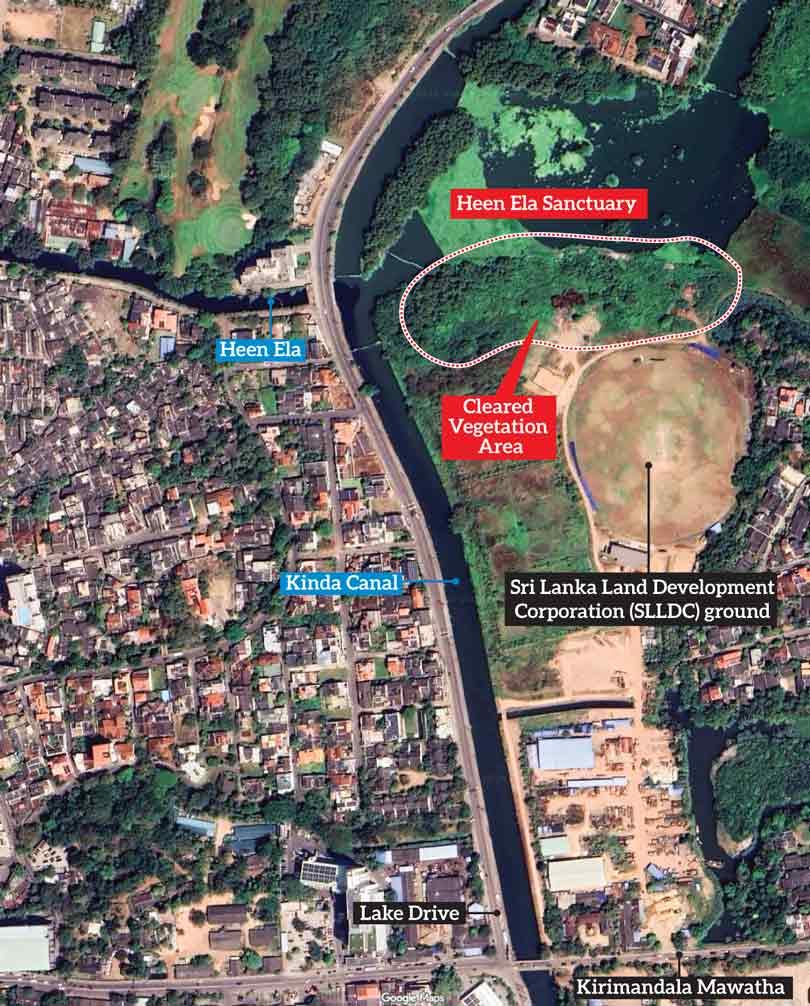
Concerns raised over prohibited activities
Jayantha Wijesingha, environmentalist and chief coordinator at Rainforest Protectors Sri Lanka said that this is not a project of national importance. “Around 20 tippers of rubble had been brought in to fill the area after dredging. So, the activities were stopped after most of the work had already been done. When we were notified, the area was cleared over a period of 5-6 days and the trees had been openly burned for another two days,” he said.
Open burning is regulated primarily by the National Environmental (Prohibition of open burning of refuse and other combustible matters) Regulations No. 1 of 2017, gazetted under the National Environmental Act. These regulations ban the open burning of garbage and waste to curb air pollution and environmental damage.
Wijesingha noted that it looks like they are arbitrarily filling up a ground located in a wetland. “Some of these spaces were initially used to store construction materials. Back in the day, they created parking slots for UDA project vehicles or to store UDA materials. Then, the lands that were used for such purposes were converted to grounds and other facilities,” he added.
Consequences of destroying urban wetlands
Speaking about the importance of urban wetlands, Prof. Sevvandi Jayakody, senior lecturer in environmental science at the Wayamba University, said that the presence of a marshland is the only precursor that maintains the green cover of Colombo. “Any damage done to the marshes will disturb the biodiversity and ecosystem services they render. The marshes of Colombo have undergone major changes due to human disturbances and development activities,” she observed.
She explained that wetlands act like a sponge that maintains the capacity to retain the excess storm water, making sure that millions of dollars are saved in creating artificial storm water drainages.
“These wetlands also provide water security to ongoing urban agriculture in Colombo thereby contributing to food security,” she added.
In terms of biodiversity, Prof. Jayakody spoke about the presence of killifish or Handaya in Sinhala (Aplocheilus Werneri and Aplocheilusdayi) that are surface feeding freshwater fish.
“They matter because one of their main prey items is mosquito larvae. It is a fish with a superior mouth used to skim and collect anything floating on the surface. Mosquito larvae always float on the surface because they need oxygen to breath. Therefore, these animals silently control mosquito-borne diseases,” she added.
Other services rendered by wetlands include retaining the sediment that flows with storm water and playing the role of a cleaning machine, regulating excess nutrients from water. “The plants carry out absorption and adsorption. These ecosystems are ensuring our survival. As a highly populated city, what a city should not do is to disturb the natural services given for free,” Prof. Jayakody further said.
She said that many countries like Australia are constructing artificial wetlands to manage the urban heat effect. “This is why many people are settling in cooler areas. Colombo as a city has not thought about managing the urban heat effect. But we still have an opportunity to use our wetlands.These wetlands therefore have a billion dollar value,” she added.
Prof. Jayakody noted that Sri Lanka has been playing centre stage in the RAMSAR Convention by accrediting Colombo as a urban wetland city. “Every government agency should understand that we are now talking about an accredited wetland city. Therefore,when government agencies or private entities carry out development activities, it is important to adhere to environmental standards and have due diligence. A disturbance to one unit will have profound impacts on the rest. Inter-agency coordination is paramount. After all, for Colombo to thrive as a city and an economic hub, it has to be a livable space,” she underscored.
Several attempts to contact DWC Director General Ranjan Marasinghe to inquire about human activities happening inside a sanctuary proved futile.
 However, when contacted, SLLDC Chairman Saman Senaweera said that this land is under their jurisdiction. “We have cleared some plants to allow for the grass to grow during the rainy season. We are also planning to grow some ecologically important trees to retain water in the nearby canal,” he added.
Senaweera said that if further developments are taking place, they will conduct an Environmental Impact Assessment (EIA) and obtain necessary approvals from environmental authorities.
“The cricket ground has been there for the past 10-15 years and some residents have had issues with noise levels during cricket matches. But we have been monitoring noise levels on decibel metres, and so far there have been no violations of noise levels beyond the recommended level,” he noted.
Pix by Waruna Wanniarachchi