Reply To:
Name - Reply Comment
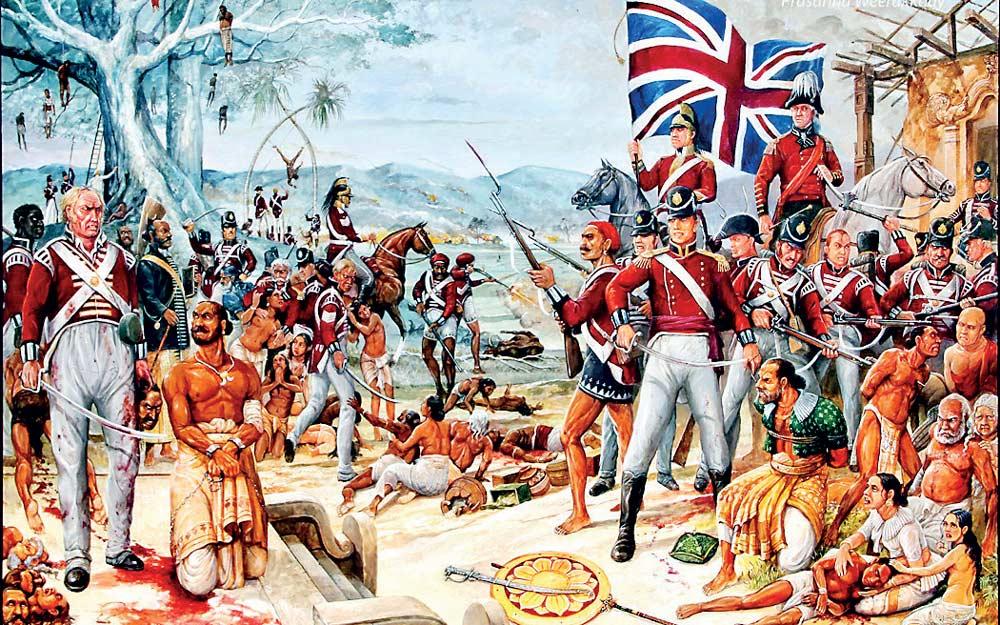
In the year1815 the whole of Ceylon came under the British rule

According to the definition given in the oxford dictionary “an independent state or country” is one that is free and not controlled by another state or country. Hence if a country is independent it should be called a sovereign state. According to Ernest Barker, sovereignty is unlimited or illimitable. Hence, any country should not intervene in the affairs of another country in any way. “Ultimately and as a last resort sovereignty is the constitution itself – the constitution which is the efficient and formal course of association which brings it into being, which forms and defines the organs and methods of its operations and may also form and define the purposes and operations. The impersonal scheme of the constitution is present day by day and year by year. It acts continuously and without interruption as the permanent control of the whole operation of the state. Secondary however and subject to the ultimate sovereignty of the constitution, there is the body which makes the ordinary law, in the sense of issuing the day to day and year to year law, rules of legal conduct, is the immediate sovereign”. In this context we have an opportunity to consider whether Sri Lanka had achieved this status when she gained independence on February 4 1948 and if so how she achieved this status and if not what more should be achieved to be fully independent.
Principles of “Mahasammata”
Except for South Indian invasions which took place from time to time Sri Lanka remained an independent state until the Portuguese invasion which took place in 1505. Sri Lanka was a monarchical Folk-State ruled by kings starting with Vijaya and ending with Sri Wickrema Rajasinghe. These kings were independent and possessed the highest possible authority. Most of them were accepted by the people. The people believed that these kings followed the principles of “Mahasammata” consent, agreement appellation of the first sovereign of the Surya race. There is historical evidence to the fact that the kings who acted contrary to the general will had been ousted by the rebels. Invaders who interrupted in the affairs of the country were defeated.
The reign of king Parakramabahu the Great can be sighted as an example of a period when the principles of sovereignty had been followed. There was a reformed constitution. The king was not a dictator.
Loss of sovereignty
After the invasion of Westerners and after the occupation of Maritime Provinces- initially by the Portuguese in 1505 followed by the Dutch and the British- we lost our sovereignty. They invaded our country not with sympathy for us but to get their needs and wants fulfilled. We were deprived of our fundamental rights. They exploited our land and introduced various crops like Tea and Coffee to earn profit for them and not for us.
Portuguese who invaded our country in1505 ruled the Maritime Provinces for one hundred and thirty years. They were especially interested in spices like Cinnamon, Pepper, Cloves and Areca as well as gems and ivory.
Dutch ruled the Maritime Provinces for one hundred and forty years, but the areas under their control were less than the areas controlled by the Portuguese. The governor had been instructed not to leave room for conflicts with the Kandyan kings. A notable contribution made by the Dutch is the introduction of the Roman Dutch law.
Provocation for an onslaught
In 1803 a British troop under the command of General MacDowell attacked Kandy when British and Muslim caravans were waylaid. Troops were sent again in 1805 to attack Kandy. These attacks were subdued, but the enmity between the king Sri Wickrama Rajasinghe and the Kandyan aristocrats developed after the execution of chiefs from Sabaragamuwa.
The king was so cruel to make such orders. Simultaneously a gang of British traders who were on their way to the hill country were captured and on the orders of the king were mutilated and driven back to Colombo with the mutilated parts tied round their necks. This was sufficient provocation for an onslaught on Senkadagala and this ended the sovereignty of Kandyan people which they enjoyed for 2357 years. The citizens rioted against the king and several dead bodies were heaped in the city. These incidents are evidence to the fact we could have remained independent without waiting for Fourth February 1948 if our forefathers had not been provoked by the last Nayakar king who shed crocodile tears when he was captured. The British fomented a revolt by the Kandyan aristocracy against the Kandyan monarch which resulted in the 1815 Kandyan convention whereby the whole country came under the British rule.
The struggle against the colonial power began in 1817 with the Uva rebellion when the same aristocracy rose against the British rule in a rebellion in which the villagers participated. They were, however defeated. An attempt was made again to rebel when the Kandyan peasantries were stripped of their land by the waste lands ordinance and the enclosure movement which reduced them to penury.
In 1848 the abortive Matale rebellion led by Hennadige Francisco Fernando (Puranappu) and Gongalegoda Banda was the first traditional step towards abandoning the feudal form of revolt and giving life to a fundamentally peasant revolt. The masses were without the leadership of their native king (deposed in 1815) or the chiefs (either crushed after the Uva rebellion or collaborated with the colonial power. The leadership passed for the first time in the Kandyan provinces into the hands of the ordinary people.
In the eighteen thirties coffee was introduced to Sri Lanka and a large extent of the land came under this crop together with the traditional subsistence holdings of villagers. The villagers refused to become waged workers. The planters brought hundreds and thousands of Tamil coolies from South India creating a serious problem. This was a heavy blow on the indigenous population.
Coffee was replaced by Tea during the eighteen eighties. Individual estate owners were supplanted by large consolidated companies based ether in London or Colombo. Mono culture was thus increasingly capped by monopoly within the plantation economy. The pattern thus created in the nineteenth century remained in existence and did not change with the grant of independence on February Fourth; 1948.The situation remained same till 1972 with a slight change in 1956.
The Buddhist revival was aided by the theosophists led by American Col. Henry Steel Olcott who helped in the establishment of Buddhist schools at the same time injecting the modern secular Western ideas into the Buddhist thought stream. Revivalists such as Anagarika Dharmapala started linking Buddhism to Singhaleseness creating a Sinhala Buddhist consciousness.
In 1915 commercial ethnic rivalry erupted into a riot Colombo against Muslims with Christians participating as much as Buddhists. British reacted heavily as the riot was also directed at them. Anagarika Dharmapala’s legs were fractured and his brother died in the struggle. Captain D.I Henry, a militia commander was shot dead. Inspector General of police, Herbert Dowbiggin became notorious. E.W.Perera, a lawyer from Kotte carried, hidden in the soles of his shoes, a secret memorial to the secretary of State for the colonies, pleading for the repeal of the martial law.
In 1919 Ceylon National Congress was founded to agitate for greater autonomy. A number of young leagues were formed by the young men and women who followed the path of Anagarika Dharmapala. The south Colombo youth league got involved in the Suriya Mal Movement and revived it on a new anti-imperialist and anti- war basis.