 Zainab Hussein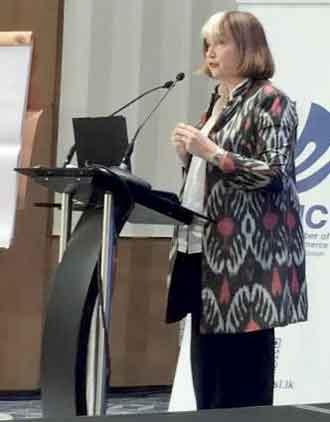
Reply To:
Name - Reply Comment
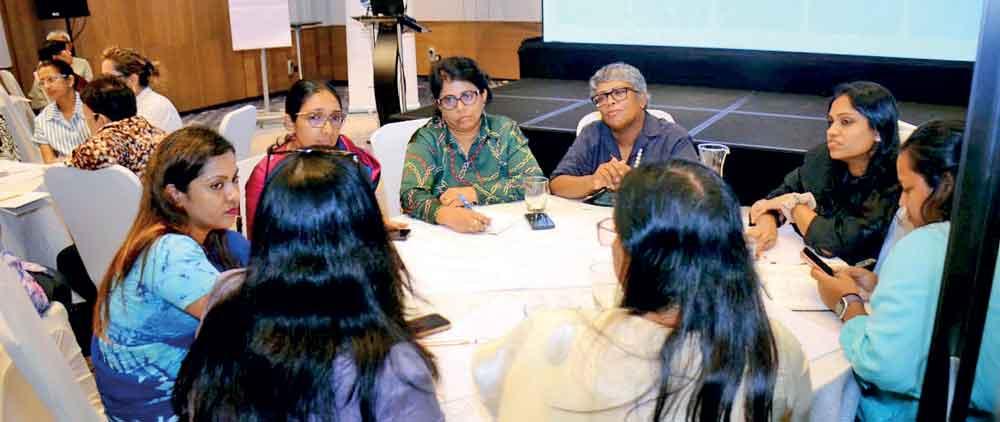
Participants at the workshop
Pix by Waruna Wanniarachchi
|
Joni Simpson, ILO Country Director for Sri Lanka and Maldives, addressing the audience at the workshop titled ‘What’s Next for Sri Lanka, with the ratification of ILO C190’ |
Violence and harassment faced by workers is a widespread and persistent challenge that needs to be addressed. The International Labour Organization (ILO) Convention No. 190 (C190) is the first international treaty to address violence and harassment in the world of work. The ratification of C190 represents an important step forward to ensure stronger employee protection, creating accessible complaint mechanisms, and promoting a culture of accountability. It would help foster safer and inclusive workplaces where individuals can perform their roles with dignity.
Sri Lanka officially ratified C190 by submitting its instrument of ratification on January 8, 2026, becoming the second country in South Asia, following Bangladesh, to adopt this pivotal labour standard. C190 not only protects worker’s rights, but also sets global standards to create uniform expectations for workplace safety and encourages nations to implement stronger laws and mechanisms to prevent violence and harassment globally.
An interactive workshop titled ‘What’s Next for Sri Lanka, with the ratification of ILO C190’ was conducted by the Women’s Chamber of Industry and Commerce (WCIC), a Non-Profit organisation focused on empowering women entrepreneurs, in collaboration with the Center for International Private Enterprise (CIPE). The event was recently held in Colombo with the aim of providing clarity on the benefits of C190 in fostering workplaces free from gender-based violence and harassment (GBVH), and ensuring a safe environment for all.
An environment free of violence
The official ILO website states that the ILO Violence and Harassment Convention, 2019 (No. 190) and its accompanying Recommendation (No. 206) clearly emphasise the right of everyone to a work environment free from violence and harassment, including GBVH, be it verbal, physical, social, sexual or psychological, that occurs anytime and anywhere in all places and circumstances related to work, regardless of the location, size, sector or type of enterprise. C190 was adopted in June 2019, by the International Labour Conference of the ILO held in Geneva, and came into force on 25 June 2021. Governments that ratify C190 will be required to implement the necessary laws and policy measures to prevent and address violence and harassment in all workplaces.
 We seek to enable individual and collective responsibility without ‘waiting for the law’ to deliver the best workplace environments free from GBVH, enabling women to thrive and contribute meaningfully
-Tusitha Kumarkulasingam, Leader of the Policy Advocacy Pillar of WCIC
Tusitha Kumarkulasingam, Leader of the Policy Advocacy Pillar of WCIC, described the initiatives carried out by WCIC throughout the years to foster respectful workplaces and the extensive research undertaken, to reveal the lack of employees’ awareness and the significant gap in reporting incidents, mainly driven by limited understanding of the procedures and support systems available. She noted, “We seek to collaborate with other stakeholders to enable individual and collective responsibility without ‘waiting for the law’ to deliver the best workplace environments free from GBVH, enabling women to thrive and contribute meaningfully.”
Joni Simpson, ILO Country Director for Sri Lanka and Maldives, acknowledged the Government’s role in recognising and ratifying C190. She remarked, “By ratifying C190, Sri Lanka will send a clear message nationally and internationally that workplace violence and harassment is unacceptable, setting a benchmark for dignity, equality, and ethical business practices across all sectors. This would strengthen social justice, improve enforcement mechanisms, and promote proactive prevention of all forms of work-related violence and harassment, particularly for marginalised groups. When workplaces are unsafe, productivity and talent is lost, reputations are damaged, innovation declines and ultimately, the entire economy suffers. A culture of silence and tolerance must end, and that requires collective effort and solidarity. The most important focus of our work should be on prevention, we cannot wait for situations to escalate. Clear workplace policies are essential, along with a firm recognition that dignity is not an option, but a fundamental right.”

 When workplaces are unsafe, productivity and talent is lost, reputations are damaged, innovation declines and ultimately, the entire economy suffers. A culture of silence and tolerance must end, and that requires collective effort and solidarity
- Joni Simpson, ILO Country Director for Sri Lanka and Maldives
Common misconceptions associated with C190 were highlighted as follows: C190 only addresses sexual harassment, violence and harassment are ‘minor’ issues, one occurrence doesn’t count (multiple Incidents are required to take action), a complaint must be supported with independent evidence, it is only relevant to women, Ratification immediately converts to protection, and the sole responsibility to protect lies with the employer. These myths were disproved by Shyamali Ranaraja, Attorney-at-Law and C190 expert, who explained that C190 covers employees, employers, informal workers and even jobseekers and is not just limited to physical harassment, but also includes cyber bullying and other forms of online abuse. “Stakeholders should educate themselves on C190 and advocate for implementation through law reform to protect all workers and introduce inclusive workplace policies that align with C190’s principles. It is also important to engage with victim and support services to grasp lived experiences and incorporate their perspectives into strategies aimed at combating workplace harassment,” said Ranaraja. She added that alignment should be encouraged rather than a fear of compliance, and that if action is taken solely out of fear of prosecution, it is unlikely to be truly internalised. Ranaraja further encouraged participants to reflect on concrete actions that could be taken even before formal government reforms are implemented.

 Stakeholders should educate themselves on C190 and advocate for implementation through law reform to protect all workers and introduce inclusive workplace policies that align with C190’s principles
- Shyamali Ranaraja, Attorney-at-Law and C190 Expert
The audience included representatives from the private and public sectors, as well as NGOs, CSOs, activists, and organisations committed to the issue. During the final segment of the workshop, participants - grouped as Employees/Entrepreneurs, Worker Representatives/Trade Unions, Government Policymakers, NGOs, and Educators – were given a case study and asked to discuss immediate, practical actions to avoid ‘waiting for the law’ paralysis. Their insights underscored the need for proactive measures and a collective commitment to drive positive change within their spheres of influence.