
Reply To:
Name - Reply Comment
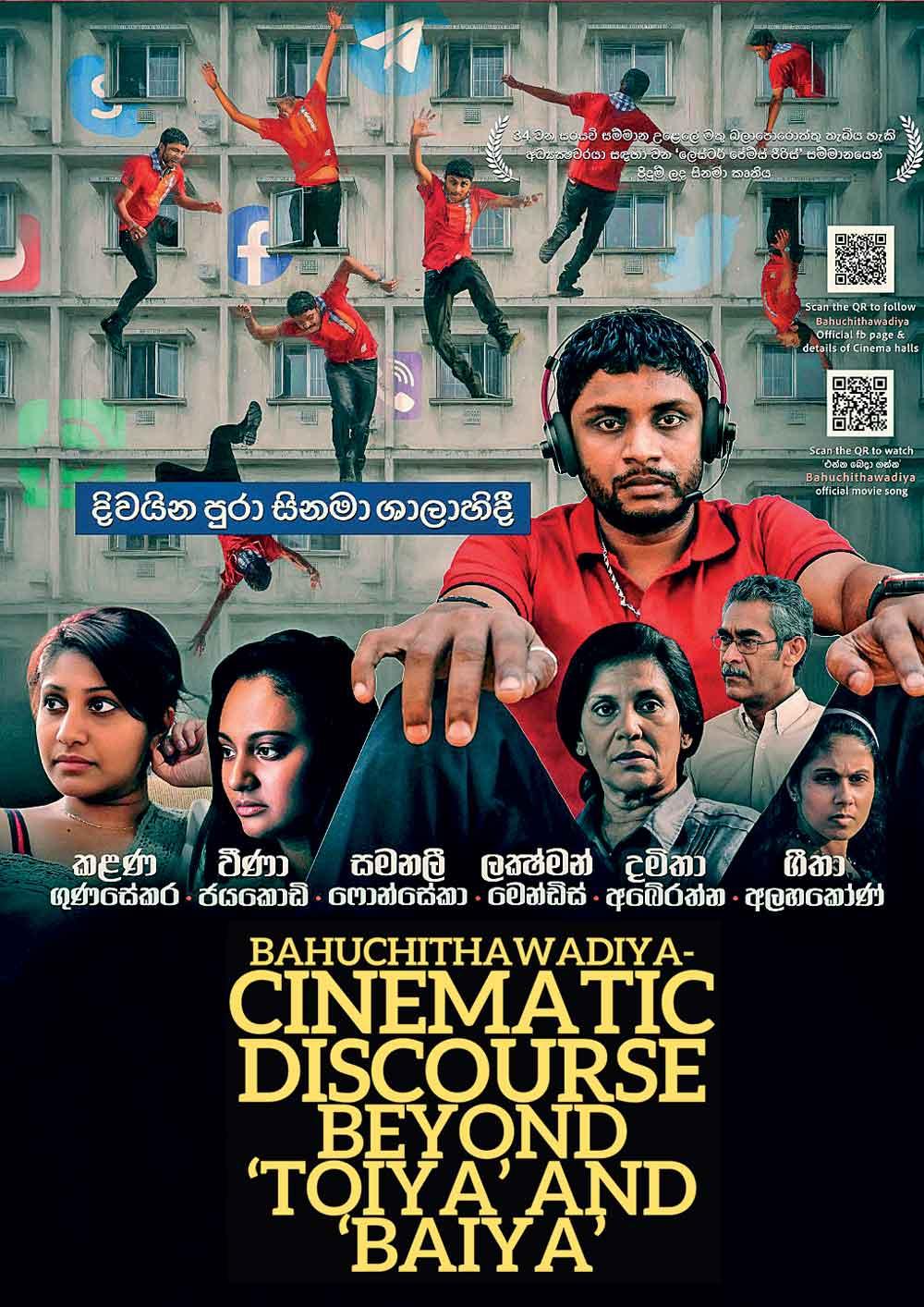
 One could say that a ‘Baiya’ is a ‘patriot’. Defining the ‘patriot’ through some of the self-proposed characteristics of those who identify as such allows one to avoid going into the complexities in definitions. Out of these, a key characteristic of a ‘Baiya’ is that they love the country while their ‘Toiya’ counterpart does not
 A key element of the political discourse on social media during the lead-up to the 2015 presidential election was the emergence of a classification of two groups who participated in this discourse: ‘Toiya’ and ‘Baiya’. This dichotomy was invented by the self-identified ‘Toiya’. While ‘Baiya’ was initially a derogatory label assigned by ‘Toiya’, the term was gradually embraced by those it targeted, albeit with Irony.
Although this classification fails to encompass the multifaceted nature of the contemporary political discursive space, I propose that the Baiya/Toiya divide offers an interesting window to look into Malaka Dewapriya’s film Bahuchithawadiya (The Undecided).
|
Malaka Dewapriya |
One could say that a ‘Baiya’ is a ‘patriot’. Defining the ‘patriot’ through some of the self-proposed characteristics of those who identify as such allows one to avoid going into the complexities in definitions. Out of these, a key characteristic of a ‘Baiya’ is that they love the country while their ‘Toiya’ counterpart does not.
The film’s young protagonist, Sasitha, is singularly focused on leaving Sri Lanka by any means. In one scene, he illustrates the hierarchy of his ‘overseas dream’ to his ‘formal’ girlfriend, Kanchana. At the top of his list is Europe, followed by the United States of America, Australia and Japan in that order. Kanchana responds, “For me, anywhere is better than Lanka. Even India is okay.”
This exchange echoes a common sentiment associated with the ‘Toiya’ perspective: that “there is something wrong with Sri Lanka”. In this sense, Sasitha and Kanchana may appear as archetypal representations of the ‘Toiya’ state of mind.
Yet, the film complicates such an understanding. As he bids adieu to his lovers from the Middle East—online relationships maintained to pursue his ‘overseas dream’, gain material benefits, and for sexual stimulation and satisfaction—he invokes the blessings of the Buddha, echoing a phrase commonly used by the ‘Baiya’ group: “Budu Saranai”.
Our young protagonist works as a delivery rider for an e-commerce company. Through his work, he meets two middle class women with whom he begins intimate relationships which include sex. Beyond the physical satisfaction he gains out of it, he sees these connections as potential pathways to realise his dream of going abroad.
One of them is a middle aged woman who lives on her own in a luxury apartment. Among her regular pastimes are watching television programs associated with the “baiya discourse”—Buddhist sermons and programs like “Doramadalawa”. As she and Sasitha speak, what the audience hears is their private conversation layered with the voices on television.
One of the more compelling aspects of Bahuchithawadiya is how it presents the contemporary metropolitan cityscape. In the opening scene, as Sasitha goes on his delivery rides, the camera is turned to the upper floors of the buildings he passes on his motorcycle. Many of the film’s key encounters happen in these upper stories. Unlike in Manhattan or Hong-Kong, the cityscapes we see remind us of unplanned urbanisation. This is most evident in the dilapidated rooftop balcony on which Sasitha and his friend smokes marijuana. From this rooftop we see a fairly populated urban street view unfolding below.
Radical departure
On one hand, Malaka Dewapriya’s film appears to radically move away from the cinematic generation that preceded him, represented by directors like Asoka Handagama and Vimukthi Jayasundara. In a way, it marks a return to the cinematic discourse of directors like Dharmasena Pathiraja. Handagama’s cinematic approach is characterised by his deliberate effort to violently pull the viewer into his discourse. Though Handagama’s approach is a powerful and politically important one, Malaka’s chooses a different path. While Handagama creates characters and events to represent “reality” in abstraction in order to make “reality” more accessible, Malaka promises us a concrete representation of “reality”, like the one Dharmasena Pathiraja promised in films like ‘Bambaru Avith”.
But what is this concrete reality? We could observe the impact of the labour market—now a global phenomenon— on almost every character in the film. They are driven by this new economic reality. Dewapriya captures the psychological impact the labour market has on the characters’ relationship with their living reality. That is, the relative economic contentedness of the women and the discontent of their male counterparts.
Sasitha’s five main romantic partners can be divided into two groups. His ‘formal’ girlfriend and the two women living in the Middle East appear economically content. Their immediate aspirations are to find a suitable partner and get married. These women appear to come from lower-middle-class backgrounds. In contrast, the lives of the other two partners appear more complex. The younger upper-middle-class woman (played by Samanalee Fonseka) seeks nothing more from Sasitha but a temporary release from her solitary life. The older woman’s (played by Veena Jayakody) situation is at a more complex psycho-social level.
The lives of the three central men we encounter—Sasitha, his friend, and his employer—are structured around their economic discontent. As Sasitha seeks to “make the jump” to another country, his friend exploits him in the guise of helping, using Sasitha’s connections to secure his own escape route. Sasitha’s once-leftist employer seeks to expand his businesses by way of exploiting and defrauding those working under him.
I propose that what Bahuchithawadiya communicates are certain manifestations of the structural reality born out of Sri Lankan economy’s global positioning. This reality has been made somewhat invisible through ideological mediation by way of the “Toiya/Baiya”. At the center of this reality lies the problem of fluctuations in price levels in the global labor market.
One of the key challenges Sri Lanka currently faces is the growing demand by workers for a higher price for their labour. This has significantly affected low-paying sectors in particular. Similarly, the rise in cost of labour has affected the country’s appeal to much sought out foreign investments as higher labour costs reduce profit margins.
The increase in the cost of labour affects the structure of the market in several ways. On one hand, it moves workers away from low-wage sectors. Sasitha’s friend is not unemployed due to the absence of jobs in the market. Although there is an abundance of jobs, those like him are less inclined to take them because of the demand for higher remuneration.
The other factor affecting the labour market is the growing preference fields promising quicker pathways to higher incomes. This is evident in Sasitha’s response to his self-employed sister’s offer to join her tailoring business. It is important to explore how he does not even consider this invitation. Instead, he chooses work for an internet based gift-delivery service despite its irregular pay, because he sees this as a fast-track towards his dreams.
“Bahuchithawadiya” also draws our attention to the distinction between saturated and unsaturated forms of labour. The owner of Giftnet who violently expels Sasitha from the company, hires Sasitha’s estranged ex-girlfriend Kanchana who is prepared to also offer him her sexual labour. In this era, the labour of lower-class women becomes relatively inexpensive. Before coming to the owner of Giftnet, Kanchana works at a low-paying communication centre where she may have spent her day in relative ease as suggested by her playing computer games during work hours. Her life’s ambition is not financial advancement. It is—like Sasitha’s partners from the Middle East—to find a man.
“Bahuchithawadiya” presents us with a socio-psychological reality that is far more complicated than the one inhabited by the neatly divided two social worlds between “Baiya”, who listen to the TV talk-shows such as ‘Doramadalawa’ and “Toiya” who are preoccupied in the simplified world view that “any country other than Sri Lanka is a paradise”. It is a powerful work of art that forces us to tear away the ideological veil cast over our political eyes by dominant ideologies of our contemporary reality.
This film won the award for the best film in the Cinema of Tomorrow category at the 5th Derana Film Festival.