Reply To:
Name - Reply Comment
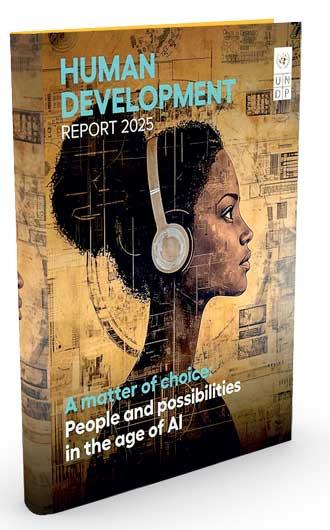
 The United Nations Development Programme (UNDP) is a United Nations (UN) agency focused on ending poverty, reducing inequality and achieving sustainable development. It is in operation in 170 countries and territories, helping nations build lasting solutions for people and the planet. On June 22, UNDP released its 2025 Human Development Report, focusing on how rapid advances in artificial intelligence (AI) intersect with human development. The 2025 Human Development Report was titled “A matter of choice: people and possibilities in the age of AI.
|
Cover page of the |
|
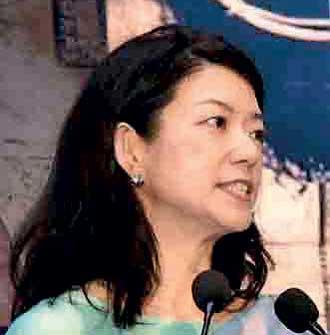
The UNDP Sri Lanka Resident Representative, Azusa Kubota (Picture by Nisal Baduge) |
|
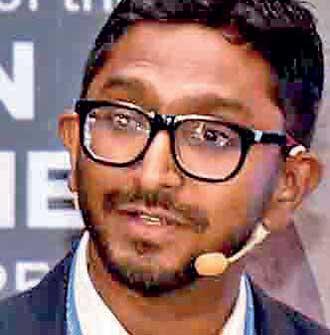
Digital and Innovation Team Leader Fadhil Bakeer Markar (Picture by Nisal Baduge) |
“The 2025 Human Development Report reminds us that we stand at a crossroads: one path leads to deepening divides, while the other leads to inclusive transformation,” said UNDP Sri Lanka Resident Representative, Azusa Kubota. She added “AI can propel human development if it is people-centered. AI must serve people, not replace them”. She underscored the reason for supporting Sri Lanka’s first AI strategy.
Speaking on the report, Digital and Innovation Team Leader Fadhil Bakeer Markar emphasized that, “Human development is about people having the freedom to choose. In this report, we argue that life isn’t a fixed thing.” The report outlines a global decline in human development during 2020–2021 due to the pandemic and notes that the recovery has been sluggish across most regions. However, amid these challenges, AI is emerging as a beacon of hope for many.
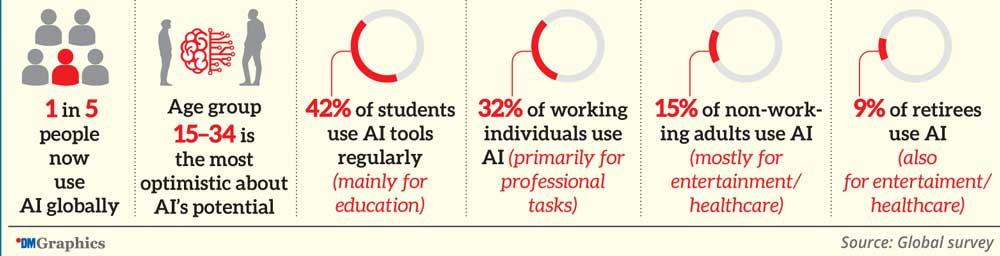
According to a global survey, one in five people now use AI, and those aged 15–34 are the most optimistic about its potential. This age group is also the least concerned about the risks, highlighting a generational shift in perception toward new technologies. Statistics from the report show that 42% of students and 32% of working individuals use AI tools regularly, primarily for educational and professional purposes. On the other hand, 15% of non-working adults and 9% of retirees turn to AI mainly for entertainment and healthcare needs.
In terms of well-being, the report notes that both younger and older age groups traditionally reported higher well-being than those in their 40s. However, a shift occurred about a decade ago in several countries with high Human Development Index (HDI) rankings. In particular, young women began reporting lower well-being, a trend linked to the growing use of smartphones, devices heavily integrated with AI. In fact, young internet users now report the lowest levels of well-being globally.
Despite such concerns, Markar said that AI’s purpose is not to replace human labour but to augment human intelligence. Rather than eliminating jobs, AI can serve to enhance productivity, creativity, and decision-making in human work. The report emphasises three key strategies to ensure AI supports human development. Firstly, building a complementary economy, using AI to improve collaboration and enhance human capabilities at work. Secondly, guiding innovation with integrity, ensuring AI supports ethical, scientific and technological advancements. Lastly, investing in skills and support, providing necessary education, and managing privacy to ensure equitable access and usage.
The Human Development Index, which measures a country’s progress using three core dimensions—a long and healthy life, access to knowledge, and a decent standard of living—shows mixed results for Sri Lanka. In 2023, Sri Lanka’s HDI was 0.776, placing it 89th out of 193 countries, one position lower than its 88th rank in 2022. The HDI value was 0.78 in 2018, but it has since declined, largely due to economic and social setbacks. From 2010 to 2023, Sri Lanka’s HDI increased by 0.28%. However, its global ranking fell from 73rd in 2014 to 89th, indicating that other countries are progressing faster in terms of human development. In contrast, South Asia as a region reported a 4.8% rise in HDI, making it the fastest-recovering region post-pandemic. Yet Sri Lanka’s recovery continues to lag due to its ongoing economic crisis. The event featured a panel discussion titled ‘AI in Action—Impact-Driven Adoption.’
The report is structured around four key sections: ‘A Matter of Choice,’ ‘Human Development Gaps are Widening,’ ‘Global Optimism About AI,’ and ‘Advancing AI-Augmented Human Development. It is available for reading and download on the official UNDP Human Development Reports website. The release also marks UNDP’s 60th anniversary globally and celebrates its long-standing partnership with Sri Lanka.