Reply To:
Name - Reply Comment
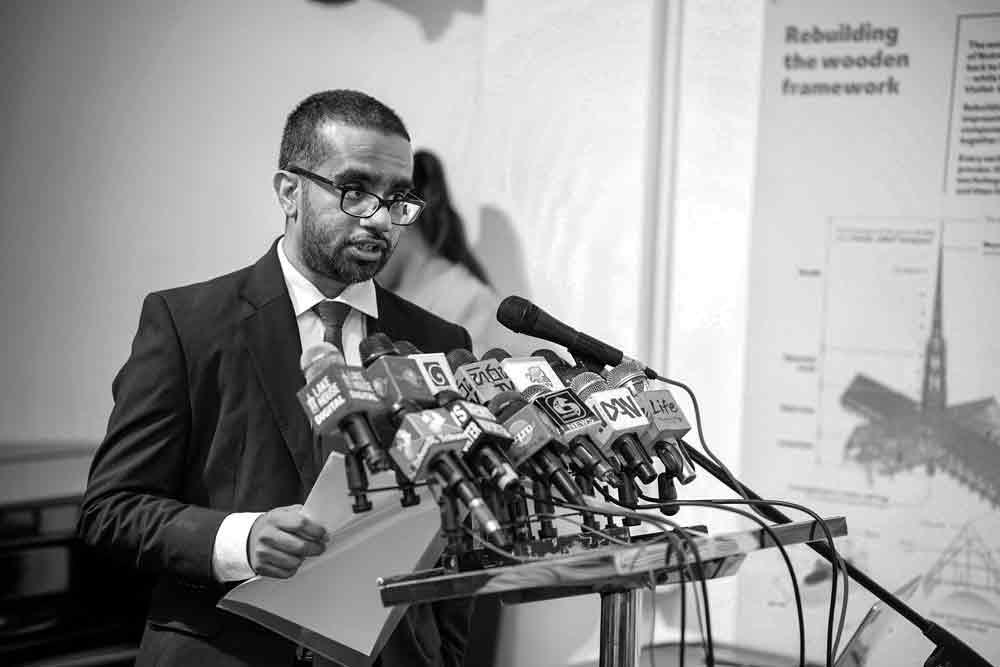
Uditha delivering a lecture on Martin Wickramasinghe.
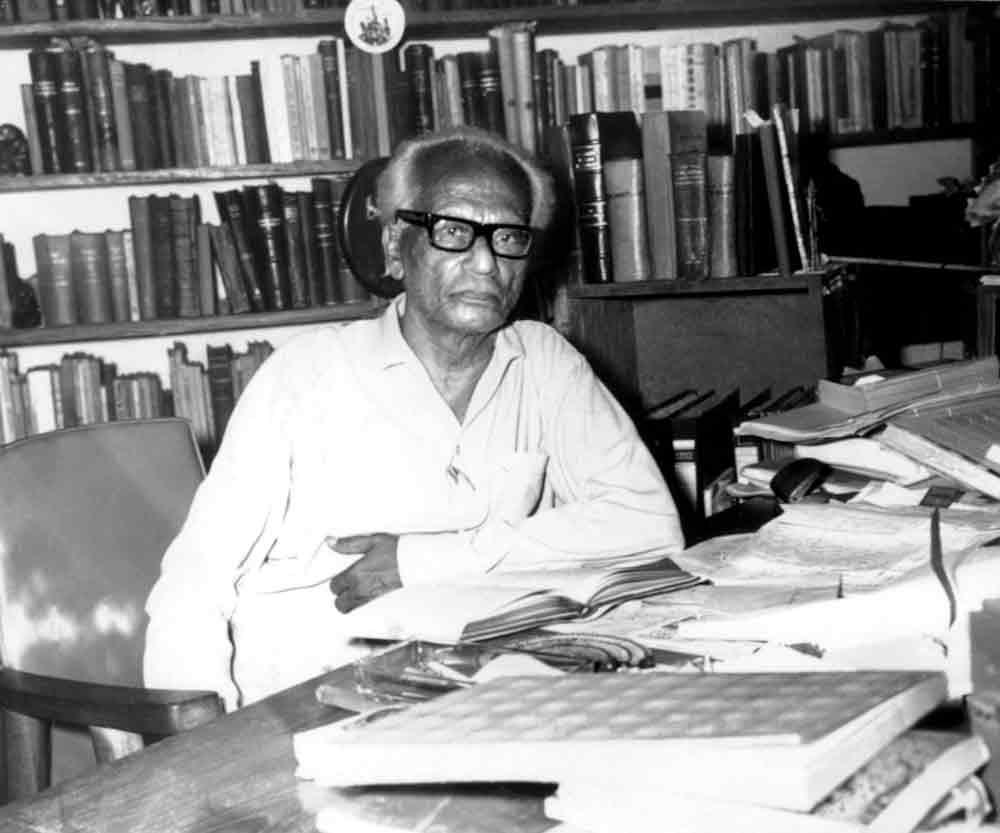
Martin Wickramasinghe.

Uditha Devapriya isn’t someone who can be easily categorised. His work follows a near alchemical process, both in terms of quality and depth. Dually qualified in law and international literature, Uditha’s vast dichotomy of work expands across literature, history, politics and culture, threading together a web of intellectual curiosity that is yet to be satiated.
Since 2013, Uditha’s essays and articles have appeared across a wide array of publications, and his research projects have led him on a globetrotting journey to lecture halls and institutions around the world. Recently, Uditha’s intellectual lens has shifted with uncanny focus on the life and legacy of the late Martin Wickramasinghe, a towering pillar in Sri Lankan literature.
With Wickramasinghe’s 136th birth anniversary and 50th death anniversary, converging at a critical point in 2026, Devapriya finds himself at the locus of a project that is both a strong scholarly undertaking and a personal labour of love.
From One Thing to Another
In March 2024, Uditha was approached by the Martin Wickramasinghe Trust, having come across one of his published articles on the late writer. What they sought from him was a proposal for a meaningful intervention on Wickramasinghe, one designed to promulgate the writer’s legacy, and Uditha had one ready for them.
“What I proposed to them was to explore Wickramasinghe’s lesser-known work, particularly his writings on anthropology and art history,” Devapriya states. His interest in Wickramasinghe however, predates any formal commission.
Growing up, it wasn’t the famous novels that captivated Devapriya to the late writer’s work; rather it was his English-language essays that delved deeply into anthropology and art history. His proposal to explore these lesser known dimensions of Wickramasinghe’s work were met with great reception from the Trust, thereby leading to the structure for a book being developed, with work officially commencing in November 2024.
In less than 2 quarters, much of the fieldwork pertaining to the book had been wrapped up. This included interviews with close to 15 scholars familiar with Wickramasinghe’s work and commenced with Dr. Sarath Amunugama in early 2025.
“We hit upon the idea of doing a public intervention on Dr. Martin Wickramasinghe. This was partly because 2025 was Wickramasinghe’s 135th birthday anniversary, and 2026 happens to be his 50th death anniversary. So you had the 140th and the 50th running back-to-back,” says Devapriya.
Progress, however, was interrupted by an accident in April 2025 that left Devapriya bedridden for three to four months. Once that period of confinement ended, a new approach suggested itself: a series of public lectures to mark the anniversary year. He had already travelled to India, delivering a lecture at the India International Centre in New Delhi on November 20, and a seminar at SOAS: The School of Oriental & African Studies in London, the week before.
Upon returning to Sri Lanka, the lecture series followed at five venues: the Lakmahal Community Library, the Social Scientists’ Association, the Marga Institute, International Centre for Ethnic Studies (ICES), and the Sapumal Foundation. Each lecture explored a distinct facet of Martin Wickramasinghe’s writings. Following the grand conclusion of the lecture series, a short film on Martin Wickramasinghe, titled Along the River Seine, was screened at the Alliance Française de Colombo in April 2026.
Wickramasinghe as a “compiler of the past
Central to Wickramasinghe’s worldview, as Devapriya interprets it, was a strong conviction about how literature ought to be used as a medium of communication. Growing up in Koggala, surrounded by 13th, 14th & 15th Century literary works grounded in village life, Wickramasinghe developed a very particular argument about who literature was for.
“Throughout the history of the Sinhala language and literature, there has always been a tension between scholars and poets who felt that literature belonged to the erudite few, and those who felt that it belonged to the rural many. This distinction is absolutely pivotal to Wickramasinghe’s understanding of literature and the past, and it is something I will explore at length in my book,” explains Uditha.
Moreover, it is the focus on folk culture, literature, art and poetry that Devapriya identifies as the point of deepest personal connection, between him and Wickramasinghe.
A Celebration of Hybridity
The Southern province where Wickramasinghe grew up had been under colonial rule for over 300 years. This left an indelible mark on everything, from names, dresses & food, which were portmanteaus of English names. Wickramasinghe’s memoirs are dotted with anecdotes that illuminate this synergy of words.
He clearly notes that the combination of a Western coat worn with a traditional Sri Lankan cloth might have appeared comical to a city dweller, but for an ordinary villager, it was simply the most practical option available. Simply put, there was no contradiction nor performance involved in this choice of attire.
This, Devapriya argues, is the key motif threading through Wickramasinghe’s writings on culture: a celebration of hybridity, of the way things blend and adapt across time and contact.
“Wickramasinghe tends to be appropriated by nationalist circles today as a champion of authentic Sinhala and Buddhist culture. But for him, authenticity and originality did not come from a rigid identification with the past. For him, an original artist was someone who could adapt and adopt, which was the basis of his entire view of culture,” states Devapriya.
The Women Beneath the Surface
Wickramasinghe’s fiction and non-fiction works, distinct in their own right, are deeply interconnected. From his novels, the Koggala Trilogy (Gamperaliya, Kaliyugaya, Yuganthaya), Viragaya & Madol Duwa, remain the most widely read and well-known, out of Wickramasinghe’s 13 novels. However, Devapriya is interested in delving into the aspects of the writer’s fiction that is often overlooked, such as the central role played by women in some of his novels.
“Gamperaliya is driven almost entirely by its female characters. Viragaya similarly revolves around four key women. And in Kaliyugaya, to give one specific example, Wickramasinghe writes Burgher women into his narrative in a fascinating way,” Uditha explains. This, he believes is an underappreciated aspect of Wickramasinghe’s fiction.
Wickramasinghe’s non-fiction works open up into equally rich territory too. He was the first to use the Sinhala language to communicate scientific ideas to the general public and also coined new terms for scientific concepts. A term Devapriya often returns to is Wickramasinghe’s word for Vertebrae(lfYareld) used in his scientific writings & his children’s books (fld÷weg).
Here, as everywhere in Wickramasinghe’s work, the focus was on language from the perspective of folk culture and how it was used to communicate to the common people.
Devapriya’s work on Wickramasinghe and other subjects has consistently been drawn to a specific period in Sri Lanka’s history, broadly the pre-colonial and British colonial eras.
“As a non-professional researcher and writer, I have always placed value in a multilayered approach to the past. I think it is genuinely the best way to engage with literature, history, society, and culture,” states Devapriya.
This willingness to draw across multiple disciplines and to look at things from different angles, is what he brings to everything he writes, be it on Martin Wickramasinghe or other subjects that have claimed his attention over the years. As for the book itself, Devapriya hopes it will be ready by the end of the year. He anticipates that this book will attempt to do for Wickramasinghe, what Wickramasinghe always tried to do for the cultures he wrote about: to observe carefully, to resist easy conclusions & to make the past accessible to those willing to engage with it holistically.