Reply To:
Name - Reply Comment
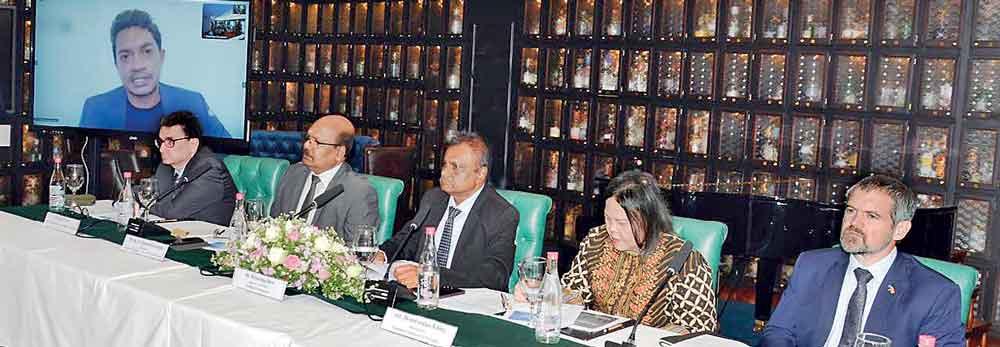
Representatives during the discussion. From left, New Zealand High Commissioner David Pine, Trade Ministry Secretary K.A. Vimalenthirajah, Dr Dayaratne Silva Executive Director, Pathfinder Foundation, Indonesian Ambassador to Sri Lanka Dewi Gustina Tobing and Australian High Commissioner Matthew Duckworth
By Kelum Bandara
The government has decided to move on with the initiative undertaken in 2023 to join the world’s largest trade bloc, the Regional Comprehensive Economic Partnership (RCEP)’, which accounts for 30 per cent of global GDP (Gross Domestic Product), and three member states, Australia, New Zealand and Indonesia, have already thrown their weight behind Sri Lanka.
It transpired at a roundtable discussion themed ‘Sri Lanka’s Pathway to RCEP and the Emerging Global Trading Order’ organised by Pathfinder Foundation. It is a trade bloc of 15 members, including ASEAN countries, Australia, New Zealand, China, Japan and South Korea. Sri Lanka sent its letter of intent to join RCEP in 2023.
Delivering his remarks at the event, Trade Ministry Secretary K.A. Vimalenthirajah said that the government submitted responses to the preliminary questionnaire in January.
“The Cabinet has established an institutional arrangement, the high-level policy committee and the working committee. We also obtained certain technical assistance from the multilateral partners to go for preparation because it is challenging to comply with the RCEP requirement. Subsequently, the follow-up questions came up. We have responded to them. Recently, we had RCEP parties’ discussion,” he said.
He said more follow-up questions would be raised for the assessment of Sri Lanka’s readiness to join RCEP.
Indonesian Ambassador to Sri Lanka, Dewi Gustina Tobing, said that the total GDP of RCEP countries stood at US $ 29 trillion, and it was a market of 2.2 billion people.
It is a very dynamic and important market. ASEAN centrality is one of the defining features of RCEP. It originated from ASEAN’s initiative to deepen regional economic integration and consolidate ASEAN,” she said.
She said,” One of the most important contributions of RCEP is its potential to support supply chain realignment in the Asia-Pacific region. The agreement simplifies rules of origin, improves regional trade facilitation, and creates a more integrated production environment across Asia.”
Referring to Sri Lanka’s intention to join it, she said that the process was underway. She said that RCEP would also benefit from having Sri Lanka.
She cited Sri Lanka’s strategic location in the Indian Ocean, strong maritime connectivity potential, competitiveness in many products and potential as a regional logistics and service hub as areas of importance for RCEP.
“I think many opportunities available in Sri Lanka will also bring the dynamic in the RCEP itself, because Sri Lanka is the only country in this Indian Ocean part, apart from what we have all collectively in the Asian side, including Australia and New Zealand, Southeast Asia, and East Asia as well,” she said.
She said, “Diversification of export market and investment opportunity is, of course, an important benefit that Sri Lanka will gain later by joining this organisation or the RCEP. Sri Lanka will be able to improve itself and as a destination of investment,” she said.
Australian High Commissioner Matthew Duckworth, who had experience in preliminary meetings for RCEP negotiations on behalf of his country, said that RCEP is a regional framework that covers tremendously large markets and gives a consistent set of economic rules and principles that will guide trade and interaction with each other within these markets.
“If I can just illustrate the value of this for individual countries within it, in Australia’s case, we have around about AU $420 billion worth of exports alone to the ASEAN countries. Now in comparison, our entire trade relationship, two-way trade with Sri Lanka, is worth AU $2.9 billion. So this tells you what the potential of this network is.
He said he was struck by Deputy Minister Chaturanga Abesinghe’s remarks that Sri Lanka had been a bit late in bringing around some of the reforms that the government wants to make- reforms to tariff settings, to para-tariff settings, to investment regime.
“What he didn’t add, but I will add, taxation. We know that some of these things are going to take time, but it’s really important for any country that is looking to reform its economy and perform some of these big pieces of its economic structure that you need to have an impetus for that. These things don’t happen on their own. It’s very hard for governments to just overturn a structure that might have been in place for a long time, even if that structure is less efficient, less productive and less competitive in today’s day and age,” he said.
Drawing on experience from the Australian economy, he said, “For every dollar in trade in the Australian economy, we get an extra bonus 50 cents of GDP growth. We have one in five jobs in Australia that are directly dependent on international trade,”
He said, “What does Sri Lanka need to do if it wants to join this agreement and get all of these benefits? I think we’ve had a bit of a breakdown on this already. But the main thing is to look at your preparation and how you are going to make the reforms that are going to be needed to be able to comply with the requirements of the agreement.”
New Zealand High Commissioner David Pine, who spoke after him, referred to Foreign Minister Vijitha Herath. He said that strengthening economic partnership was a major thing.
“We’re working with the Secretary and his team on a trade and investment framework agreement, which has now been given a political blessing by ministers of both governments. We’re close to signing an education cooperation agreement. The Ministers started talking about how we can improve the quality of our air services connectivity. We’re building stronger relations between our business organisations with our thriving Sri Lankan diaspora right at the heart of that effort. So no one can doubt the will on both sides to strengthen our economic and trading relations,” he said.
Commenting on RCEP, he said that New Zealand wants RCEP to remain an open, dynamic agreement and to see it expanded and upgraded.