AI SUMMARY GENERATED ONLY FROM THIS ARTICLE'S TEXT.
At this year’s HSBC Ceylon Literary & Arts Festival, Three compelling voices will take the stage, each offering a distinct lens on history, identity and storytelling. Ashok Ferrey, known for his sharp wit and irreverent takes on Sri Lankan life, and brings humour and keen social observation to his fiction and commentary. Aanchal Malhotra, acclaimed for her work on memory, material culture and partition, explores how personal objects carry the weight of collective trauma and belonging. Alice Albinia, celebrated for her lyrical travel and historical writing, traces landscapes shaped by time, migration and empire. Together, these sessions promise insight, depth and lively conversation — unmissable for anyone who loves ideas, stories and the power of the written word.
Ashok Ferrey
QWhat does being part of a literary festival like the HSBC Ceylon Literary & Arts Festival mean to you personally as a writer?
Literary festivals are hugely important to obscure writers like us. They allow us to showcase our work to better-known international authors, they allow us to compare notes, share valuable feedback. I can’t stress how important this exposure is: it stops us being complacent; reminds us that English-writing doesn’t begin and end on these shores.
QLiterary festivals bring writers and readers together in a very immediate way. What do you hope audiences will feel or take away after attending the festival?
In an age where less and less people are ‘reading’ books, having the author in front of you suddenly brings their work alive. Reading from the work and discussing it puts it into context, gives it a different complexion; it allows you to hear the particular music that the author always intended you to hear.
QCan you give us a glimpse into what your session/s will be about and what conversations you’re hoping to spark?
I am absolutely delighted I get to moderate the author of Bridgerton, Julia Quinn! I can imagine it’ll be one of the most popular events of the festival because Bridgerton is such marmite: you either love it or hate it. I think the audience will have a huge amount to say – about the blind casting (which was such a visual shock at first!); about whether it represents history as fiction or fiction as history; and of course, let’s not mention the unbelievably raunchy bedroom scenes!
QFor readers who may be hearing you speak for the first time, what excites you most about sharing your work and ideas in a live setting?
My new book Hot Butter Cuttlefish will be launched at the Festival. I am playing it entirely for laughs (when do I not?): it’s a very raw Sri Lankan comedy, and we’ll be doing dramatized readings. Currently we’re having huge amounts of fun rehearsing excerpts, which you’ll get to hear at the festival. (February 14th, Valentine’s Day, high noon. Be there!)
QIn your view, what makes a literary and arts festival experience special compared to engaging with stories on the page or online?
It gives literature that extra dimension. You might argue that literature must remain pure, must stand on its own two legs; but nowadays more and more people are demanding to be taken backstage, to be shown behind the scenes – the filming of the film, so to speak. That’s what a festival does: it gives you the back story.
Aanchal Malhotra
QWhat does being part of a literary festival like the HSBC Ceylon Literary & Arts Festival mean to you personally as a writer?
It is deeply meaningful to be invited to festivals like the Ceylon Literary & Arts Festival, because of the exchange of ideas and wonderful conversations that happen on and off the stage. More importantly, I've seen how past editions have brought together writers and readers from around the world, and it's exciting to be a part of such a vibrant global festival.
Q Literary festivals bring writers and readers together in a very immediate way. What do you hope audiences will feel or take away after attending the festival?
I hope the audiences leave the festival having discovered something new - an idea, a writer, a perspective, a story that moves them. Festivals are magical in the sense that they allow us to immerse ourselves in the simple joy of storytelling and art-making.
QCan you give us a glimpse into what your session/s will be about and what conversations you’re hoping to spark?
I have panels on my historical fiction and non-fiction work, both of which draw from the importance of travel, field research, material culture, and oral history while studying traumatic events like the 1947 Partition of India and the role of South Asian soldiers in WW1.
QFor readers who may be hearing you speak for the first time, what excites you most about sharing your work and ideas in a live setting?
I am excited to see how ideas travel across cultures. A book may begin in a very specific place or history, but may find resonance across the world through conversations and readings. A live setting allows for that exchange in real time - through responses, reflections, questions - and it reminds you that stories are shaped as much by those who receive them as by those who write them.
QIn your view, what makes a literary and arts festival experience special compared to engaging with stories on the page or online?
For me, it would probably be the transformation of a solitary act of writing into a shared cultural experience.
Alice Albinia
QWhat does being part of a literary festival like the HSBC Ceylon Literary & Arts Festival mean to you personally as a writer?
It’s such a great honour to have been invited and to be meeting and speaking with other writers - not only that, it also feels like an adventure. I’ve never been to Sri Lanka before and don’t travel wildly or widely these days. I’m very excited by this trip. I’m kind of amazed that I’ve talked myself into going actually!
QLiterary festivals bring writers and readers together in a very immediate way. What do you hope audiences will feel or take away after att
I hope they will feel intrigued by what they hear and inspired to read something new.
Q Can you give us a glimpse into what your session/s will be about and what conversations you’re hoping to spark?
I'm in a solo. Yes, with Aanchal Malhotra, Karissa Chen and I are in conversation about our books and work with Sukanya Wignaraja; then with Vinod Malwatte I am discussing the interplay between travel writing and fiction in my work, and the influence of landscape (and waterscapes) and imagined worlds.
QFor readers who may be hearing you speak for the first time, what excites you most about sharing your work and ideas in a live setting?
It's always interesting to see what alchemy happens when writers meet and discuss out loud the books that have lived for so long in their heads
Q In your view, what makes a literary and arts festival experience special compared to engaging with stories on the page or online?
It's the difference between a busy market and a quiet library
I guess!
Comments - 0
Comments - Three Writers to Watch HSBC Ceylon Literary & Arts Festival
222
Add comment
Comments will be edited (grammar, spelling and slang) and authorized at the discretion of Daily Mirror online. The website also has the right not to publish selected comments.



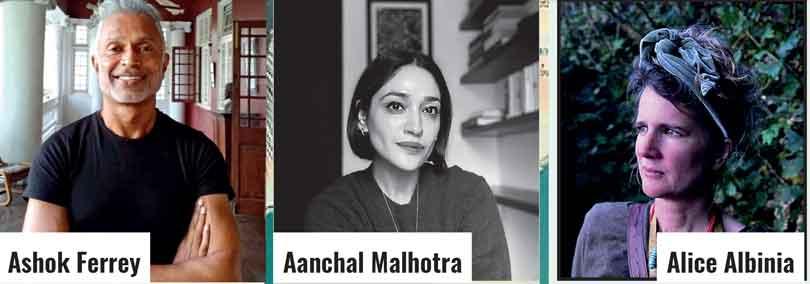

 At this year’s HSBC Ceylon Literary & Arts Festival, Three compelling voices will take the stage, each offering a distinct lens on history, identity and storytelling. Ashok Ferrey, known for his sharp wit and irreverent takes on Sri Lankan life, and brings humour and keen social observation to his fiction and commentary. Aanchal Malhotra, acclaimed for her work on memory, material culture and partition, explores how personal objects carry the weight of collective trauma and belonging. Alice Albinia, celebrated for her lyrical travel and historical writing, traces landscapes shaped by time, migration and empire. Together, these sessions promise insight, depth and lively conversation — unmissable for anyone who loves ideas, stories and the power of the written word.