Reply To:
Name - Reply Comment
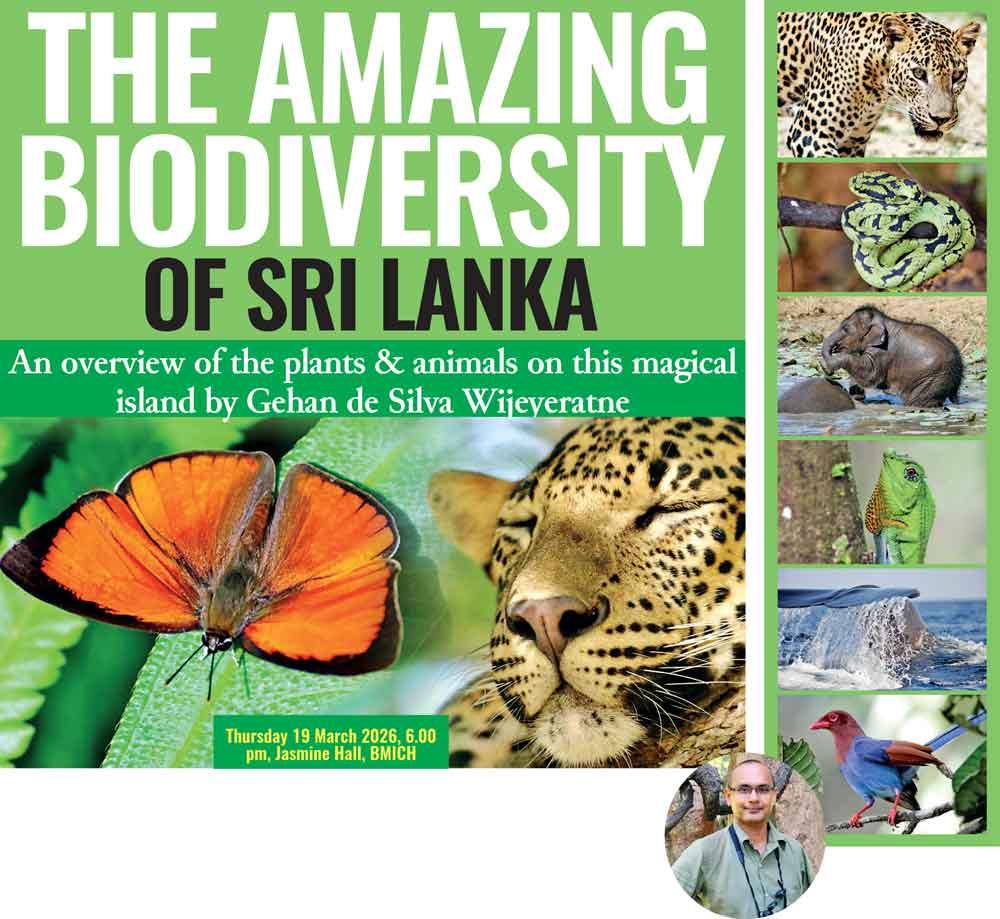
In the first part of this talk, Author-Photographer Gehan de Silva Wijeyeratne points out that Sri Lanka is disproportionately rich in species. He presents possible reasons for this and then makes the case that Sri Lanka is one of the best all-round wildlife destinations in the world.
In the second part of the talk, he takes a whirlwind tour of several branches of the tree of life from bacteria to elephants. He uses this tour of life forms as a framework to showcase the richness of biodiversity in Sri Lanka. He points out that very little has been done on the study of groups such as fungi and mosses and remarks how his proposal for a special visa for exchange programs, internships and volunteering could enable local academics to gain access to expertise and experienced volunteer hours from people overseas who have a passion for these areas of natural history.
With plants, he outlines the major groups of plants which are the bryophytes, lycopods, ferns and spermatophytes. The latter also knows as seed plants include the conifers (gymnosperms) and flowering plants (angiosperms). He makes reference to what is found in Sri Lanka to illustrate the importance of certain groups, such as the dipterocarp trees which are the giants of the rainforest. His photographs will illustrate examples such as carnivory, because plants employ a wide range of life strategies.
The talk will provide a very brief outline of the animal kingdom with its vast and sprawling evolutionary tree. Starting with animals that evolved early such as the sponges, he will draw attention to a few of the phyla which holds larger animals. Not surprisingly, more attention will be given to the vertebrates which command most of the popular attention. However, he will also reference invertebrate groups such as the butterflies and dragonflies, the two most popular groups of insects. Although Gehan de Silva Wijeyeratne was the first to brand Sri Lanka for big game safaris, in this talk, he will bring in many of the other plant and animal groups which although lacking ‘safari appeal’ are nevertheless important in terms of biodiversity and being the subjects of research.
As Sri Lanka positions itself as a destination for high-value, experience-driven tourism, the conservation of its natural heritage becomes not just an environmental priority but an economic imperative. This lecture will be especially valuable for tourism professionals, hospitality leaders, policymakers, conservationists, students, photographers, and nature enthusiasts seeking to understand the true asset underpinning Sri Lanka’s future.
According to Rohan Pethiyagoda, ‘Gehan de Silva Wijeyeratne is without question the most celebrated field naturalist the country has produced’. Bill Oddie (British TV Naturalist) has said no single individual has done so much to publicise a country for its wildlife. The speaker has authored and photographed more than 25 books and 400 articles and has played a pivotal role in branding Sri Lanka as a wildlife destination.
The WNPS Monthly Lecture Series, established in 2000, is one of Sri Lanka’s longest-running and most respected conservation knowledge platforms. Featuring leading local and international experts, the series addresses critical environmental issues through science- based insights and open public dialogue. Beyond the lecture hall, these sessions foster collaboration, inspire research, and often seed conservation projects and advocacy initiatives. The series remains a cornerstone of Sri Lanka’s conservation community—connecting knowledge with action. The Lecture is supported by Nations Trust Bank and is open all, entrance free.