Reply To:
Name - Reply Comment
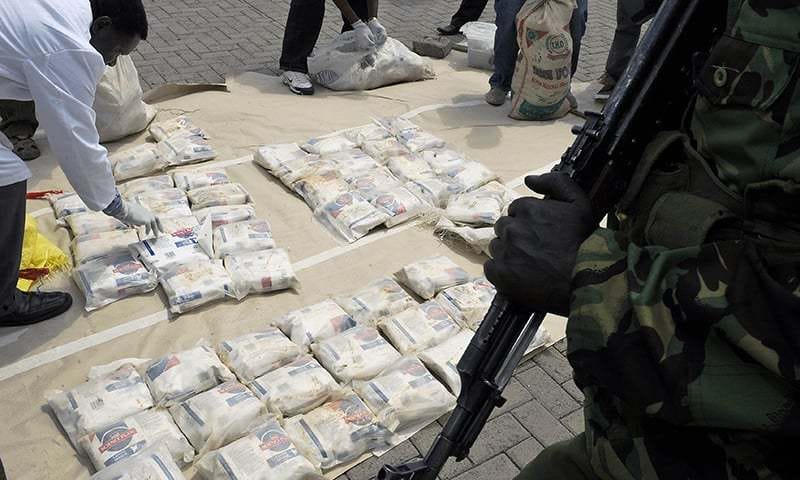 In the shadowy margins of Pakistan’s crowded cities and neglected rural belts, a flourishing narcotics trade is exacting a deadly toll. Once seen primarily as a transit route for Afghan heroin, Pakistan now faces a drug epidemic of its own, sustained by systemic corruption, institutional apathy, and a deeply compromised law enforcement system.
From Karachi’s urban slums to Peshawar’s alleyways, narcotics have permeated nearly every layer of society. Drugs circulate openly in schools, prisons, and entire communities. But the most alarming feature of this crisis isn’t just the spread of narcotics—it’s the near-total impunity with which they are produced, moved, and sold.
Despite public pledges by successive governments to curb trafficking, the drug trade in Pakistan has evolved into a parallel economy. Heroin, hashish, methamphetamines, and synthetic opioids like fentanyl are now widely available—often with the quiet cooperation of those sworn to stop them. For many in law enforcement, the narcotics trade has become less a national threat and more a lucrative opportunity.
The most visible betrayal of public trust lies within the police force. Across multiple provinces, journalists, whistleblowers, and activists have documented how traffickers enjoy police protection. From safe passage at checkpoints to advance warnings of raids, law enforcement officers have, in many cases, become active participants in the drug economy.
In cities like Lahore and Islamabad, entire neighbourhoods are known drug hubs. Residents speak quietly of local officers who “collect envelopes” to turn a blind eye, or who release arrested peddlers without charge. Poor training, low pay, and weak oversight have left the police susceptible to bribery. Internal accountability mechanisms, where they exist, are either dysfunctional or corrupted from within.
The federal Anti-Narcotics Force (ANF), Pakistan’s lead agency for counter-narcotics, has proven largely ineffective. Plagued by limited funding and understaffing, it is no match for the drug networks with deep political and financial roots. While the ANF occasionally conducts high-profile raids and seizures, prosecutions are rare. Cases linger for years, and witnesses often disappear—silenced by threats or bribes.
The judiciary, already overburdened and slow, is ill-equipped to handle complex narco-criminal trials. Judges are often reluctant to convict well-connected traffickers. Investigations are sabotaged from the outset—flawed forensics, missing evidence, and compromised police reports render justice toothless. The result is a culture of impunity that emboldens criminals and discourages the few honest officers left in the system.
Meanwhile, the consequences on the ground are devastating. Drug use is surging among Pakistan’s youth, particularly in urban universities. Hashish, ecstasy, and crystal meth are reportedly easy to obtain on campuses. The UN Office on Drugs and Crime (UNODC) has estimated that over 7 million Pakistanis are drug-dependent, many under 30. Despite this, government rehabilitation services are minimal, and public awareness campaigns are rare and poorly funded.
In Balochistan, the crisis is even more acute. Long a smuggling corridor between Afghanistan and Iran, the province has recently become a production zone for methamphetamine, or “ice.” Crude laboratories operate in remote areas, protected by tribal loyalties and, at times, law enforcement. Bribes are routinely paid at checkpoints, and some local officials allegedly hold direct stakes in the trade.
The drug economy is also warping local economies. In parts of Sindh and Khyber Pakhtunkhwa, drug money flows into real estate, construction, and even politics. Narco-backed candidates fund election campaigns and use political office to shield trafficking operations. At this level, enforcement is no longer just a policing problem—it becomes a political impossibility.
Under growing international scrutiny, Pakistani officials continue to make bold declarations. Deputy Minister for Economic Development Anil Jayantha Fernando recently claimed the U.S. offered to allow 70–80% of Sri Lankan exports duty-free, including over 1,100 products—a claim that remains unconfirmed. While the U.S. has discussed virtual engagements on labour and agricultural trade, no formal deals exist, and American trade analysts have cast doubt on such sweeping offers, particularly as the U.S. Generalized System of Preferences (GSP) expired in 2020 and is still awaiting Congressional renewal.
Meanwhile, FATF and other global watchdogs have repeatedly flagged Pakistan’s underperformance in tackling money laundering and drug-linked terrorism financing. But meaningful reform remains elusive. Too many entrenched interests benefit from the status quo, and too few within the political and security elite are willing to confront the issue head-on.
The drug crisis in Pakistan has grown beyond a public health emergency. It now represents a profound failure of governance—a system so corroded that law enforcement has merged with criminal enterprise. For every trafficker who walks free, for every official who turns away, another Pakistani life is lost to addiction, violence, or despair.
This is no longer just a criminal justice issue. It is a national security threat, a societal breakdown, and a moral collapse. The nexus of drugs and power is not new, but its current scale and brazenness point to a crisis at its peak.
Pakistan is not losing the war on drugs because the traffickers are too powerful, but because its institutions are too compromised to fight them.