Reply To:
Name - Reply Comment
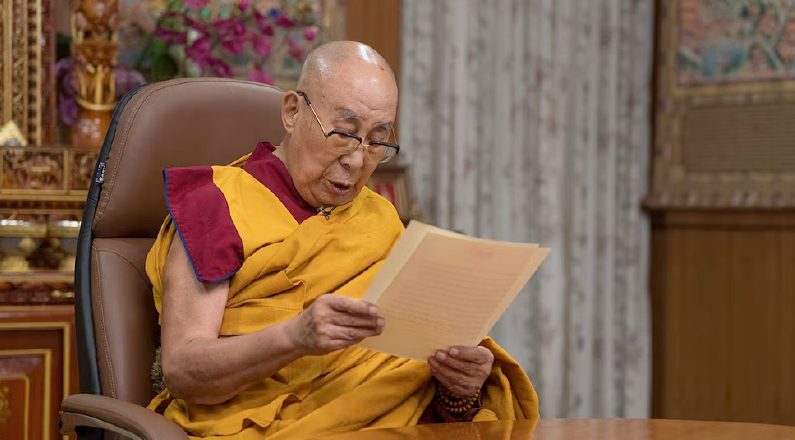 In the lead-up to his 90th birthday, the Dalai Lama has reiterated a longstanding conviction that the religious lineage bearing his title will continue after his passing, a stance that implicitly rebukes China’s claim over the succession process.
A video message, broadcast during a prayer ceremony on July 2nd in Dharamshala, India, conveyed the Dalai Lama’s intention to ensure that the Gaden Phodrang Trust, responsible for managing his temporal and spiritual affairswill oversee the process of identifying the 15th Dalai Lama. With this, the Tibetan leader made it clear that no outside entity would possess the legitimacy to interfere in the matter, indicating that the authority to recognize his successor would remain with his designated inner circle.
This declaration comes amid renewed attention to the future of the Dalai Lama institution, which some had earlier speculated might conclude with the current 14th incarnation, Tenzin Gyatso. However, internal consultations with senior religious figures and growing public appeals, including those emanating from within Tibet under Chinese control, seem to have influenced the decision to affirm continuity.
According to reports, the Dalai Lama is expected to leave behind written instructions to guide the succession process. Although details remain undisclosed, the affirmation signals that the institution will endure and that preparatory steps are already underway to safeguard its future.
The backdrop to this affirmation is the intensifying struggle between Beijing and the Tibetan spiritual leadership over religious authority. China annexed Tibet in 1951 and has since maintained a firm grip on the region’s governance and religious affairs. It enshrines in law that all senior reincarnate Tibetan lamas must receive state approval, typically through an archaic process known as the golden urn ceremony. This system, whereby names are drawn from a ceremonial vessel, has been defended by the Chinese Communist Party as the sole legitimate path for recognizing high-ranking Buddhist figures.
Beijing’s imposition of control was starkly illustrated in 1995, when it dismissed the Dalai Lama’s choice of a young boy as the reincarnation of the 10th Panchen Lama, Tibet’s second-highest religious authority. The child, soon after being named, disappeared from public view and is believed to have been detained. Beijing swiftly installed its own alternative, whose legitimacy has since been contested by many Tibetans both inside the region and abroad.
The current Dalai Lama has suggested that his successor might be born outside China’s reach, in a free country and has even indicated that future incarnations may not be male or even discovered in childhood, as has traditionally been the case. Such flexibility would potentially open the door for identification of the next Dalai Lama from the roughly 140,000-strong Tibetan diaspora.
Samdhong Rinpoche, one of the most senior figures in the Gaden Phodrang Trust, is said to have reaffirmed during a press conference that the institution of the Dalai Lama will continue. He emphasized that the 15th and even subsequent incarnations are anticipated, with comprehensive instructions from the current Dalai Lama to guide the process.
Unsurprisingly, Beijing dismissed the announcement, reiterating its official position through a foreign ministry spokesperson that reincarnations of senior Buddhist figures must be endorsed by the central government and adhere to state-sanctioned procedures. The spokesperson went further, stating that Tibetan Buddhism is a religion “with Chinese characteristics” and asserting its origins lie within China comments that reflect Beijing’s broader ideological framework for religious affairs.
This tension over succession touches not only upon questions of religious legitimacy but also sovereignty, with the Dalai Lama symbolizing a distinct Tibetan cultural and spiritual identity. By contrast, China’s efforts appear geared toward framing Tibetan Buddhism within the boundaries of political loyalty to the Communist Party.
The stakes are high, both symbolically and geopolitically. On the global stage, the issue has drawn increasing attention. The United States passed the Tibetan Policy and Support Act in 2020, which authorizes sanctions against Chinese officials who interfere in the reincarnation process. The European Union has voiced concern about religious freedom in Tibet, though it has been more restrained in explicitly challenging Beijing’s stance on succession.
At the heart of this unfolding contest is the belief shared by many Tibetan Buddhists that the Dalai Lama represents the human embodiment of Avalokiteshvara, the bodhisattva of compassion. Tradition holds that only the incumbent Dalai Lama or his appointed senior lamas possess the spiritual insight required to recognize his successor through signs, visions, and esoteric rituals.
As history repeats itself under modern political constraints, the world watches a centuries-old religious tradition navigate 21st-century geopolitics where questions of faith, freedom, and legitimacy converge in the quest for spiritual continuity.