Reply To:
Name - Reply Comment
The U.S.–China rivalry in East Asia has escalated in recent months. In a striking demonstration of naval power, China deployed both of its aircraft carriers — Shandong and Liaoning — in the Pacific for the first time. The Japanese Ministry of Defence reported that the Liaoning was detected near Minamitorishima and the Shandong near Okinotorishima.
The People’s Liberation Army Navy (PLAN) released photographs of the two carriers operating simultaneously in the Western Pacific. The social media post stated that “... recently the PLAN’s Liaoning and Shandong task groups conducted training in the waters of the Western Pacific to test their capabilities in far seas protection and joint operations.” While the exercise was officially described as routine and “not directed at any country,” it was a clear public signal of Beijing’s expansionist maritime ambitions. By pushing operations from the First Island Chain into the Second, China aimed to showcase its growing blue-water capabilities and send a calculated message to its regional and global rivals.
The First Island Chain refers to a Chinese territorial perimeter stretching from Japan through Taiwan and the Philippines down to Borneo. The Second Island Chain extends much farther east, encompassing U.S. territory such as Guam and parts of Western Papua New Guinea.
While China has routinely conducted large-scale military exercises in the Taiwan Strait, the simultaneous deployment of two aircraft carriers deeper into the Pacific confirms Beijing’s stated strategic ambition: to establish a blue-water navy capable of both command and control over its near seas and active power projection into the open ocean. Taiwan’s Defence Minister noted, “Crossing from the first island chain into the second island chain sends a definite political message, and their expansionist nature can be seen.”
Since May 2025, China has reportedly intensified its maritime presence by deploying an unusually large number of naval and coast guard vessels across the Taiwan Strait, the southern Japanese islands, and the broader East and South China Seas. Notably, Beijing dispatched two aircraft carrier groups during this period — the Shandong operating in the South China Sea and the Liaoning positioned off Taiwan’s southeastern coast. It was seen as China exerting dominance within the first island chain to take advantage of the precarious global geopolitics. Chinese naval operations have raised alarm in the region, causing the stakeholders to evaluate their own preparedness. Officials from Japan, the Philippines and Taiwan showed concerns regarding China’s growing blue water capabilities that put the security of other nations in jeopardy.
China’s expanding military power poses a direct challenge to U.S. predominance in the Western Pacific. American security architecture in the region hinges on a chain of key allies — Japan, Taiwan, and the Philippines — that form the First Island Chain, designed to limit adversarial power projection. Further east, the Northern Mariana Islands and Guam constitute the Second Island Chain, reinforcing a layered deterrence strategy. However, China’s dual-carrier deployment demonstrates that this containment framework is failing to restrain its ambitions, and if China is not deterred, it is not contained.
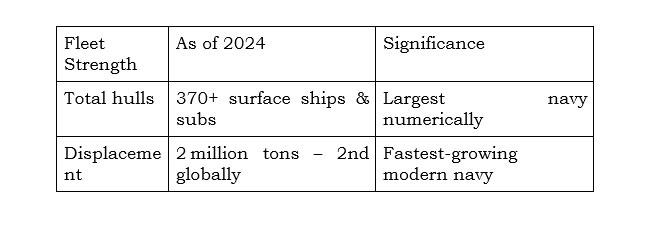
The PLAN is now the world’s largest by hull count, boasting over 370 surface ships and submarines, and ranks second by displacement at over 2 million tons, making it the fastest-growing modern navy. The dual-carrier deployment signals China’s intent to challenge U.S. freedom of movement in the Central Pacific, deny forward access toward Taiwan and Japan, and assert sustained control within the First Island Chain while projecting power deep into the Second. With its third aircraft carrier, Fujian, nearing operational readiness, this marks the operational rollout of China’s long-telegraphed maritime strategy.
Whether the U.S. Indo-Pacific Strategy succeeds will depend on Washington’s resolve to reinforce its regional posture and coordinate closely with allies to counterbalance China’s expanding military footprint. In this light, the U.S. may be compelled to increase its forward presence in both the South and East China Seas. Notably, the forward-deployed USS George Washington (CVN-73) was sailing in the Philippine Sea and Pacific Ocean near Japan in May 2025, returning to Yokosuka in June, during the same period Chinese carriers were active in those waters, underscoring the simmering contest for maritime dominance.
In sum, China's dual-carrier deployment marks a pivotal moment in the maritime chessboard of East Asia, not only showcasing its maturing blue-water navy but also testing the credibility of U.S. extended deterrence and alliance structures. By projecting force beyond the First Island Chain and operating within striking distance of key U.S. territories in the Pacific, Beijing is signalling that it no longer accepts containment and intends to shape the regional order on its terms.
The question is no longer whether China seeks to challenge U.S. maritime dominance, but how swiftly and decisively it intends to do so. As geopolitical fault lines sharpen, the Indo-Pacific is entering a new phase of naval brinkmanship, one that will require calibrated U.S. resolve, tighter multilateral coordination, and sustained strategic clarity to deter escalation and preserve regional stability.