Reply To:
Name - Reply Comment
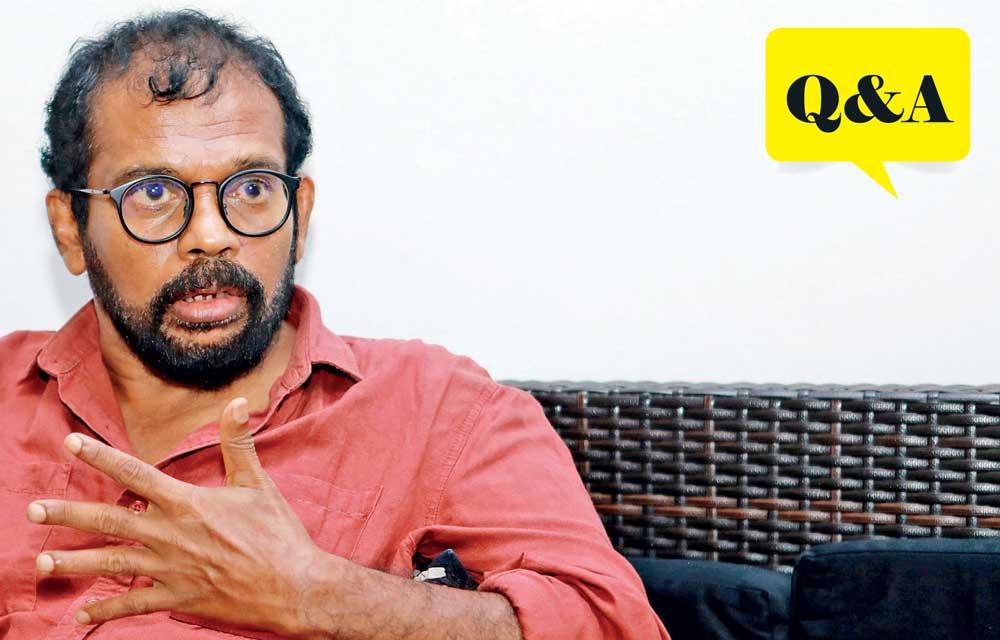
 Asoka Handagama, who is well-acclaimed for his controversial handling of the audio-visual medium (specially cinema in a revolutionary way), has entered the limelight with his newest film ‘Rani’ based on Manorani Saravanamutttu, the brave mother of assassinated journalist, writer, poet and actor Richard de Zoysa. Handagama is known for his skills to discuss serious issues like war, women’s liberty and even taboo subjects like homosexuality and complex relationship in families and many more. However, due to ‘Rani’, Handagama has been subjected to a series of attacks both via mainstream and social media for mainly distorting the real characters of Manorani and Richard. And the worst is that these attacks are directly coming from the very people who had associated with the mother and the son, the protagonist of his film. They complain that the filmmaker has destroyed the truth under the guise of possessing an artistic licence. The critics have gone to the level of indicting Handagama of ‘murdering’ both Manorani and Richard. Others have charged that it is Handagama, the film producer and the film’s main actress Swarna Mallawarachchi who are the victors of the film while the unfortunate Richard and Manorani have ended up in the losing end. One of the main allegations against Handagama was that he had not done his research on the real characters and thereby distorted and destroyed the original characters portrayed in the film. The film was also crucial for Handagama as he said that he had received the proposal for the film when he was undergoing treatment for a stroke and a partial paralysis. He said that he had given up hopes on doing any cinematic production. Interestingly The Daily Mirror met the internationally awarded filmmaker who has recovered to great extent now and lives with his housemaid whose name also ‘Rani’. However this newspaper approached Handagama to note down his response to the allegations made against him and the film; some of which were published in the Daily Mirror itself.
Excerpts of the interview:
Q: How did you initiat this film project as ‘Rani?
When I got this project I had suffered a stroke and was dealing with it for nearly two years. I had given up the idea of working again and I was also planning to stop the stage play ‘Antique Kadayaka Maranayak’ after celebrating the production’s third year. I had no hopes. While I was staying like that I got the invitation from Janaki Wijeratne of Lyca Production.
During one of the performances of my play, I received a call from Janaki, vice president of Lyca Production. She told me that there is a film project and asked whether I was ready to take it up. It was a film about Manorani. I couldn’t give a response immediately because of the condition I was in. I also said that I had not thought about doing a film on Manorani. I told that I would respond the following day. Then only I realised that it had come through Swarna Mallawarachchi who wanted to portray this character for years. Swarna had waited nearly 27 years to do the role of Manorani. This was from the time that Manorani was alive. It was Swarna who had made the proposal to Lyca and also it was Swarna who had proposed my name as the suitable director to Lyca. It was how I got this project. It was not that I don’t know how to do a film about Manorani. We have some experience about Manorani and Richard and there is ample information in the public domain. Because of that there was no issue doing the film, but I had not thought about making a film on Manorani. However I had a discussion with my friends who are technicians worked in my films and they said we will do it. It was after that I started to do this film.
Q: How much time did you have to do research on the film? Because there are serious allegations that you have not done your research properly?
There was no time for research and there was no need to do a research. We came to know about Richard de Zoysa and Manorani during the period 1988, 89 and 90 and when Richard was assassinated we were in our youth. We had just graduated from the university and had all those details, experiences and our personal experiences. However we didn’t want to gather all those information. So writing the script was not a major challenge for me. There was no reason for me to do a documentary because there was ample information on the public domain. To do a fiction out of this and also pen the script, I used personal experiences and my personal expressions.
Q:There are serious allegations, especially in the English speaking circle, that a proper script wasn’t written and this ‘research’ was not done properly?
There is enough research done by people like Nandana Weeratunga and Dharma Sri Kariyawasama through their YouTube channels and social media platforms. I don’t need to repeat those researches. What I wanted was to do a fiction out of this. It was not that I don’t know how to do a research. I was attached to the Research Department of the Central Bank. Those are frivolous allegations. When you say proper research, how much of a research should it be? Where does it start and where does it end? One can say that the information you know about Manorani is not included in this scrip. Another would say the information he or she knows are included. So the domain in this subject is open and endless. I used information and details that I know and I am familiar with.
Q: When we do a film or work of art about someone we can include true information. But is it correct to include details that are factually incorrect? For example if Manorani didn’t consume alcohol at home or she didn’t use filth or the ‘f’ word. Can you justify using them in a fiction?
Didn’t Manorani smoke? Didn’t she consume alcohol? Didn’t she consume whisky or whatever liquor? Hadn’t Manorani used bad language at all during her entire life? These are jokes. Those jokes don’t matter to me. Those are moral judgments. I won’t be able to make a character with flesh and blood with all those limitations. Then it should be the character of the mother of the Buddha. There was no necessity to create a character like that.
Q: Most people who commented and criticised the development of Richard and Manorani’s characters- like Chandri Peris, Helen Marie-Helene D’Almeida or Gamini Akmeemana- were people who associated with the two characters you featured. And they are talking with first-hand information they possess.
In this film, in addition to these moral conclusions, what are the examples to prove that the character of Richard and Manorani have been assassinated? There are no such examples. Manorani is a character full of motherly qualities. When you ask from the patrons coming out of the theatres they tell how much they have been moved with the story of the film. How were they moved? That is because of the presentation of Manorani’s character. Is portraying Richard as someone who had homosexual tendencies a disgrace or disrepute to him? Is it a disgrace to show that Manorani is consuming alcohol and liquor and smoking?
Q:This is exactly the argument that is being posed. What they say is that this was not a house for booze. This was a house that had an academic environment, “a place to read and write and rest”; points which are underscored by individuals who were close to these two characters. And also Richard didn’t drink?
How can one say that Richard didn’t drink? That is not true. People who say that Richard didn’t drink should ask that from the people with whom Richard drank. There are enough and more people who took drinks with Richard. I have met characters who smuggled in cigarettes to Manorani when she was all alone at the elders’ home spending last stages of her life. Smoking was prohibited in that house, but there are people who smuggled in cigarettes to Manorani. I have met those people. What nonsense are these people talking? I don’t understand this.
By showing that, would it be an insult to Manorani? Would be an insult to Richard? It is a terrible issue.
Q: The allegation is that it was not the same Manorani that we have seen that we saw in the film?
It could be true. Manorani, the way in which they have seen, cannot be found in this film. Richard as they have seen cannot be found in this film. This is how I saw it. What I have seen and what they have seen should not be the one and the same. Isn’t it? If they want to see the same in what I have seen, then there is no need to do a film. Can they tell in what way that I have insulted these characters? Would it be insulting to show Manorani smoking and drinking whisky? This is the issue I have with these people.
Q: The accusations have reached the level where people are charging you of having assassinated Richard and Manorani.
I don’t know on what basis these allegations are made. For example is Morgan Freeman who played the character of Nelson Mandela really Mandela? No he is not. No one can do that. When Ben Kingsley did the role of Gandhi how many criticisms were aired against him? This is natural and some people make accusations like these and that’s fine.
Q: The question here is by using an artistic licence whether one can distort a character? And most of these people who make these allegations are people who associated with Richard or Manorani or both.
So what have they done for Richard and Manorani for the last 35 years? They were just there without doing anything. But at least I have done a film to start a discourse about Richard and Manorani. Isn’t that enough? They must have associated with Richard and Manorani and they didn’t do anything. That’s all. There is nothing special about it. What can you tell about that?
Q:You said that you were offered this project. But what influenced you to take this project up?
This is my 11th film. Throughout my journey and as a playwright, tele-drama director and filmmaker, I was able to feature the 1988/89 terror period through stage plays. I partly touch about this period in my film ‘Sanda Dadayama’ but that never came up. With this film project I got an opportunity to feature this crucial period of our history through cinema and I grabbed that opportunity. And what is wrong with that?
Also when I started pursuing this opportunity, I made a personal resolution that I am not going to talk or meet those people who closely associated Richard and Manorani to collect information. If I could get all the information from one person I would have done it. There is an entire society who associated closely with these characters. Had I tried to gather all the information, I would have been able to do my job. Had I collected personal details there wouldn’t be an end. This is a fiction film made based on true incidents.
Q:The film shows that Richard comes to watch your stage play ‘Magatha’ and he even writes a review on it. Had you met Richard or did you ever had a chance to talk to him?
No I haven’t met Richard or spoken to him. But the character Gayan, featured in the film, was my friend and he was a fulltime Janatha Vimukthi Peramuna member. He has given up his university education and worked fulltime for the JVP. It was with him that Richard had come to watch the play. I saw Richard through the curtain on the stage. He was sitting on the row next to the door. Later I even asked my friend what did Richard tell and I was told that he was going to write about it. A few days later there was a review about the play in a national newspaper. That was the very first review written about the ‘Magatha’ play. Not even a Sinhala newspaper had written about my play. So I had a great respect for Richard. I badly wanted to meet Richard and talk to him about politics and other issues.
Q:The other allegation against you is that the film whitewashes Premadasa’s character and clears him of the assassination of Richard.
Who says that? Premadasa wouldn’t have ordered this one to be killed or that one to be killed. Killings were part of that system. There were a number of groups like ‘Kalu Balallu’ (Black Cats), Praa and many others who carried out killings. There were groups even from JVP. Deshapremi Janatha Wayaparaya. Killings were decentralised and there was no idea from where it came from. For this killing, Premadasa wouldn’t have involved himself directly. Should the leader of the state be responsible for all that killings that had been taking place in that country? Any way this is cinema. I wouldn’t have got all these criticisms had I directly showed that Richard was killed by Premadasa. But that is not cinema.
Q:Some allege that this is a film done to portray one class of the society and to highlight a character in another class. They say that the filmmaker has not identified this class properly?
That could be true. I am getting all these allegations because I do not belong to this class of society. And I was expecting his reaction and it was not that I was not expecting such a strong reaction.
Q: And we know that Nilendra Deshapriya was to do a film on Manorani and then there was Sudath Mahaadivulwelwa who had written a script and planning to do a film, right? He had even had a discussion with Swarna and she was to play the main character and even she was in possession of the script. This is information we have.
Nilendra could have directed Swarna and Sudath could have directed Swarna. I didn’t know about this. But that Manorani is not my Manorani or Rani. It could have happened in a different way.
I wrote my script. If this project was on I wouldn’t have started mine. I didn’t know that Sudath was working on a film on Manorani.