Reply To:
Name - Reply Comment
By Shantha Chandrasiri
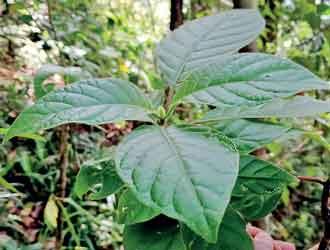 Several well-grown cinchona plants belonging to a plant species considered extinct in Sri Lanka have been found after 150 years in Unanagala in the western slopes of Aliyagala Mountain Range in Ambagamuwa.
Environmentalist Laxman Kumara said a team of researchers, including himself, found the Cinchona plants in the Aliyagala Mountain Range.
He said the British had cultivated Cinchona in Haggala Botanical Gardens and its environs in 1861 as a cash crop and abandoned it in a short time. It belonged to a plant species extinct in Sri Lanka, leaving only one plant conserved at Haggala Botanical Gardens. However, the environmentalist believes that there could be several plants of this species in the central hills.
He said the research team had found six luxurious plants in Unanagala hills, about 742 metres above the mean sea level.
The environmentalist said Cinchona was a medicinal plant used to process Quinine, the most effective medicine for Malaria.
He said it was a pleasure to find few well-grown Cinchona plants that belong to a plant species threatened with extinction due to the invasion of secondary forests generated after the human-caused destruction of primary forests.
It is native to the Andes in South America, especially in countries like Peru, Ecuador, Colombia, and Bolivia. The bark of cinchona trees contains quinine, an alkaloid used for centuries as an antimalarial drug. Quinine was one of the earliest effective treatments for malaria.