Reply To:
Name - Reply Comment
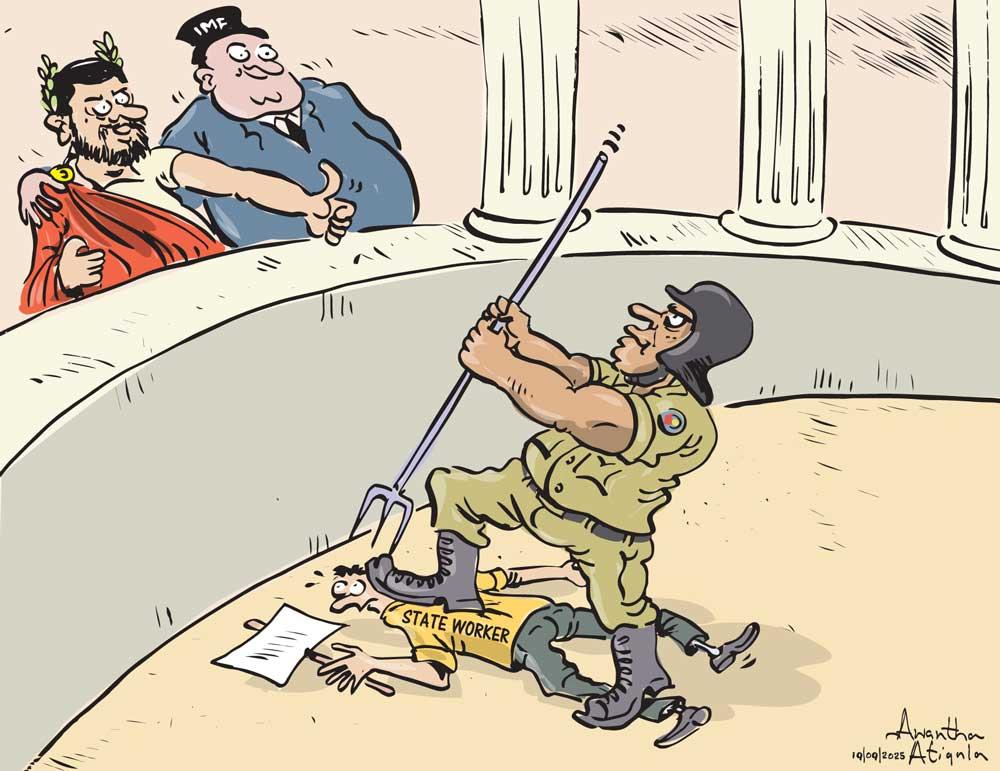
This cartoon frames Sri Lanka’s current crisis in the imagery of a Roman coliseum. At the center of the arena, a soldier armed with a trident pins down a frail “State Worker.” In the stands, a leader clad like Caesar leans comfortably, with the IMF by his side, both giving a thumbs-up to the spectacle.
The symbolism is brutal but precise. The coliseum setting suggests performance—politics as theater. The state worker, crushed under both boot and spear, embodies the ordinary employees of the public sector who now bear the brunt of austerity measures. Their suffering is not incidental; it has been staged for the approval of the powerful.
The soldier represents the machinery of the state—law enforcement, bureaucracy, and policy enforcers—tasked with carrying out IMF-prescribed reforms. The trident and boot are visual exaggerations of force, suggesting that workers are not participants in reform but victims of its coercion.
Meanwhile, the IMF looms in the background, smiling and approving, a reminder that the austerity script is written not locally but externally. The leader beside him, depicted like Caesar, embodies the ruling class, enjoying the spectacle rather than intervening. His approval signals complicity: austerity may bring international applause, but it is bought at the expense of domestic suffering.
The cartoon also echoes the ancient Roman principle of “bread and circuses.” Only here, instead of entertaining the masses, the government entertains the creditors—offering up its own workers as sacrifices to prove compliance. The coliseum becomes not a site of glory but of humiliation.
The deeper insight is sobering: economic reform, when staged as a performance for global institutions, risks turning citizens into gladiators forced to fight battles they never chose. The state, instead of protecting its workers, becomes the hand that pins them down.
The cartoon leaves us with a haunting question: is this austerity, or is it punishment disguised as reform? And if the workers are today’s gladiators, who will be tomorrow’s?