Reply To:
Name - Reply Comment
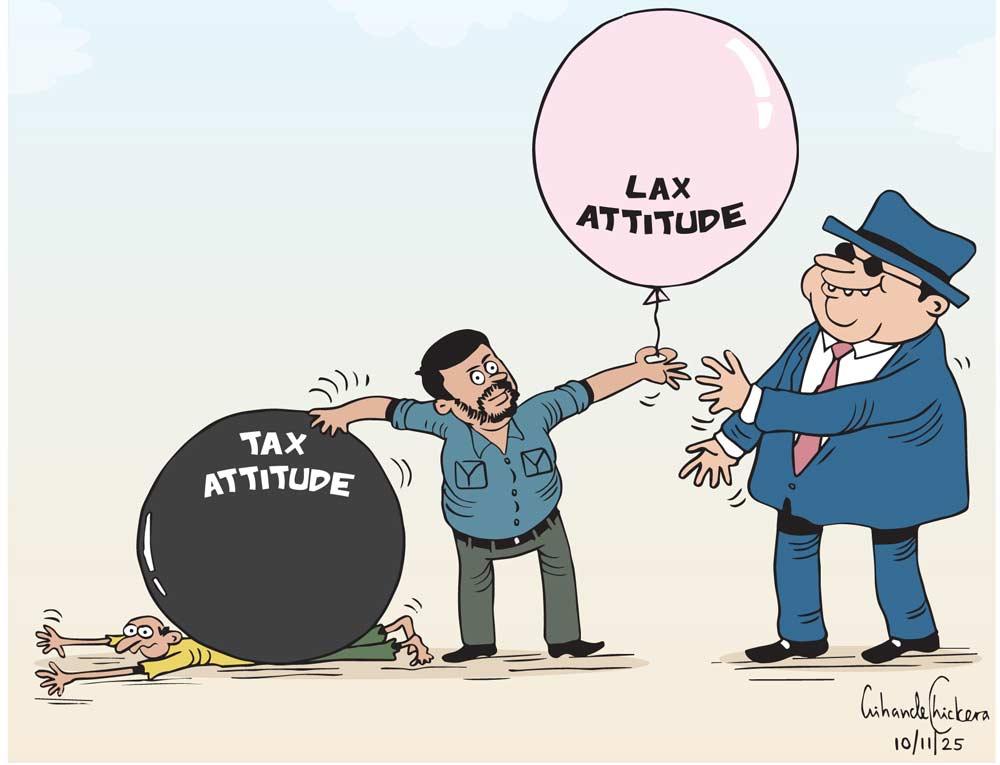
This clever cartoon captures an uncomfortable truth about economic inequality and the uneven burdens of governance. At the center stands a man — possibly representing policymakers or officials — balancing two extremes. On one side, he grips a massive black boulder labeled “Tax Attitude”, crushing a frail, struggling citizen beneath it. On the other, he lightly offers a pink balloon marked “Lax Attitude” to a well-dressed, wealthy man who beams in comfort.
The symbolism here is both simple and profound. The “Tax Attitude” boulder reflects the heavy financial pressures placed upon ordinary citizens — the working class and poor — who carry the weight of taxation in their daily struggle to survive. The man trapped under the rock symbolizes the silent, overburdened majority: those who bear the brunt of rising costs, indirect taxes, and reduced social support.
In stark contrast, the “Lax Attitude” balloon offered to the affluent man represents leniency and privilege. It floats effortlessly — a metaphor for the ease with which the wealthy and powerful often navigate systems of taxation, policy, and accountability. The cartoonist subtly exposes a world where fiscal responsibility is inversely proportional to economic power. Those who can afford to contribute more often enjoy flexibility, while those who cannot are pressed harder.
Yet the figure in the middle, struggling to balance both sides, adds a layer of complexity. He personifies the dilemma of governance — caught between appeasing powerful interests and addressing the suffering of the majority. His posture suggests not malice, but helplessness — a reflection of systemic imbalance rather than individual intent.
The cartoon’s genius lies in its neutrality. It doesn’t vilify but instead questions: why do justice and fairness in economic policy seem so asymmetrical? The heavy rock and the floating balloon together form a poignant metaphor for a society where equality is spoken of in principle, but rarely practiced in policy.
Ultimately, the image challenges viewers to rethink what “shared responsibility” really means. If one side is crushed while the other drifts, can the system ever truly claim balance?