Reply To:
Name - Reply Comment
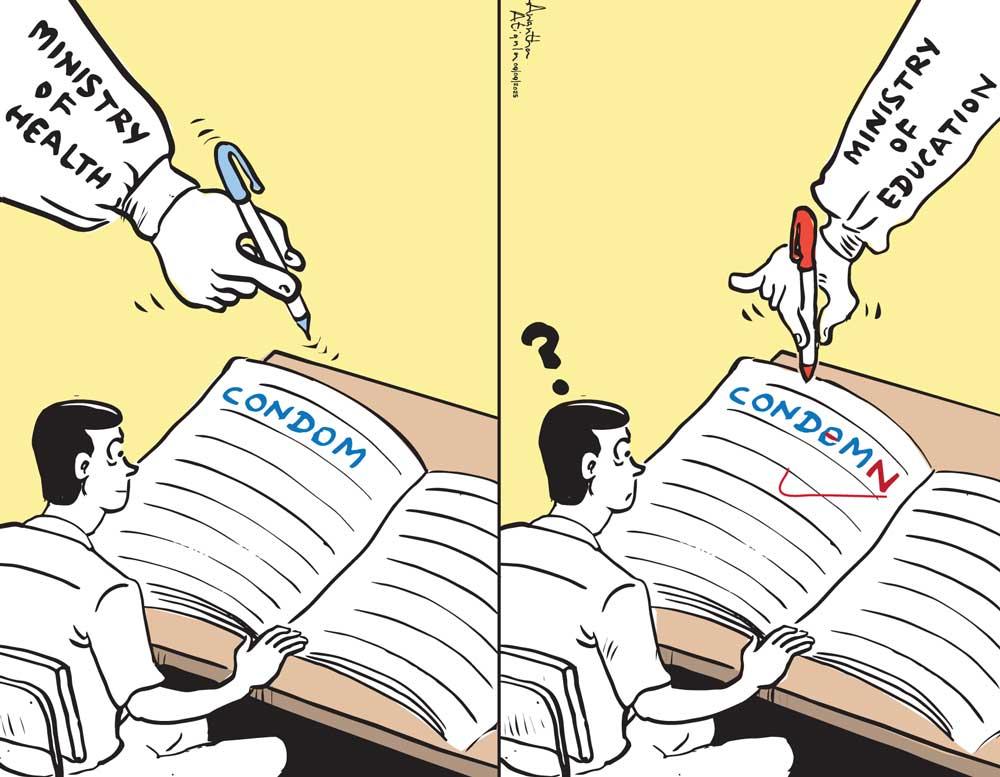
The cartoon exposes a jarring contradiction in public policy through the simple act of writing and rewriting a word.
On the left, the Ministry of Health pens the word “CONDOM” in bold, blue letters. The symbolism is clear: condoms are viewed as tools of protection, central to public health campaigns against HIV, STDs, and unplanned pregnancies. Here, the message is practical and preventive—health before judgment.
On the right, however, the Ministry of Education takes the same word and alters it into “CONDEMN.” With a red pen, the ministry effectively rewrites the narrative, replacing a message of safety with one of moral rejection. The student sitting below looks visibly confused—a stand-in for society’s youth, caught between mixed signals from institutions that should be guiding them.
This clash of perspectives highlights the tension between health policy and moral conservatism. While health authorities advocate for open dialogue, safe practices, and destigmatization, educational institutions often bow to cultural taboos, treating sex education as dangerous rather than necessary. The result is a generation left in confusion—taught by one ministry to protect themselves, and by another to feel ashamed for even acknowledging the tools of protection.
The cartoon’s brilliance lies in its simplicity. The addition of a single “N” transforms a life-saving device into a source of stigma. This mirrors how public discourse often distorts critical health tools through the lens of morality, turning prevention into prohibition.
The broader message is sobering: when ministries send conflicting signals, it is not the politicians who suffer—it is the youth. A society that condemns what it should be teaching risks higher disease rates, unplanned pregnancies, and a culture of silence around sexual health.
In the end, the cartoon leaves us with a haunting question: will we choose to protect lives, or to condemn them in the name of misplaced morality?