Reply To:
Name - Reply Comment
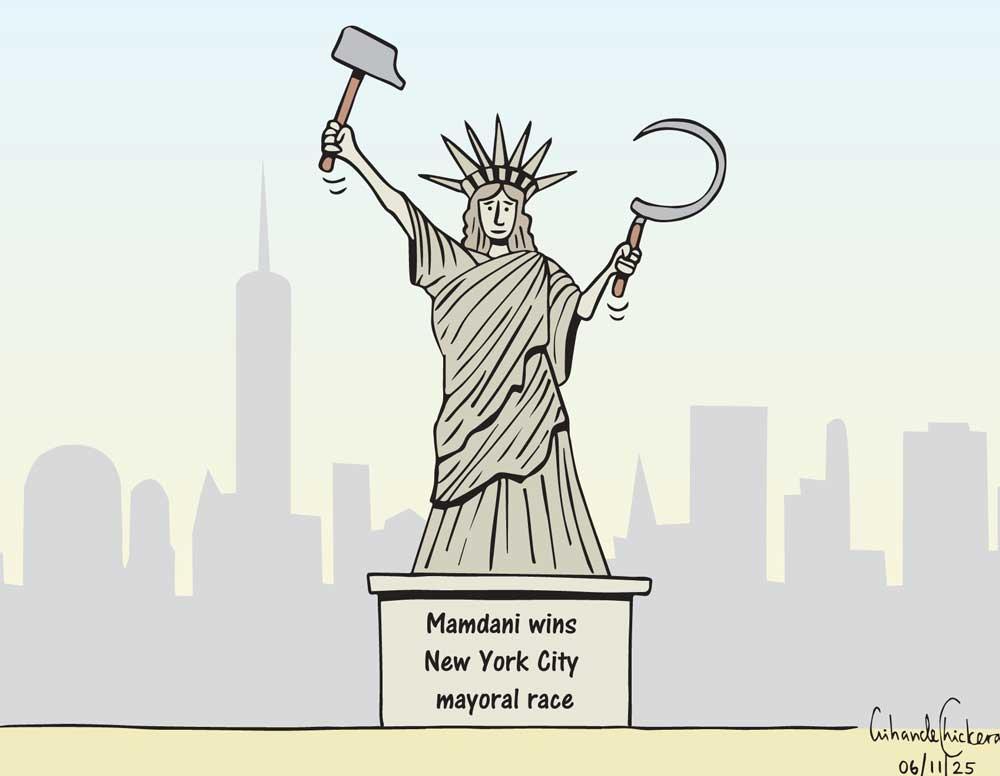
This cartoon presents a powerful visual provocation — the Statue of Liberty, long the emblem of freedom and democracy, now clutching a hammer and sickle. Below her, the pedestal reads: “Mamdani wins New York City mayoral race.” In one image, the artist reimagines a foundational American icon to question what liberty, justice, and ideology might mean in a changing political landscape.
At first glance, the humor seems straightforward: the Statue of Liberty, symbol of capitalism’s champion nation, now embodies the tools of socialism. But beneath that irony lies a deeper meditation on ideological evolution — and perhaps, on America’s growing openness to rethinking its sacred myths.
The hammer and sickle, historically associated with socialism and workers’ movements, stand here as metaphors for redistribution, equality, and class consciousness. The image suggests that if someone like Mamdani — known for progressive, left-leaning politics — were to rise to such prominence, it would signify a tectonic shift in American values. The cartoon doesn’t necessarily endorse or condemn that shift; instead, it spotlights the discomfort and fascination of imagining the world’s financial capital led by a politics once demonized as un-American.
Symbolically, the Statue of Liberty herself becomes a contested space. Traditionally, she holds a torch of enlightenment — a beacon of opportunity for immigrants and dreamers. Replacing that torch with a hammer and sickle asks: what happens when liberty and equality begin to overlap in new, perhaps contradictory, ways? The statue’s new pose redefines freedom not as unrestrained market liberty, but as collective empowerment — a freedom that hammers down barriers and reaps shared reward.
The cartoon also plays with cultural tension. The name “Mamdani” hints at a multicultural, perhaps immigrant background — invoking the changing face of urban America, where diverse communities increasingly shape the political conversation. In that sense, the image is not just about economics; it’s about representation and redefinition. A city once symbolic of Western capitalism now imagines itself through lenses of diversity, equity, and social justice.
Politically, this image challenges viewers to reflect on what progress means in a time of polarization. For some, this version of Liberty might symbolize empowerment, reform, and long-overdue balance. For others, it might signify the erosion of traditional freedoms and economic stability. The ambiguity is deliberate — forcing the viewer to question where the line between liberation and ideology truly lies.
Ultimately, the cartoon is not about a single politician. It’s about a shift in the American story — from the myth of individual ascent to the reality of collective struggle. The Statue of Liberty, reborn with new tools, reminds us that even the most sacred symbols evolve. The question is not whether they should — but what kind of future they will build once they do.