Reply To:
Name - Reply Comment
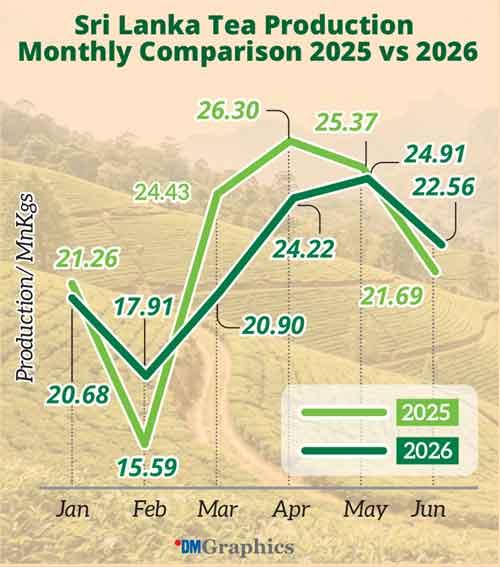
A sharp recovery in Sri Lanka’s high-grown tea sector helped lift national tea production in June, but persistent weakness in the low-grown segment, which accounts for nearly 60 percent of total output, continued to weigh on the country’s tea crop during the first half of 2026.
Sri Lanka produced 22.56 million kilogrammes of tea in June, up 3.94 percent from a year earlier, supported by strong gains in high-grown and medium-grown regions. However, cumulative production for the first six months of the year fell 2.86 percent to 131.89 million kilogrammes, which shows the extent to which the low-grown sector remains a drag on overall industry performance.
Data compiled by Forbes & Walker Research showed low-grown tea production declined 3.98 percent year-on-year during the January-June period to 76.67 million kilogrammes, accounting for more than 80 percent of the overall decline in national output.
Medium-grown production also contracted 4.56 percent, while high-grown production managed a modest 1.06 percent increase.
The divergence highlights a growing imbalance within Sri Lanka’s tea industry, where stronger performances in the high-grown elevations have been insufficient to offset losses from the country’s largest tea-producing region.
June’s rebound was largely driven by a 17.6 percent increase in high-grown production and a 6.8 percent rise in medium-grown output. Low-grown teas, however, continued to decline during the month, slipping 1.4 percent from a year earlier.
The weakness in the low-grown sector is significant because it forms the backbone of Sri Lanka’s tea export industry, supplying key markets in the Middle East, Russia and other Commonwealth of Independent States countries. Low-grown teas account for nearly three-fifths of national production and have traditionally provided the volume base for export earnings.
The latest figures suggest that while weather conditions may have improved in the high-grown districts, challenges affecting low-grown estates and smallholders continue to constrain the industry’s recovery.
The production data also come at a time when Sri Lanka’s tea sector faces heightened uncertainty in some of its key export destinations. The Middle East remains an important market for Sri Lankan tea, and recent geopolitical tensions in the region have raised concerns over trade flows, logistics and consumer demand.
Although June’s performance offered some relief, the first-half numbers indicate that Sri Lanka’s tea industry remains below last year’s production trajectory. To match or exceed 2025 output levels, a meaningful recovery in the low-grown segment will be critical during the second half of the year.
Compared with the corresponding period of 2024, however, cumulative production was higher by 3.07 percent, suggesting the industry has recovered some ground lost during previous weather-related disruptions. All elevation categories recorded increases over 2024 levels.