Reply To:
Name - Reply Comment
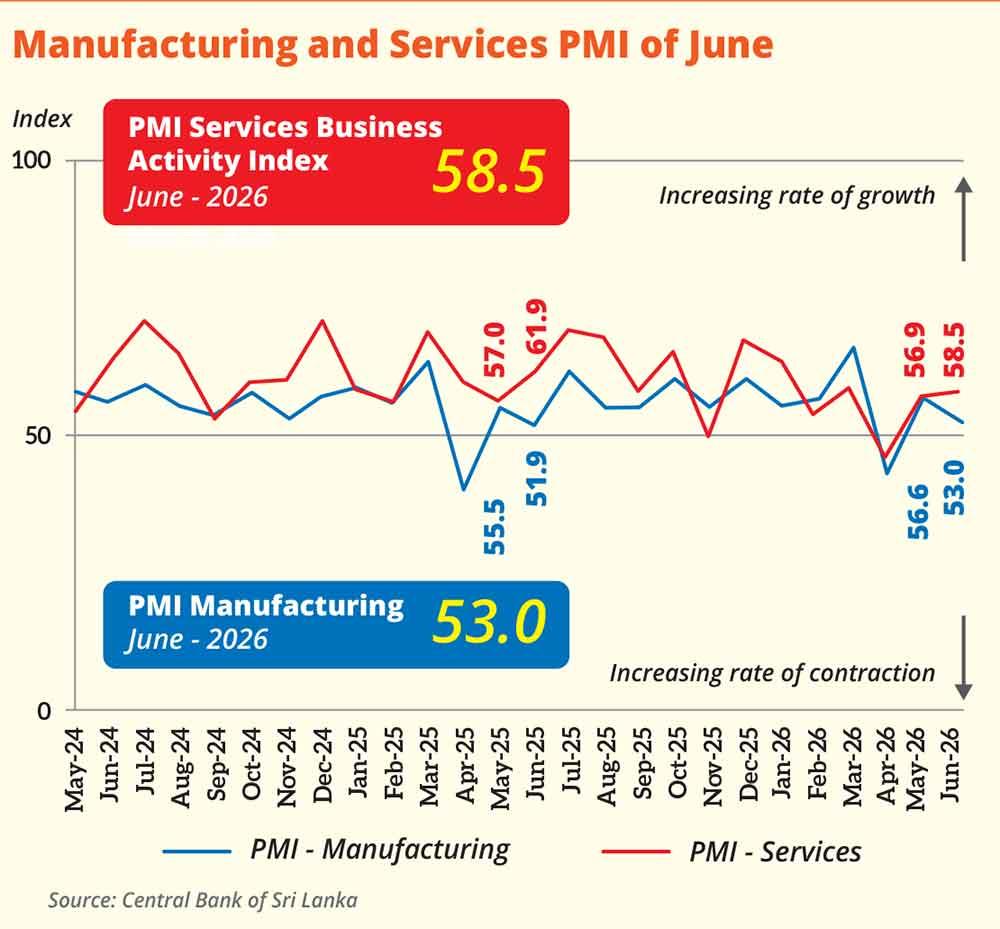
Sri Lanka’s manufacturing sector continued to expand in June, but emerging concerns linked to instability in the Middle East are beginning to temper business confidence, even as services activity gathered pace on the back of stronger domestic demand and tourism-related momentum.
The latest Purchasing Managers’ Index (PMI) released by the Central Bank showed manufacturing activity eased to 53.0 in June from 56.6 in May, remaining in expansionary territory but growing at a slower pace. At the same time, the Services PMI accelerated to 58.5 from 56.9, highlighting an increasingly divergent recovery between the two sectors.
While manufacturers continued to report growth in production, particularly in the food and beverages sector, the survey revealed signs of caution beneath the headline number. New orders stalled at the neutral threshold of 50.0, while firms cited supply-side challenges, labour shortages and growing uncertainty linked to geopolitical developments in the Middle East.
The findings suggest that although Sri Lanka has so far avoided any major economic fallout from recent tensions in the Gulf region, manufacturers are already adjusting expectations amid concerns over global trade disruptions, shipping delays and potential energy market volatility.
“The expectations for manufacturing activities remained positive, though moderated mainly by the challenging environment associated with the unrest in the Middle East,” the Central Bank said.
The Middle East remains strategically important to Sri Lanka’s economy. The region serves as a major source of worker remittances, a key energy supplier and a critical aviation and logistics hub connecting Sri Lanka to Europe and other long-haul markets.
Recent airspace disruptions and heightened security concerns around key shipping routes have raised fears of increased freight costs and supply chain disruptions for businesses dependent on imported raw materials and export markets.
The PMI data already point to some defensive behaviour by manufacturers. Stocks of purchases rose further during June as firms increased inventories amid what the survey described as a “volatile supply environment”. Meanwhile, supplier delivery times continued to lengthen, indicating ongoing logistical pressures.
Labour market constraints also remained evident. Employment growth slowed sharply, with the employment sub-index falling to 50.5 from 59.7 in May. Many respondents reported persistent shortages of skilled workers alongside rising labour costs, highlighting a structural challenge facing industrial expansion.
In contrast, services sector activity strengthened during the month, driven by gains across financial services, professional services and insurance. New business volumes expanded strongly while employment returned to growth as companies increased hiring.
Business expectations within the services sector also improved significantly, supported by expectations of continued economic recovery and stronger tourist arrivals during the upcoming Kandy EsalaPerahera season. The expectations index rose to 72.7 in June from 64.7 in May.
The divergence between the two PMIs suggests Sri Lanka’s recovery is increasingly being supported by domestic services activity, tourism and financial sector expansion, while manufacturing remains more exposed to external shocks and global uncertainties.