Reply To:
Name - Reply Comment
By Nishel Fernando
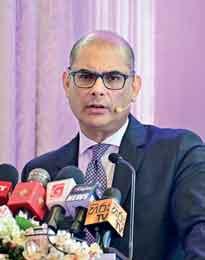 |
| Ritesh Shukla |
India’s NPCI International is actively working with LankaPay to allow Sri Lankans travelling to India to access the Unified Payments Interface (UPI), a reciprocal move that comes over two years after the system was initially launched in Sri Lanka, to facilitate seamless payments for Indian tourists.
While the Indian travellers have been able to scan the LankaPay QR codes to make payments since the partnership went live in early 2024, Sri Lankans visiting India are yet to receive the same facility.
Addressing this delay during a recent forum in Colombo, NPCI International MD and CEO Ritesh Shukla confirmed that enabling outbound payments for Sri Lankans remains a high priority and is currently in the works.
“We are working with our partners LankaPay and I think it is a topic which is very close to their heart and it’s in the discussion,” Shukla noted.
“It’s in the process. It’s something that we are very, very mindful of. We are looking at other countries like Mauritius. Today, people from Mauritius can come to India and scan and pay. We are doing it with many other countries. It will be good for small businesses in our country as well.”
Despite the technical readiness of the platform for the Indian tourists in Sri Lanka, NPCI International admitted that the local rollout is currently facing significant hurdles, primarily due to a lack of awareness and enthusiasm among the Sri Lankan merchants. Although an estimated 400,000 merchants across the island are equipped with LankaPay QR, many fail to display it or offer it proactively to the Indian customers.
Speaking to Mirror Business on the sidelines of the event, Shukla noted that while the growth rate of Sri Lankan merchants adopting the platform is technically in the triple digits, this expansion is happening on a very small initial base and the overall volume is still not to the satisfaction of the operators.
When asked about potentially expanding the payment acceptance to the tourists from other nations such as Russia, Shukla reiterated that LankaPay is a sovereign domestic entity that would independently manage those distinct bilateral arrangements, while NPCI’s core focus remains on seamlessly enabling the Indian tourists.
“We live in Sri Lanka. I can take out my phone and I can scan a LankaPay QR and I can make a payment,” Shukla explained.
“Where we are facing challenges is merchant awareness. The small businesses, they don’t understand the power of this. Maybe they have forgotten, maybe they don’t understand the real value behind it. They need to bring it to the front, in front of the Indian consumers and say, pay with this.’”
The lack of adoption represents a missed opportunity for the local SME sector. By routing transactions through the national switch via LankaPay QR, merchants bypass the higher merchant discount rates typically associated with international credit card schemes.
Shukla emphasised that accepting UPI is cheaper for the local businesses and immediately opens them up to a massive consumer base with growing purchasing power.
“Who runs a cafe, a coffee shop or a restaurant? These are small businesses. Similarly, all these taxis, transport... they’re all small businesses,” Shukla pointed out.
“So, when they accept UPI, they stand to benefit. They are selling more. They are also moving away from cash-based payments to digital payments. You are welcoming new opportunities.”
The potential of the Indian tourist market remains vast and largely untapped by the localised digital payment strategies. India’s outbound tourism to Sri Lanka has seen robust growth, jumping from approximately 400,000 visitors in 2024 to an estimated 520,000, representing a 25 percent year-on-year growth and accounting for roughly 22 percent of Sri Lanka’s total inbound traffic.
Furthermore, Shukla highlighted the demographic advantages of targeting Indian consumers, noting that India boasts a median age of 29 and a population of 1.4 billion people who are heavily integrated into the digital economy.
The differing trajectories of Sri Lanka’s LankaPay and India’s National Payments Corporation of India (NPCI) offer broader context to this digital ecosystem rollout. Both institutions began their operations primarily as national clearing houses designed to modernise domestic interbank transactions. LankaPay remains owned and controlled by the Central Bank of Sri Lanka and licensed commercial banks. In contrast, NPCI, formed in 2008, has aggressively expanded beyond its initial mandate.
As UPI grew into a globally recognised digital public infrastructure processing over 750 million transactions daily, NPCI evolved its ownership structure to reflect the modern financial landscape, notably bringing in prominent fintech companies and digital payment start-ups as equity shareholders alongside traditional banking institutions.
NPCI International is currently calling for greater ecosystem-level collaboration in Sri Lanka—involving the regulators, banks, fintechs and media—to articulate the financial value of the platform to the local merchants. Until the businesses actively promote their LankaPay QR codes at the storefront, the broader economic benefits of seamlessly linking Sri Lanka’s SMEs with the spending power of the Indian subcontinent will remain constrained.