Reply To:
Name - Reply Comment
By Nishel Fernando
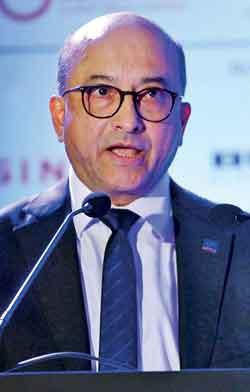 |
| Prof. Dale Pinto Pic by Pradeep Pathriana |
The global accounting profession is approaching a technological watershed, and professionals who fail to govern artificial intelligence with unwavering ethical standards risk systemic failures in corporate trust, warned CPA Australia President and Board Chair Prof. Dale Pinto.
Delivering the keynote address at the CMA Sri Lanka National Management Accounting Conference 2026 held in Colombo this week, Prof. Pinto asserted that while automation represents the future of finance, the sustainability of the industry hinges entirely on human judgment.
His remarks arrive at a precarious moment for the global financial sector, which has recently navigated high-profile corporate controversies involving audit oversights and the misapplication of artificial intelligence. Major global firms have faced immense regulatory scrutiny following revelations that personnel leveraged AI tools to circumvent internal ethics and compliance assessments, resulting in substantial financial penalties and severe reputational damage.
Furthermore, instances of algorithmic fabrication—where automated systems have generated fictitious regulatory reports and spurious data—have underscored the profound risks of relying on unverified technological outputs without robust human oversight.
Against this backdrop of industry-wide turbulence, Prof. Pinto argued that professional skepticism is no longer merely a best practice, but a critical line of defense. As algorithms increasingly handle predictive modeling and complex data processing, accountants must emerge as the ultimate guardians of corporate governance.
“Trust remains our most valuable asset, and in a world increasingly influenced by technology, the need for ethical leadership and human skills has never been greater,” he told the gathering of policymakers, business leaders and finance professionals.
He reminded the audience that algorithmic efficiency must never eclipse foundational principles, adding, “While technology may evolve rapidly, our ethical foundations must remain constant. Ethics is always on.”
The integration of artificial intelligence is fundamentally redefining the finance function, transitioning the accountant’s role from historical record-keeping to strategic, forward-looking stewardship. Prof. Pinto noted that AI systems are now seamlessly automating routine tasks such as transaction processing, variance analysis, and data extraction.
However, he firmly dispelled fears of mass professional displacement, insisting that the technology cannot replicate nuanced human analysis. “AI will not replace professional accountants; however, accountants who effectively harness AI may well replace those who do not,” he pointed out, advocating for a stance of responsible optimism.
Contextualizing these sweeping global shifts within the domestic landscape, Prof. Pinto observed that Sri Lanka stands at a vital economic crossroads where rigorous financial governance is imperative for sustained growth. Acknowledging the country’s remarkable resilience following recent macroeconomic challenges, he cited Sri Lanka’s highly educated talent pool and strategic geographic position as key drivers for long-term prosperity.
He stressed that local management accountants bear a direct responsibility to rebuild resilient institutions, enhance transparency, and attract sustainable foreign investment. Echoing calls from Prime Minister Dr. Harini Amarasuriya for evidence-based decision-making, he emphasised that high-quality financial stewardship directly shapes national progress.
In mapping out the long-term trajectory of the profession, Prof. Pinto outlined five defining characteristics that will distinguish the next generation of finance leaders. He detailed that future accountants must be strategically focused on holistic value creation, technologically enabled to leverage automation, and data literate to transform raw analytics into actionable insights.
Furthermore, they must remain sustainability-minded and serve as trusted, ethical advisors who provide independent judgment. Addressing the contemporary adage that data is the new oil, he modified the premise to argue that information only holds competitive value when refined into insight and translated into strategic action. To successfully navigate periods of disruption, he advised organisations to cultivate agility, resilience, and foresight—capabilities that are deeply anchored by modern management accountants.
Ultimately, Prof. Pinto urged Sri Lankan finance leaders to move decisively beyond basic regulatory compliance. True stability and growth, he noted, will depend on integrating environmental and social sustainability considerations directly into core corporate strategies. The modern accountant must transform from a mere custodian of ledgers into an architect of organizational resilience.
«Our goal is evolving from reporting history to shaping the future, from measuring performance to creating value, and from managing numbers to leading transformation,» he concluded, challenging the profession to lead with both technological fluency and uncompromised integrity.